
A Cursor For An AI World; Anthropic Pisses Off Devs; OpenAI To Sue Apple?
Today's AI Outlook: ⛅️
Gemini Gives God Mode For Your Screen
Google DeepMind showed an experimental Gemini-powered pointer that turns the mouse into an AI control surface. The idea is simple and very Google: point at something on your screen, say what you want, and let Gemini interpret the object, the screen context and your command together. That means “this,” “that,” “here” and “there” suddenly become actionable instead of annoyingly vague.
Why it matters
This is Google’s most natural path to making AI feel more like muscle memory. If it works, Gemini can show up across Chrome, Workspace, Android and future hardware without asking users to open yet another chatbot tab. The mouse becomes less of a pointer and more of a tiny AI wand, minus the Hogwarts tuition.
The Deets
- Google DeepMind demonstrated a Gemini-powered cursor that understands screen objects and user intent together.
- It can work across images, maps, menus, PDFs and webpages.
- The bigger play is turning every interface into an AI-ready surface.
- The commercial upside is massive because Google already owns many of the places where people work, search and browse.
Key takeaway
The next AI interface battle is moving toward the layer between intent and action. Google wants that layer to be Gemini.
🧩 Jargon Buster - AI control surface: A place where users can direct AI to act, such as a cursor, screen, document or app interface.
⚡ Power Plays
OpenAI And Apple’s Siri-ous Relationship Problem

OpenAI is reportedly considering legal action against Apple over their 2024 ChatGPT-Siri partnership. The relationship has apparently deteriorated, with OpenAI exploring options that may include a breach-of-contract notice. The original deal gave Siri the ability to call on ChatGPT for more complex queries, but the integration has not delivered the user growth OpenAI expected.
Why it matters
This is another crack in the Apple Intelligence story. OpenAI expected the Siri deal to drive billions in paid ChatGPT signups, but users appear to prefer the standalone ChatGPT app over Apple’s limited integration. Now Apple is reportedly preparing to open Siri to rival providers, including Claude and Gemini, while OpenAI is pushing further into hardware after its Jony Ive deal. Cozy partnership, meet competitive awkwardness.
The Deets
- Apple and OpenAI struck the ChatGPT-Siri deal in 2024.
- OpenAI reportedly expected major paid signup growth from the integration.
- Apple plans to open Siri to other AI providers in iOS 27.
- Apple was reportedly upset about OpenAI hiring from its hardware teams.
- OpenAI’s hardware ambitions could make it a more direct Apple rival.
Key takeaway
The Apple-OpenAI relationship is shifting from strategic handshake to potential cage match, especially as AI assistants and AI hardware start to merge.
🧩 Jargon Buster - Breach-of-contract notice: A formal claim that one party failed to meet the terms of an agreement.
AI’s Power Bill Is Now A Governance Problem
SpaceX is reportedly running 46 gas turbines beside its Mississippi data center, while only 15 have permits. The loophole: the turbines sit on trailers and may be treated as mobile equipment, putting them outside parts of the normal regulatory process. Local residents and the NAACP say the emissions are worsening air quality in an already polluted area.
Why it matters
AI infrastructure is now moving faster than public power systems, permitting offices and environmental oversight can comfortably handle. Companies need compute now, while the systems that approve power projects often move in years. That mismatch is creating a new kind of AI fight, where the bottleneck is not model talent or chips, but electricity, emissions and who gets to bend the rules.
The Deets
- SpaceX is using gas turbines near a Mississippi data center.
- Only a portion of the turbines reportedly have permits.
- Local residents and the NAACP raised concerns about air quality.
- The broader AI industry is increasingly looking at private grids, gas, nuclear deals and other faster power sources.
Key takeaway
AI scale is becoming a local governance fight. The cloud may feel abstract, but the smoke, noise and permits are very much on the ground.
🧩 Jargon Buster - Compute: The processing power needed to train or run AI systems, usually supplied by chips, servers and data centers.
OpenAI Chip Bet Goes Public
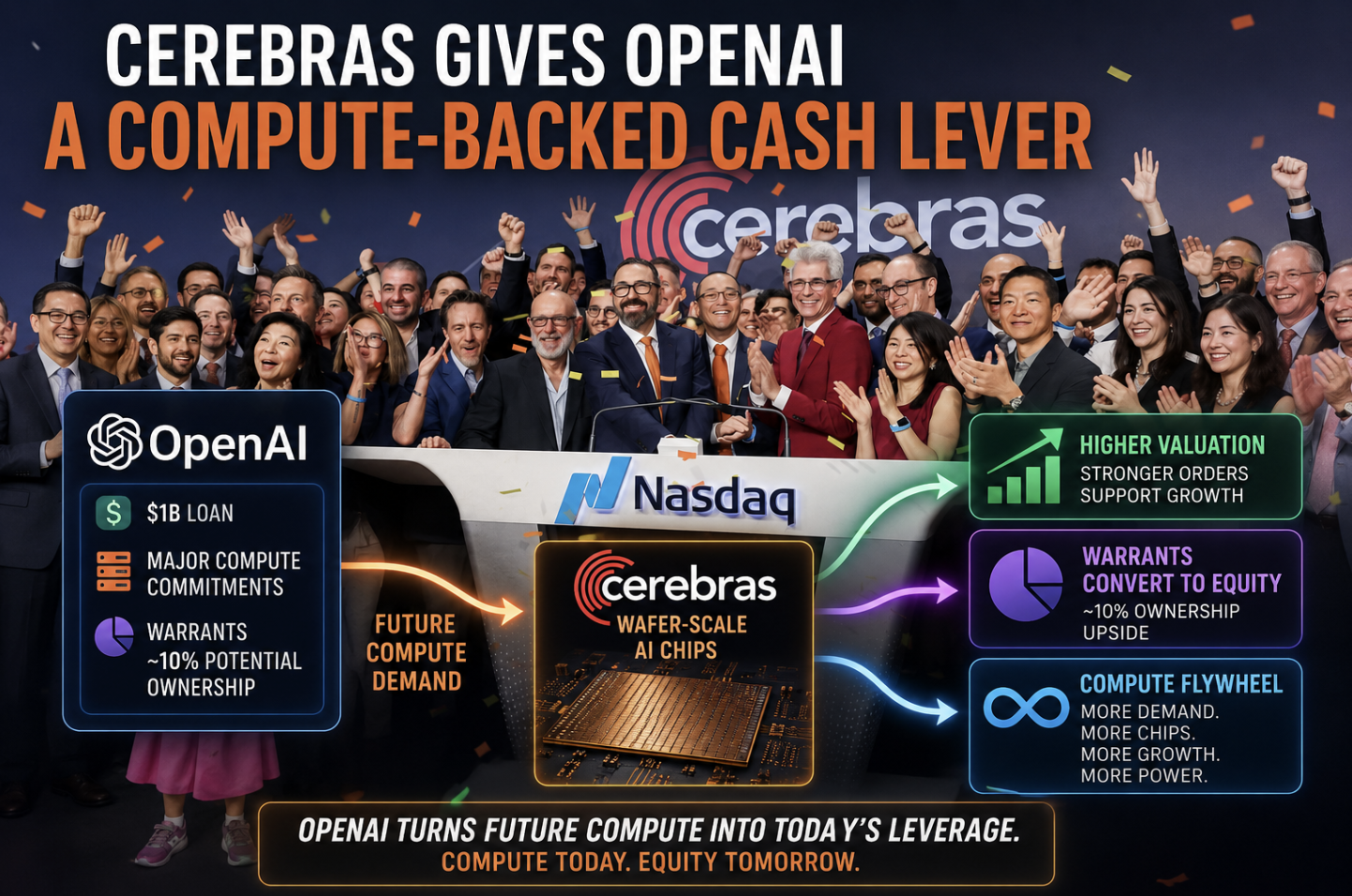
Cerebras went public after becoming one of OpenAI’s key compute bets. The company builds wafer-scale AI chips, a giant-chip alternative to Nvidia GPUs. OpenAI is not currently a formal major shareholder, but it has a $1B loan, major compute commitments and warrants that could become roughly 10% ownership.
Why it matters
This is infrastructure finance with an AI glow-up. OpenAI is using future compute demand to create financial upside today. Its orders can support Cerebras’ valuation, while warrants could turn that valuation into equity. That flywheel works best as long as AI demand keeps screaming for more chips, more servers and more power.
The Deets
- Cerebras went public as demand for AI compute keeps climbing.
- OpenAI has a $1B loan tied to Cerebras.
- OpenAI also has compute commitments and warrants.
- Those warrants could convert into roughly 10% ownership.
- Nvidia still dominates the AI chip market, but Cerebras offers a different architecture and financial upside.
Key takeaway
OpenAI is trying to turn compute scarcity into strategic leverage. Cerebras gets the IPO spotlight, while OpenAI gets optionality.
🧩 Jargon Buster - Warrants: Financial rights that let a company buy shares later at a set price or under set conditions.
🛠️ Tools & Products
Codex Goes Mobile ... Now Vibe In The Bathroom
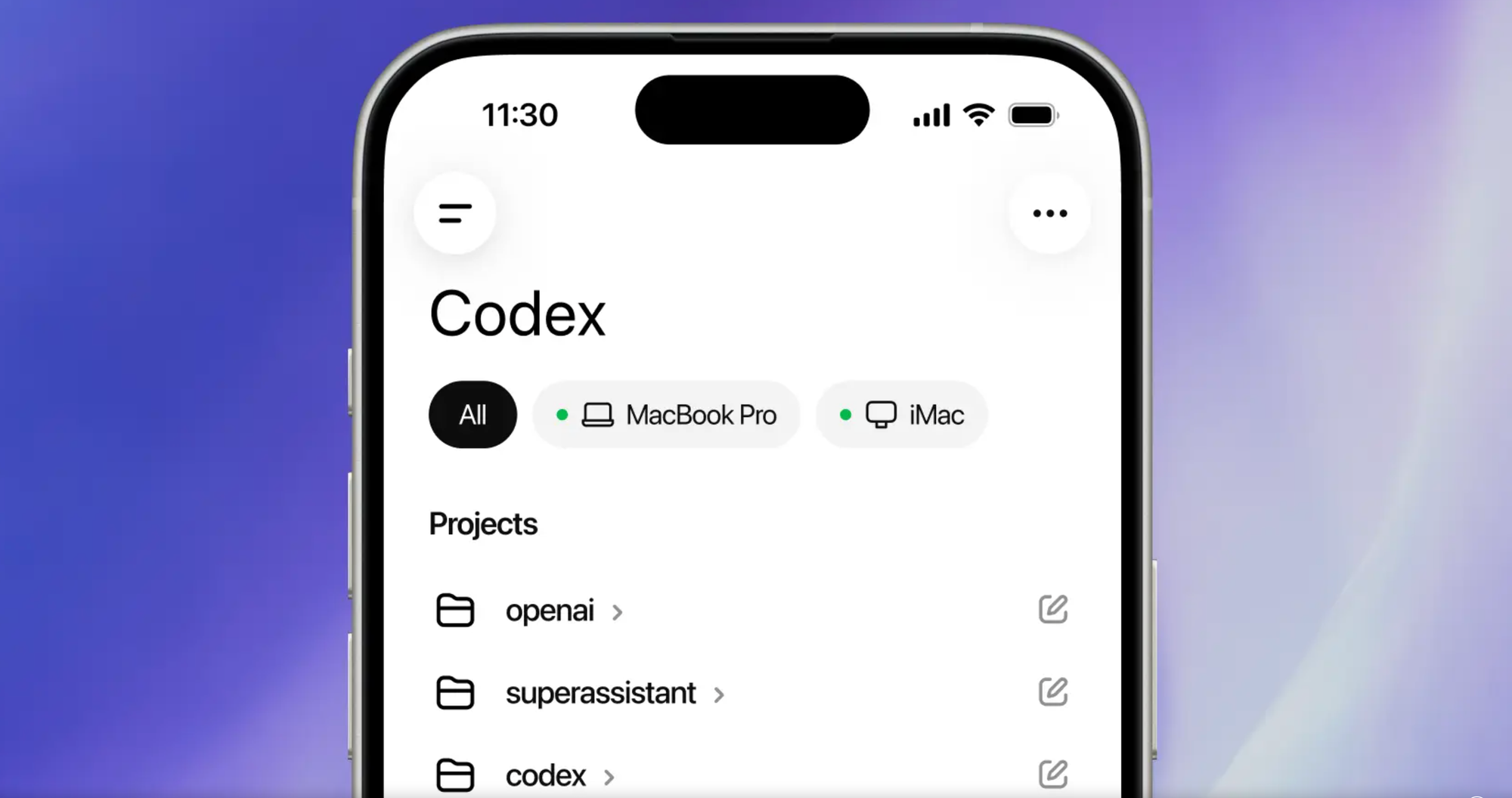
OpenAI rolled out Codex in preview inside the ChatGPT iOS app across all plans, letting developers monitor and manage long-running coding tasks from their phones. Codex still runs on a laptop or remote host, but users can now check live threads, review code changes, approve decisions and start new tasks from mobile.
Why it matters
AI coding agents can now run for hours, which is useful until your laptop becomes a needy houseplant you cannot leave unattended. Mobile Codex gives developers more freedom to keep agents moving while they are away from their desks. It also sharpens OpenAI’s competition with Anthropic, which has been pushing mobile access for Claude coding workflows.
The Deets
- Codex is now available in preview inside the ChatGPT iOS app across all plans.
- Users can view threads, approve changes, manage plugins and start new tasks.
- OpenAI said the system uses a secure relay layer that does not expose the computer to the open internet.
- Anthropic previously introduced Remote Control and Dispatch for Claude.
- OpenAI positioned Codex mobile as more capable than simply controlling one remote task.
Key takeaway
The AI coding race is moving from model quality to workflow convenience. The winning agent may be the one that keeps working while you are pretending to have a life.
🧩 Jargon Buster - Secure relay layer: A system that passes messages between devices without directly exposing a computer to the public internet.
Anthropic’s Agent Credits Make Devs Reach For The Cancel Button

Anthropic announced a new policy that separates Claude’s agent usage into a monthly credit pool, restoring support for third-party agent tools but walling them off from normal subscription limits. Starting June 15, Agent SDK and claude -p usage will no longer draw from standard subscription limits.
Why it matters
Agentic tools can burn through tokens like a teenager with a parent’s gas card. Anthropic is trying to control those costs, but developers are unhappy because the new credits feel tiny compared with the value they were getting before. The backlash arrived just as OpenAI is expanding Codex access, which gives annoyed Claude users somewhere obvious to look.
The Deets
- Anthropic will move agent usage into a monthly credit pool starting June 15.
- Pro users get $20/month in agentic credits.
- Max 5x users get $100/month.
- Max 20x users get $200/month.
- Credits reset each billing cycle and do not roll over.
- The move reverses Anthropic’s earlier ban on third-party agents like OpenClaw.
- Power users, including T3 founder Theo Browne, publicly criticized or canceled subscriptions.
Key takeaway
Anthropic solved one developer complaint by creating another. The subscription model is groaning under the weight of agents.
🧩 Jargon Buster - Agentic credits: A monthly spending allowance for AI tools that can take actions or run workflows on a user’s behalf.
🔬 Research & Models
arXiv Tells AI Slop To Take A Gap Year
arXiv is cracking down on low-quality AI-generated research submissions. Papers with fake references, leftover model notes, placeholder data or obvious hallucinations can get all listed authors banned from submitting for one year. The message is simple: the author is accountable, not the chatbot.
Why it matters
Researchers can use AI, but they cannot outsource responsibility to it. Fake citations and AI-written junk threaten the trust layer of academic publishing, so conferences and repositories are starting to build consequences into the system.
The Deets
- arXiv will punish papers containing obvious AI hallucinations or fake references.
- All listed authors can receive a one-year submission ban.
- The policy targets sloppy delegation, not all AI-assisted writing.
- Other research venues are also tightening standards around AI-generated content.
- The main issue is accountability for what gets submitted under an author’s name.
Key takeaway
AI-assisted science is here to stay, but authorship now comes with a sharper warning label.
🧩 Jargon Buster - Hallucination: A false or fabricated AI output that may sound believable but is not grounded in real evidence.
⚡ Quick Hits
- xAI released Grok Build, an early beta of its agentic command-line tool, currently limited to SuperGrok Heavy subscribers.
- Higgsfield AI launched Supercomputer, a cloud AI agent that can complete creative and marketing tasks end-to-end by coordinating multiple models and tools.
- Runway introduced Agent, an assistant built into its video platform to collaborate with users through creative workflows.
- Bumble is phasing out swiping in favor of Bee, an AI dating assistant for matchmaking, profile optimization and more. Romance, now with fewer thumb workouts.
- Anthropic partnered with the Gates Foundation on a $200M push to expand Claude across health, education and economic mobility.
- Microsoft is canceling most internal Claude Code licenses and steering developers toward GitHub Copilot CLI.
- Meta is rolling out neural-wristband handwriting for Ray-Ban Display glasses, turning hand gestures into messages across major apps.
- Microsoft launched Legal Agent inside Word to help legal teams review contracts, track negotiations and identify document risks.
🧰 Tools Of The Day
- Recraft V4.1: An image AI tool with improved photorealism and illustration features.
- Notion Developer Platform: An open platform for building directly on Notion.
- AutoScientist: Adaptions’s tool for automating AI model training.
- Grok Build: xAI’s early agentic CLI beta for SuperGrok Heavy subscribers.
Today’s Sources: The Internet, The Rundown AI, AI Secret