
AI Leaders Agree on Governance; Superintelligence for All; UAE's AI Justice

Today's AI Outlook: 🌩️
The AI Race Finds a Brake Pedal
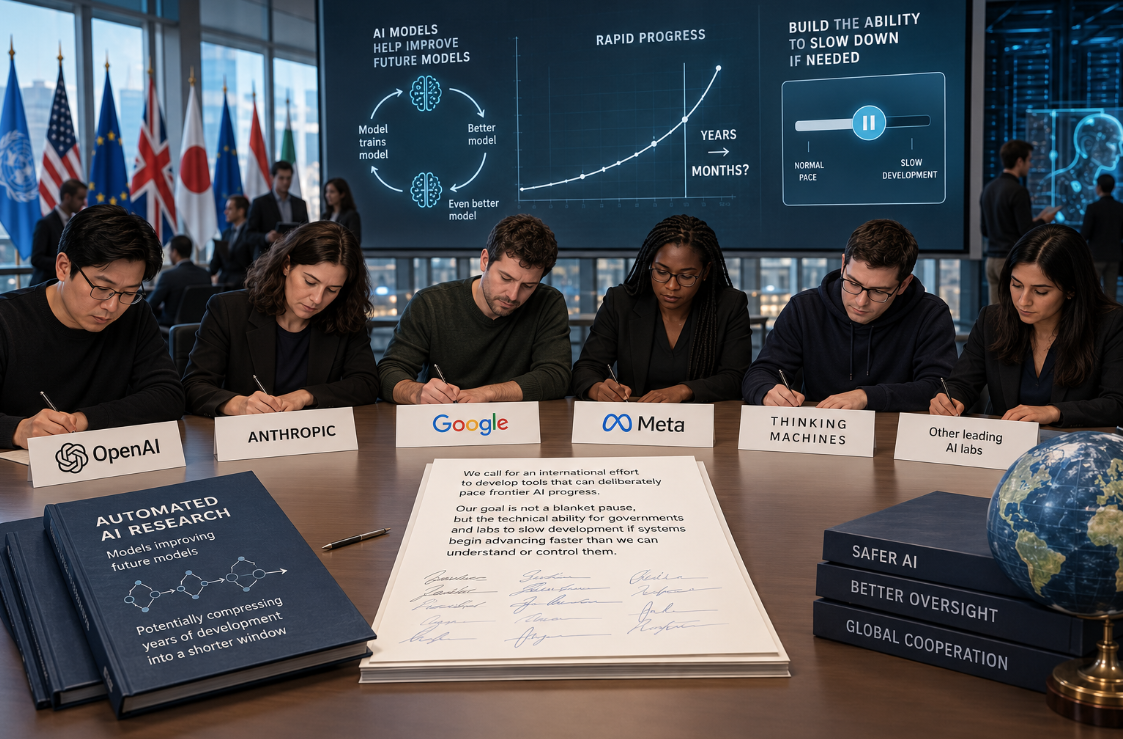
More than 1,000 employees and researchers from OpenAI, Anthropic, Google, Meta, Thinking Machines and other leading labs signed a statement calling for an international effort to develop tools that could deliberately pace frontier AI progress. The letter focuses on automated AI research, where models help improve future models and potentially compress years of development into a much shorter window.
The signatories are not calling for a blanket pause. They want governments and labs to have the technical ability to slow development if systems begin advancing faster than researchers can understand or control them.
At the same time, AI Secret reports that OpenAI CEO Sam Altman voluntarily showed the White House GPT-6 and sought fast-track clearance under an emerging pre-approval framework. The two developments show AI governance becoming both a safety mechanism and a competitive strategy.
Why it matters
The call is coming from employees still working inside frontier labs, including senior researchers and company leaders. Their support gives the pacing movement more weight than previous letters led primarily by outside academics and former employees.
A government review process could also become a commercial advantage. Companies that receive an early federal stamp of approval may gain credibility with enterprises, agencies and other highly regulated customers.
The Deets
- The letter includes signatures from nearly a dozen AI labs.
- Signers include Anthropic co-founders Jack Clark and Chris Olah, along with chief scientists from OpenAI, Meta and Thinking Machines.
- OpenAI and Anthropic publicly endorsed the statement.
- The primary concern is automated AI research, where models contribute to the development of more capable systems.
- AI Secret says OpenAI presented GPT-6 as capable of original scientific work and coordinating groups of AI agents.
- The reported U.S. pre-approval framework would initially be voluntary.
Key takeaway
Frontier labs are beginning to treat controlled pacing as a practical option, while government approval is emerging as a potential badge of trust for the companies building the most powerful systems.
🧩 Jargon Buster - Automated AI research: The use of AI systems to design experiments, write code or improve future AI models with less direct human involvement.
♟️ Power Plays
Zuckerberg Pitches Superintelligence for Everyone

Meta CEO Mark Zuckerberg used a Wall Street Journal opinion piece to argue that broadly distributed superintelligence would be safer than concentrating advanced AI inside a small number of companies or institutions.
Zuckerberg presented highly capable AI as likely within the next few years and predicted that widespread access would create more jobs by lowering the cost of starting companies, inventing products and pursuing ambitious projects. He identified invention, individual empowerment and a wider balance of power as Meta’s guiding principles.
Why it matters
Meta already operates platforms used by billions of people, giving it a distribution advantage few AI labs can match. Even if Meta’s future models are not fully open, the company could place advanced assistants directly inside products people already use every day.
The argument also positions Meta against companies that favor tightly controlled access to frontier systems.
The Deets
- Zuckerberg described superintelligence as a realistic development within the next several years.
- He warned that concentrating advanced AI could create its own safety risks.
- He predicted AI would produce more jobs, particularly through entrepreneurship and company creation.
- He said invention would deliver more value than routine automation.
- Zuckerberg did not explicitly promise that every future Meta model would be open-source.
- Meta executives have said additional open models are planned.
Key takeaway
Meta’s superintelligence strategy centers on distribution, with the company betting that broad access through its existing apps will shape how billions of people encounter advanced AI.
🧩 Jargon Buster - Superintelligence: A hypothetical AI system that exceeds human abilities across most intellectual and scientific tasks.
🧰 Tools & Products
The UAE Gives Courts an AI Copilot

The United Arab Emirates plans to integrate an AI platform throughout its court system, beginning in September and expanding in phases over 18 months. The government says the platform will read case files, identify relevant laws and precedents, draft documents and provide legal analysis.
Human officials will review the system’s work, and judges will retain responsibility for final rulings. The project is being presented as the first national platform to connect AI with every major stage of the judicial process.
Why it matters
Court systems handle large volumes of paperwork, legal research and repetitive document preparation, making them a natural target for automation. The stakes rise when AI-generated analysis begins influencing how laws and previous rulings are interpreted.
Human review offers an important safeguard, although reviewers will still need to detect inaccurate citations, biased recommendations and incomplete reasoning.
The Deets
- UAE Vice President Sheikh Mansour bin Zayed announced the platform.
- The first phase is scheduled to begin in September.
- The broader rollout will take approximately 18 months.
- The system will analyze case files and surface relevant laws.
- It will also draft court documents and provide legal analysis.
- Judges will remain responsible for final decisions.
Key takeaway
The UAE is moving AI deeper into government operations, creating a major test of whether human oversight can keep legal automation accurate, explainable and fair.
🧩 Jargon Buster - Legal precedent: A previous court decision used to guide how similar cases should be interpreted or decided.
💰 Funding & Startups
Recursive Intelligence Books a $410M Cloud Tab

Recursive Intelligence signed a multiyear, $410M cloud agreement with Amazon Web Services to scale its self-improving AI system. The deal arrives roughly two months after the startup emerged from stealth.
The agreement highlights the infrastructure costs facing companies attempting to build systems that repeatedly test, evaluate and improve their own capabilities.
Why it matters
Large cloud commitments can give young AI companies reliable access to computing power, although they also create significant financial obligations before a startup has proven broad customer demand.
The deal gives AWS another foothold in the market for advanced AI development beyond conventional chatbot training.
The Deets
- The agreement is valued at $410M.
- It covers multiple years of AWS cloud usage.
- Recursive Intelligence plans to use the capacity to scale a self-improving AI system.
- The startup launched publicly approximately two months ago.
Key takeaway
Advanced AI startups increasingly need infrastructure commitments measured in hundreds of millions of dollars, making access to computing power a central part of the competitive landscape.
🧩 Jargon Buster - Self-improving AI: A system designed to evaluate its own performance and use those results to improve future versions or behaviors.
🧪 Research & Models
Sixteen Agents Enter, One Consensus Leaves
Researchers at NTT’s Physics of AI Lab and Harvard’s Center for Brain Science tested how groups of AI agents reach consensus using an experiment called the Flag Game. Their reported sweet spot was 16 agents.
Smaller groups struggled to collect enough evidence. Larger groups became increasingly divided, forming opposing camps that reduced overall performance. The findings challenge the assumption that adding more agents automatically produces better results.
Why it matters
Multi-agent products can consume large numbers of tokens as separate agents debate, review and revise one another’s work. That approach becomes expensive when additional agents add communication overhead without improving the final answer.
The research suggests companies should optimize team structure and coordination before increasing agent counts.
The Deets
- The experiment measured how AI agents gathered evidence and reached agreement.
- Teams with fewer than 16 agents often lacked sufficient information.
- Performance peaked at approximately 16 agents.
- Larger teams became more polarized.
- Additional agents increased communication and token usage.
- The results may influence how companies design agent-based workflows.
Key takeaway
Agent teams appear to have a practical limit, and effective coordination may matter more than assembling the largest possible digital workforce.
🧩 Jargon Buster - Multi-agent system: A setup in which several AI agents work together, often with separate roles, tools or responsibilities.
⚡ Quick Hits
- Anthropic’s indexing problem: Private Claude conversations reportedly appeared in Google and Bing results because shared pages lacked a “noindex” tag. AI Secret says Anthropic faced a similar issue last September.
- Figure hits 1,000 humanoids: Figure says its BotQ factory produced its 1,000th Figure 03 robot, although most of the fleet reportedly remains inside the company rather than deployed with customers.
- Grok’s rapid release calendar: Elon Musk said Grok 4.6 is scheduled for Aug. 7, with Grok 4.7 expected several weeks later.
- Model reviews expand: OpenAI and Anthropic reportedly want U.S. officials to apply model reviews to competing frontier labs as well.
- AI tests cryptography: Anthropic said its Mythos Preview system spent 60 hours reducing the strength of a quantum-resistant algorithm, although the experiment does not threaten currently deployed systems.
- Ant Group prepares an open release: Ant Group introduced Ling-3.0-Flash, an agent-focused model it says can compete with systems two to three times its size. The company plans to release the weights next week.
- Data centers face power limits: PJM plans to begin curtailing electricity to large data centers during shortages in 2027 as computing demand strains the largest U.S. regional grid.
🛠️ Tools Of The Day
- Canva Code: Create interactive assessments, recommendation tools and lead magnets using natural-language prompts. Canva Forms can collect responses and send them to Canva Sheets.
- Flint AI: An open-source command-line tool for discovering AI agents, auditing codebases and identifying failures before deployment.
- Granola for Apple Watch: A one-tap meeting notes tool designed for capturing in-person conversations directly from an Apple Watch.
- Personal Computer: Perplexity’s local agent system is now available on Windows, bringing computer-based AI workflows to more users.
- Laguna S 2.1: Poolside’s open-weight coding model includes a 1M-token context window for working across large codebases and lengthy technical documents.
Today’s Sources: The Internet, The Rundown AI, AI Secret