
AI Lets You Talk To Dead; Shh, Devs ❤️ Qwen; Robot Workforce Marches Forth

Qwen Quietly Becomes Silicon Valley’s Most Popular “Forbidden Model”
Bloomberg reporting reveals that China’s Qwen models are surging across developer communities in Silicon Valley - often surpassing Meta’s Llama in download and usage volume. This is happening even as Washington intensifies scrutiny on Alibaba’s potential alignment with the Chinese military, creating a growing disconnect between engineering reality and geopolitical pressure.
Developers love Qwen’s efficiency, multilingual strength, and price-performance. Executives and investors… not so much.
Why It Matters
Qwen exposes a widening gap between what’s politically acceptable and what’s technically irresistible. For the first time, a non-U.S. frontier model is becoming widely used in the U.S. despite escalating geopolitical tensions.
The Deets
- Teams prototype with Qwen, then scrub commit histories before fundraising.
- Qwen has become the default for early-stage indie devs and small teams.
- Meta’s “open-source saves the future” message is not translating into adoption.
- CTOs fear investor reactions, but engineers praise Qwen’s stability + cost wins.
- Governance risk is the only thing holding back widespread public adoption.
Key Takeaway
Qwen is becoming Silicon Valley’s guilty pleasure - the model everyone uses and no one admits to.
🧩 Jargon Buster: Performance-Per-Dollar - A comparison of how much useful output a model delivers relative to its computational or financial cost.
More: AI Secret
🏛️ Power Plays
Satya Nadella Outlines Microsoft’s “Positive-Sum” AI Future
Microsoft CEO Satya Nadella released a signifcant public statement - paired with a candid appearance on the Dwarkesh Podcast - outlining a philosophy shift: AI should be measured by the overall uplift to society, not by which company reaches the highest valuation.
He highlighted new AI super-factory partnerships, a shift from per-user to per-agent pricing, and Microsoft’s expanded rights to OpenAI IP under the recently restructured partnership.
Why It Matters
Microsoft is positioning itself as the collaborative backbone of the AI economy, not the apex predator. Nadella is reinforcing the idea that Microsoft wins by making everyone else more capable, including competitors.
The Deets
- Calls AI super-factories “positive-sum catalysts” for global progress.
- New per-agent pricing reflects a world where AI systems act as economic entities.
- Microsoft gains long-term access to virtually all OpenAI model IP (minus hardware).
- Nadella predicts AI’s success will be measured by GDP uplift, not market cap.
- Frames AI as a broad economic accelerator rather than a competitive endgame.
Key Takeaway
Microsoft doesn’t want to dominate the AI industry, it wants to run the infrastructure everyone else depends on.
🧩 Jargon Buster: Per-Agent Pricing
A model where companies pay for the number of AI “agents” they deploy, not human users they support.
More: The Rundown AI
🧰 Tools and Products
People Are Freaking Out Over Disney Star’s App That Lets You Chat With The Dead

Disney Channel actor Calum Worthy launched 2wai, an app that creates interactive “HoloAvatars” of deceased loved ones. A viral video showing an AI grandmother talking to family members across decades triggered massive backlash, with critics calling the technology “evil,” “manipulative,” and “emotionally predatory.” (<<— usually a sign of success.)
Why It Matters
This is arguably the first major mainstream collision between AI generation and cultural taboos around death, grief, identity and consent. It's pushing society into uncharted emotional territory.
The Deets
- HoloAvatars generated from minutes of footage.
- Free iOS beta; paid tiers and Android coming soon.
- Promo video went viral for recreating family interactions across years.
- Psychologists warn of “grief displacement” and emotional dependency risks.
- Public reaction suggests society may not be ready for AI-mediated mourning.
Key Takeaway
AI resurrection tech is no longer sci-fi, and society seems deeply unsettled by what that implies.
🧩 Jargon Buster: HoloAvatar - A lifelike AI-driven avatar created from small amounts of multimedia footage, capable of dynamic conversation.
More: The Rundown AI
Mozilla Releases New Datasets for Speech, Youth Language, and Code-Switching
Mozilla Data Collective dropped a batch of new multilingual and multimodal datasets - covering text-to-speech, youth speech and rare-language code-switching.
Why It Matters
As AI models become more global, access to diverse, representative training data becomes essential. Mozilla is positioning itself as a cornerstone of open, ethical data sourcing.
The Deets
- New datasets: Bulgarian TTS, Indonesian youth-speech audio, Nahuatl code-switching.
- Fully permissioned and permissively licensed.
- Built through contributor-driven data collection across 300+ languages.
- Optimized for ASR, TTS, translation, and speech-language models.
Key Takeaway
Mozilla is quietly building the world’s most globally diverse dataset pipeline, and open models rely on it.
🧩 Jargon Buster: Multimodal Dataset - A training dataset that contains multiple types of input (audio, text, video, etc.).
More: The Rundown AI
Claude Becomes a Bookkeeper for Small Businesses
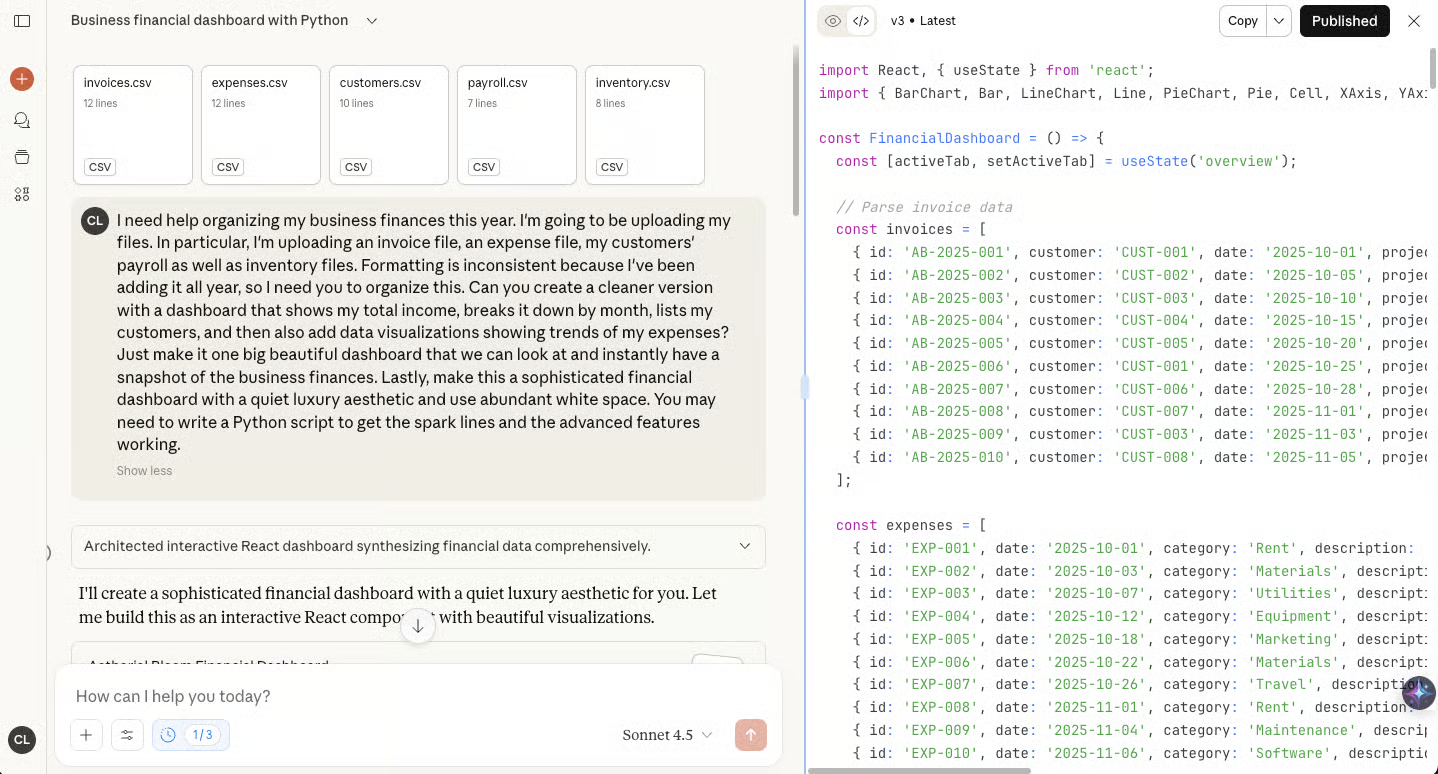
Claude can now take raw financial documents - invoices, revenue sheets, inventory lists - and automatically generate clean dashboards with charts, summaries, and aging reports.
Why It Matters
This turns financial hygiene into a natural-language interaction. Small teams can achieve CFO-level clarity without expensive software or staff.
The Deets
- Uses Sonnet 4.5 with extended thinking and web tools.
- Supports spreadsheets, PDFs receipts and mixed docs.
- Generates full dashboards: revenue, net profit, expenses, trends.
- Can publish sharable “artifact links” for teams.
- Great for teams without formal finance functions.
Key Takeaway
Claude is becoming the financial operations assistant small businesses didn’t know they needed.
🧩 Jargon Buster: Invoice Aging Report - A breakdown of how long invoices have remained unpaid, often used to track cash flow risks.
More: The Rundown University
🧪 Research and Models
AI Solves Math Problems at IMO Level With Full Proof Chains
AlphaProof has achieved Silver Medal performance on International Math Olympiad-level problems using reinforcement learning over 80 million formal math proofs.
Why It Matters
Math has always been one of AI’s most brittle domains. Achieving verifiable, formal correctness is a major step toward reliable reasoning systems.
The Deets
- Combines symbolic logic with RL-trained model reasoning.
- Produces proofs that are mechanically verifiable, not heuristic.
- Nearly eliminates hallucinations in symbolic tasks.
- Moves AI toward “mathematically grounded intelligence.”
Key Takeaway
AI can now generate correct-by-construction mathematical reasoning - the holy grail of verifiable intelligence.
🧩 Jargon Buster: Formal Logic System - A symbolic language and rule set used to ensure mathematical proofs are valid.
More: TAAFT
UBTECH Begins Mass Shipping the World’s First Humanoid Robot Workforce
Shenzhen-based UBTECH Robotics has begun large-scale industrial deliveries of its Walker S2 humanoid robots, marking the first verified mass deployment of humanlike robots into real factories, not research labs or staged demos.
Orders exceed 800M yuan (~$113M), with 500 units heading to automakers like BYD, Geely, Foxconn and Volkswagen by year-end.
Why It Matters
This is a profound threshold moment. For a decade, humanoid robotics has lived in glossy promo videos and cautious prototypes. UBTECH is the first player to cross the line from demo to deployment.
The Deets
- 500 units scheduled for delivery this year.
- Walker S2 can autonomously swap its own battery, enabling 24/7 operation.
- Early tasks include logistics, materials handling, and line support.
- Figure Robotics’ CEO mocked the video as “CGI-like,” but contracts are real.
- Shenzhen quietly became the world’s first city with a robot labor force at scale.
Key Takeaway
You can joke about the animations, but the future clocked in for its shift.
🧩 Jargon Buster: Humanoid Deployment - The moment when human-shaped robots move from controlled research environments into paid, real-world production tasks.
More: Robotics Herald
First Fully Edible, Fully Functional Robot
The EPFL Floreano Lab unveiled the world’s first fully ingestible soft robot made from gelatin, wax, citric acid, baking soda, and edible-grade components. It features a dissolvable battery, a pneumatic actuator and enough structural integrity to deliver medication before dissolving into harmless organic material.
Why It Matters
This isn’t a party trick... it’s a materials science leap that enables robotics in places traditional machines can’t go: ecosystems, animals, and human bodies. It opens the door for a new class of disposable, biodegradable robots.
The Deets
- Moves using CO₂ pressure generated internally.
- Can carry and deploy medication or nutrients.
- Leaves zero environmental waste, fully dissolving after use.
- Suitable for forests, oceans, agriculture, or wildlife deployment.
- Represents a shift away from “robot as machine” toward “robot as biological tool.”
Key Takeaway
We may not have perfected walking robots, but at least we’ve mastered robots you can eat.
🧩 Jargon Buster: Biodegradable Robotics - Robots made from materials that break down naturally without environmental damage.
More: Robotics Herald
Yomi S Becomes the First Real Robot Dentist
Miami-based Neocis - the only FDA-cleared dental robotics company - released Yomi S, an upgraded robotic implant system with a 30% smaller footprint, longer arms and new YomiPlan AI, trained on nearly 100,000 past dental implants.
Why It Matters
While surgical robotics fight over big hospital contracts, Neocis has quietly built a moat in dentistry - an area with 200,000 dentists and 200M Americans missing teeth. Yomi S automates planning and drilling with precision beyond human “hand-feel.”
The Deets
- FDA-cleared and already deployed in dental offices.
- Automatically compensates for patient breathing and micro-movements.
- Allows single-practitioner operation via touch and foot pedal.
- Aims to replace manual implant alignment with data-driven precision.
- Backed by NVIDIA NVentures and Intuitive Ventures (Da Vinci’s creators).
Key Takeaway
Forget humanoids ... the first robot delivering billable, everyday patient care is sitting in dental offices.
🧩 Jargon Buster: Surgical Robotics Workflow - A semi-autonomous system that assists or performs procedures by combining imaging, planning, and robotic actuation.
More: Robotics Herald
⚡ Quick Hits
🛠️ Incogni removes sensitive personal data from the internet.
It now detects more obscure data brokers than before, making it a realistic defense against large-scale identity scraping used to train gray-market AI models.
📚 Google NotebookLM adds Deep Research and new file types. The upgrade lets users run multi-source reasoning across Sheets, PDFs, images and transcripts, bringing NotebookLM closer to a true personal research assistant.
🖥️ Holo 2 powers lightweight computer-use agents. These models are optimized to click, scroll and type across software the way a human would, which could make “agentic desktop automation” an everyday workplace norm.
🛍️ Google rolls out AI shopping agents that call stores. The agent can confirm stock, compare local price variations, and handle multi-stop shopping tasks, pushing Google further into real-world concierge services.
🍎 John Ternus emerges as Apple’s likely next CEO. His hardware-first leadership suggests Apple may pivot more aggressively toward advanced devices and custom silicon in its post-Tim Cook era.
🇯🇵 Sakana AI becomes Japan’s most valuable private startup. Its biologically inspired model architecture is quickly becoming a national symbol of Japanese AI competitiveness amid rising U.S.–China tensions.
🏗️ Google invests $40B in Texas AI infrastructure. The multiyear buildout includes data centers, workforce training, and a dedicated Energy Impact Fund, positioning Texas as Google’s next major AI hub.
🧵 Tools of the Day
- Nebius Token Factory for lightning-fast open-source inference
- Wave for automatic meeting transcription
- Lingo Champion for news-driven language learning
- Colossyan for creating training videos from PDFs
- Reflect for backlink-based knowledge mapping
- Powtoon for AI-generated explainers
- Wobo for automated job applications
- Artbreeder for collaborative image creation
On this day in AI: In 2016, Google unveiled its first TPU (Tensor Processing Unit), the custom chip that quietly kicked off today’s AI hardware arms race. That one chip morphed into an entire ecosystem of accelerators now powering everything from ChatGPT to humanoids rolling off factory floors.
Today’s Sources: AI Secret, The Rundown AI, Robotics Herald