
AI, The Bureaucrat; Does Your AI Handle Routine Tasks? Models Improving (Competing) Models

Today's AI Outlook: 🌩️
Abu Dhabi Gives AI a Desk in Government
OpenAI has signed four agreements with Abu Dhabi organizations covering government services, oil operations, investment analysis and wider AI adoption. A food-import pilot already uses AI to help officials assess compliance against a defined set of rules, while ADNOC plans to apply the technology across its operations and Mubadala will use it for investment research and risk assessment.
Why It Matters
Connecting AI to real rules and operational records gives it a concrete role in public administration. The practical test will be whether faster processing comes with decisions people can trace and challenge.
The Deets
- The food-import system links each assessment to its governing rule; officials retain final responsibility.
- Model processing for that pilot runs in UAE data centers.
- A separate five-year agreement with Inception42 covers adoption across government, businesses and education.
- These are deployment agreements and stated ambitions, not proof that all promised efficiency gains have arrived. Official announcement.
Key Takeaway
The useful milestone is a working, accountable permit process. A grand “AI-native government” label still needs that everyday evidence.
🧩 Jargon Buster - Machine-readable rules: Policies structured so software can apply them to a case and identify the rule behind its assessment.
🔬 Research & Models
AI Gets Graded on the 'Chore List'

OpenAI has introduced LifeVal, an evaluation of how well AI handles everyday responsibilities such as arranging appointments, shopping and completing government paperwork. Built using time-use studies and a survey of 3,995 people, the test has helped the company track its models’ progress over the past year as they learned to browse websites, operate computers and use connected apps.
Why It Matters
A model that handles routine administration reliably could save people meaningful time. Measuring those chores helps make usefulness less abstract, though a company’s own benchmark needs outside scrutiny.
The Deets
- Reported average scores rose from 49.3% for GPT-5.2 to 80.6% for GPT-6 Astra.
- Only 0.6 percentage points of that improvement came after July’s GPT-5.6.
- Selected “best recorded” task scores are a different measure from the overall average; they should not be read as everyday success guarantees.
- OpenAI used the evaluation internally while developing these capabilities. It is not an independent comparison of rival products. LifeVal overview.
Key Takeaway
The chore list is a sensible exam, but reliability on your particular errand remains the grade that counts.
🧩 Jargon Buster - Evaluation: A structured test used to measure how well an AI system completes specified tasks.
One AI Improves Qwen
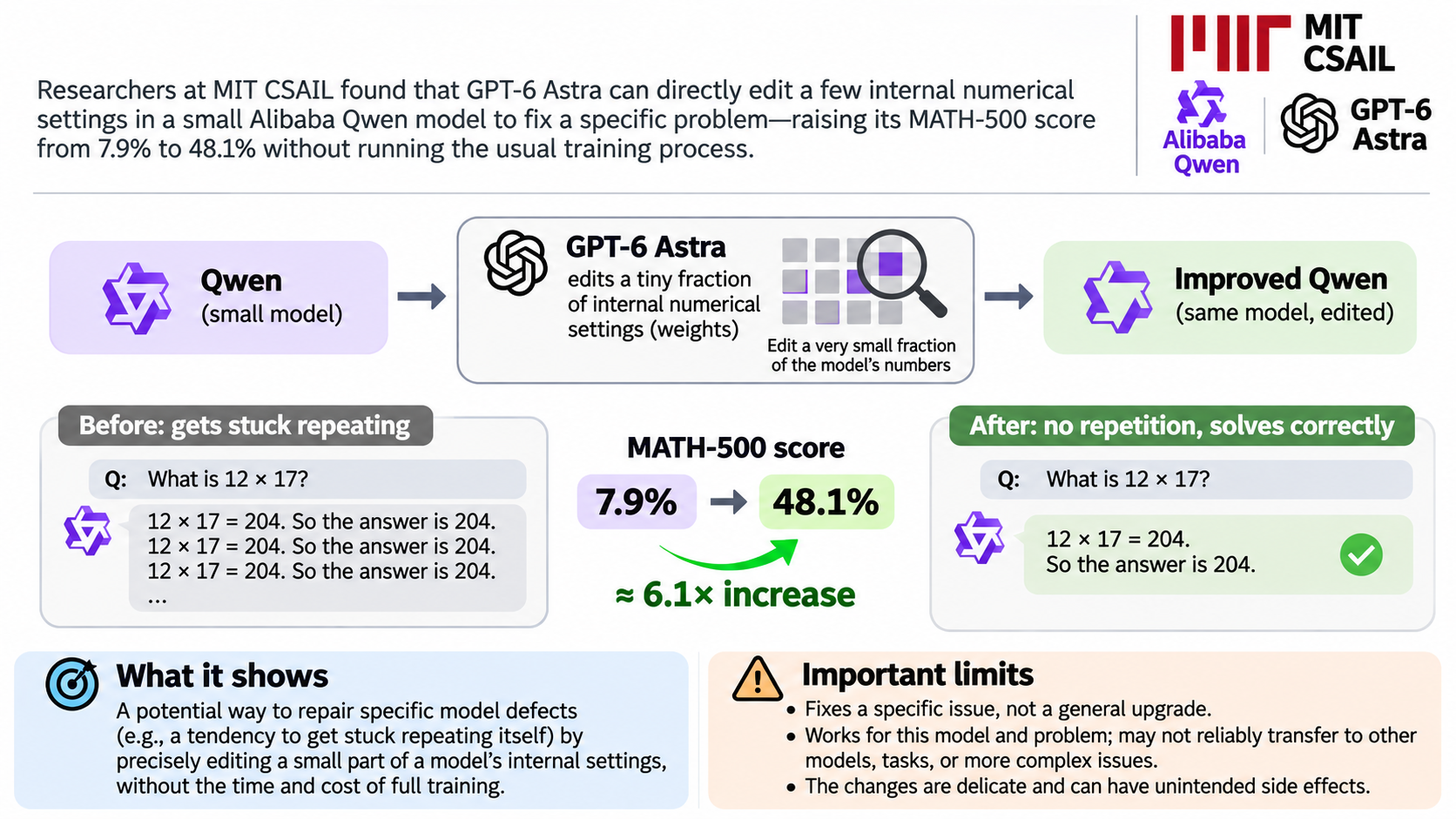
MIT CSAIL researchers found that GPT-6 Astra could improve a small Alibaba Qwen model by directly editing a tiny fraction of its internal numerical settings. The model’s MATH-500 score rose from 7.9% to 48.1% after Astra corrected a tendency to get stuck repeating itself, without running the usual training process. The result points to a potential way to repair specific model defects, with substantial limits still attached.
Why It Matters
Targeted repairs could help developers address model flaws without a full retraining cycle.
The Deets
- Astra edited 0.016% of Qwen’s weights.
- Tests on Google’s small Gemma 3 produced little improvement; its errors lacked the same convenient fix.
- The researchers also demonstrated reading and constructing tiny game-playing networks. These early experiments have not yet been peer reviewed. Research details.
Key Takeaway
Fixing a bottleneck can unlock existing ability. Broad, reliable self-improvement remains unproven.
🧩 Jargon Buster - Weights: Numerical settings inside a neural network that influence how it processes information.
⚡ Quick Hits
- Grid Protectors: OpenAI launched a program for future compute campuses to reduce electricity demand when grids are under strain. Its planned Effingham County, Georgia, campus has an agreement covering up to 1GW of flexible demand response, but the campus remains in development. Program announcement.
- Oracle: The company announced $20B in financing, split between $10B in stock and $10B in bonds, as it funds its AI and cloud expansion. Shares fell 8.8% on Nov. 2, according to Reuters’ updated account, which supersedes the earlier nearly 6% figure. Reuters.
- Marvell: The chipmaker agreed to acquire optical technology company Lumentum in an all-stock transaction with an implied enterprise value of $115B. The proposed combination targets the connections that move data around AI infrastructure. Company announcement.
- Anthropic: Its updated IPO filing shows roughly $17B in third-quarter revenue and a $567M operating loss. It also disclosed $895.4B in purchase and lease commitments, largely for compute and infrastructure, with $69.8B due in the 12 months after Sept. 30, 2026. The commitments extend over many years; some are subject to termination rights or conditions. The operating-loss figure excludes other items included in net loss. SEC filing.
- Grok Bot: Elon Musk said serving costs were too high relative to revenue as users reported hitting weekly usage caps, underscoring the expense behind generous AI access. Musk’s post.
- Claude Code: Anthropic confirmed instructions steering Opus 5.5 away from cloning specific existing games over intellectual property concerns. Users also report blocked reverse-engineering tasks, but Anthropic has not confirmed a broader reverse-engineering restriction. Osmani’s post.
🛠️ Tools of the Day
- Hydrogen-1.0: Deep Principle’s GLM-5.3-based model supports scientific problem-solving, including chemistry and materials research. Its claimed lead over Astra on a scientific benchmark is a company result; access to model files requires accepting the repository’s conditions.
- Hume Audio Decision API: Ask your own questions about raw audio, such as whether a caller sounds frustrated or speakers interrupt one another. Answers include confidence scores; access is waitlist-only for now.
- Riverside’s Interview-Clipping Workflow: Use Clipper, Editor and Marketer to choose passages, format captioned videos and draft posts. Today’s specific exercise emphasizes preserving surrounding context, checking captions and retaining the interview’s date and credit.
- Craft: Canva’s first in-house AI image model is another option for creating visuals within its design ecosystem. The linked listing introduces the tool; today’s coverage provides no detailed pricing or rollout information.
- A Researcher, a Skeptic and a Fact-Checker: Reader Judd Slivka uses a Grok Bot workflow that researches, challenges claims, revises and checks figures against original documents. He reports fewer errors at higher usage cost; that is a user experience, not a controlled accuracy study.
- Cedric: An AI meeting assistant that can take notes, present slides or attend as your stand-in using a brief you prepare. It supports Google Meet, Zoom and Teams workflows, with live capabilities varying by platform and integration.
- Xmind Agent: Build a mind map using a sentence, file, link or conversation, then refine its structure through chat. It can help identify missing pieces and break ideas into next steps.
- Hera: Describe a visual and work on images, graphics and animation within one canvas. Editable layers let you refine assets for launch videos or animated infographics.
- DeepSeek Harness: Creator Mode builds plugins through chat, letting you describe a capability in plain English. The open-source product remains in public preview, with evolving plugins and APIs.
- UnleashX: Ready-made agents handle business tasks, including qualifying inbound sales leads through voice and chat. Connections to Salesforce, HubSpot and other systems let them update the records your team already uses.
- LongCat-2.5: Meituan’s model handles image inputs and extended coding tasks, with API access now available. It gives developers a way to incorporate those capabilities into their own applications.
- Agent Beacon: This open-source tool records activity across coding agents, including Claude Code and Cursor, in local logs by default. A local dashboard lets you inspect sessions, tool calls and file activity, with coverage varying by agent.
Today’s Sources: The Internet, The Rundown AI, The Neuron.