
Bots Win Black Friday; White Collar Jobs Risk; Decades-Old Math Cracked

Today's AI forecast: 🌥️
AI Agents Quietly Won Black Friday
Black Friday online sales in the U.S. hit a record $11.8B, up 9.1% year over year, according to Adobe. A huge chunk of that did not start in a browser search bar. AI shopping agents like Walmart’s Sparky, Amazon’s Rufus and a wave of third party bots drove an estimated 805% jump in AI directed traffic as people simply asked models what to buy and let them do the hunting.
Salesforce data paints the global picture: AI and agents helped drive $14.2B in online sales worldwide, with $3B of that in the U.S. alone. The pattern is clear. Discovery starts in chat, and retailers are becoming the last mile - not the first click.
Why it matters
Search used to own purchase intent. Now large language models are upstream of the money. If consumers are asking an assistant, not a search engine, what to buy, whoever controls the model and its ranking logic controls the demand. Retail search and even Google often just end up confirming price and inventory.
Once shoppers get used to “just ask the bot,” loyalty shifts from brands and stores to whatever assistant lives on their phone, browser, or operating system. That is a structural change in how consumer markets work.
The Deets
- $11.8B U.S. online spend and 9.1% growth signal the overall health of ecommerce
- AI-driven referral traffic surging 805% shows bots are no longer cute add ons
- Global agent assisted sales hitting $14.2B indicates this is not a U.S. only phenomenon
- Retailers are racing to ship their own agents before the big general models fully capture shopping intent
Key takeaway
Black Friday was not won by retailers. It was won by the models that decide what people want before they start looking.
🧩 Jargon Buster: AI Shopping Agent - A chatbot or autonomous assistant that can search products, compare options, and often complete purchases on your behalf based on a natural language request.
More: AI Secret • The Rundown AI
MIT Puts Price Tag On White Collar Risk

MIT’s new “Iceberg Index” estimates that AI systems can already perform about $1.2T worth of work inside the U.S. economy, or roughly 11.7% of the labor market.
The first group on the chopping block is not factory workers. It is clerical and support roles like finance assistants, schedulers, medical administrators and entry level analysts whose work is repetitive, structured, and lives in documents and spreadsheets.
Why it matters
For years, knowledge workers comforted themselves with “AI will take the manual jobs, not mine.” This report basically replies, “Hold my beer.” If a job is mostly reading, summarizing, cross checking and reformatting information, AI can often do it faster and cheaper than humans can supervise it.
Companies will not fire everyone overnight, but they will quietly stop backfilling roles that look like “assistant to the thing.” The more your output looks like predictable paperwork, the more you are competing with a prompt.
The Deets
- $1.2T of automatable work equals a significant slice of white collar GDP
- About 11.7% of U.S. tasks are already within model capability, on paper
- High risk categories: routine finance, scheduling, customer support, medical office work, junior analysis
- The report reframes AI risk away from “robots in factories” toward “robots in front offices”
Key takeaway
The robots did not take the assembly line first. They took the inbox.
🧩 Jargon Buster: Iceberg Index - A metric that estimates how much economic value from human work is already technically within reach of current AI, including the “hidden” tasks beneath the surface of job titles.
More: AI Secret
China Grabs 'Open' AI Crown
A joint study by MIT and Hugging Face that analyzed 2.2B model downloads finds that the open AI ecosystem has quietly rebalanced. Chinese AI developers now account for 17.1% of downloads, edging out the U.S. at 15.8%.
The surge is powered by just a few heavyweights, especially DeepSeek and Alibaba’s Qwen, which together hold 14.2% of the market across the last year. Former download kings like Google, Meta and OpenAI, who dominated before 2023, are no longer leading the open download charts.
Meanwhile, transparency is slipping. Models that disclose their training data have dropped from 79.3% in 2022 to 39% in 2025.
Why it matters
The center of gravity in open models is shifting from California to China. That means a growing share of the “brains” that startups and researchers build on are designed, trained, and governed outside the U.S.
If open ecosystems increasingly run on Chinese checkpoints, U.S. companies may face a choice between technical performance and regulatory comfort. It also accelerates the geopolitical squeeze on truly open, fully transparent models.
The Deets
- Chinese labs now lead open model downloads with a 17.1% share
- U.S. share has fallen to 15.8%, with players like Comfy holding about 5.4% alone
- Pre 2023 giants like Google, Meta, and OpenAI are largely absent from the top download rankings
- Disclosure of training data has collapsed to well under half of open releases
Key takeaway
Open AI is no longer a U.S. playground. The next wave of “free” models may increasingly be made in China.
🧩 Jargon Buster: Open AI Economy - The slice of the AI ecosystem that runs on downloadable, inspectable models and tools rather than closed, API only services.
More: The Rundown AI
⚔️ Power Plays
Anthropic’s MCP Dream Meets The Wall
Originally heralded as the “USB C of AI tools,” Anthropic’s Model Context Protocol (MCP) is turning one with nearly two thousand servers and a fresh spec.
In theory, MCP lets any model talk to any app or data source through a common interface. In practice, it is being quietly sidelined.
Anthropic itself is now routing core capabilities through “Skills,” a closed, curated layer of trusted tools that bypasses the open MCP ecosystem. The infrastructure that was supposed to connect everything is being treated more like a sandbox for low risk, edge case abilities.
Why it matters
The fantasy of an endlessly extensible AI that can safely call any tool on the internet runs into annoying physical and economic limits. Big context windows and long chains of tool calls slow models down, drive up bills and create security nightmares when something goes wrong.
Anthropic’s pivot to in house “Skills” reflects where platforms will draw the line. Anything that must be fast, accurate, and safe will be tightly controlled. The open protocol will be reserved for things where it is okay if the model forgets, fumbles or occasionally breaks something.
The Deets
- MCP has grown to nearly two thousand servers but remains niche in real workloads
- Using many MCP tools at once can blow context windows and confuse models
- Security teams are wary of a sprawl of third party tools with access to sensitive systems
- Anthropic’s “Skills” are pre vetted, optimized abilities that sit closer to the model and bypass MCP for reliability
Key takeaway
In AI ecosystems, control wins where reliability is expensive, and openness survives where mistakes are cheap.
🧩 Jargon Buster: Model Context Protocol (MCP) - A standard that lets AI models connect to external tools and data sources through a common interface so they can act more like flexible software agents.
More: AI Secret
AI Infrastructure Money Pile Grows Higher
The capital flowing into AI infrastructure keeps getting louder numbers:
- Banks are reportedly preparing $38B in loans for Oracle and Vantage to build more data center capacity dedicated to OpenAI workloads
- Deutsche Telekom and Schwarz Group are in talks to jointly build a major AI data center in Europe, eyeing up to $20B in EU funding support
At the same time, airlines like Virgin Australia are signing deals to embed ChatGPT powered tools directly into flight search and planning, while Telegram’s Pavel Durov launched Cocoon, a decentralized compute network that pays GPU owners in TON tokens to run private AI workloads.
Why it matters
You can tell where the value is going by who is buying concrete. Traditional telecoms, cloud vendors, and even banks are repositioning themselves as the substrate that AI runs on. That means long term, infrastructure style returns rather than quick consumer app flips.
The rise of decentralized offerings like Cocoon hints at a counter trend where individuals can rent out spare compute into tokenized networks instead of everything living in hyperscale data centers. But right now the big money is still betting on huge, centralized facilities.
The Deets
- $38B in planned loans would make Oracle and Vantage key landlords for OpenAI capacity
- The Deutsche Telekom and Schwarz project aims to create a European “AI gigafactory” to reduce dependence on U.S. and Chinese clouds
- Virgin Australia is wiring conversational AI directly into how travelers search and book
- Telegram’s Cocoon offers a parallel path that crowdsources compute into a decentralized, privacy focused network
Key takeaway
Everyone wants to own the land under the AI city, not just rent an apartment in it.
🧩 Jargon Buster: AI Data Center Gigafactory - An industrial scale facility packed with GPUs, networking, and cooling systems designed specifically to train and run large AI models.
More: AI Secret • The Rundown AI
🛠️ Tools & Products
Memo Starts Where Humanoids Stop
Sunday Robotics, a startup built by ex-Tesla Autopilot and Optimus engineers, has emerged with Memo, a compact home robot focused on delicate hand work like folding socks and stacking dishes.
Instead of chasing a full humanoid body, the team is obsessing over reliable grasping, contact physics, and endurance.
Cofounder Tony Zhao and several former Tesla engineers who previously worked on manipulation stacks are effectively rebuilding the humanoid vision from the fingertips outward.
Why it matters
Humanoid robots are great in demos, less great when they have to repeatedly grab the same slippery mug every day for years. Memo reflects a more grounded bet that the real value in domestic robotics will come from robust, narrow skills, not theatrical full body motions.
If you can perfect manipulation in messy homes, broader humanoid forms can be layered on later. But if the hands do not work, nothing else matters.
The Deets
- Compact home robot focused on repetitive, fine grained hand tasks
- Built by engineers who worked on Tesla’s Autopilot and Optimus manipulation systems
- Prioritizes reliability and contact physics over general mobility or “wow” demos
- Designed as a practical entry point to domestic robotics rather than a sci fi humanoid
Key takeaway - Sunday Robotics is betting the robot revolution starts with doing the dishes, not walking like a human.
🧩 Jargon Buster: Manipulation Stack - The software and control systems that let a robot hand plan, grasp, and move objects accurately in the real world.
More: Robotics Herald
Perplexity Turns Into A Patent Scout
The Rundown’s tutorial walks through using Perplexity’s AI powered patent search as a front end for innovation research. By framing natural language questions like, “Find active patents in AI driven industrial automation,” users can pull filings, owners and grant dates, then ask follow up questions that highlight “white space” where few or no patents exist.
Agent Mode can chain searches together, compile cross region data and output CSV and visual reports that map crowded zones versus open territory.
Why it matters
Traditional patent research is slow, specialized and expensive. If anyone with a product idea can quickly see who owns what and where the gaps are, it lowers the barrier to serious innovation and reduces the risk of wandering into litigation.
It also gives small teams a way to act like they have an in house IP counsel and research department, long before they can afford one.
The Deets
- Automatically detects patent related queries and surfaces relevant filings
- Agent Mode compiles global results and produces structured outputs like tables and charts
- Users can ask for “whitespace” and get an overview of under explored areas
- Reports can be exported for deeper offline analysis or pitch decks
Key takeaway - Patent strategy is becoming a prompt away, not a lawyer retainer away.
🧩 Jargon Buster: Whitespace Analysis - A method for finding areas in a market or technology where few or no patents exist, indicating room for new products or research.
More: The Rundown AI
Warp’s Dev Agent Graduates To Full Stack
Warp’s terminal just shipped its biggest Agents upgrade yet.
The company says its Development Agent now tops the Terminal Bench coding benchmark, ahead of tools from Claude, Gemini and Codex.
The agent can plan work, run long lived commands like servers and debuggers, and support the full lifecycle from writing code to deploying it, all while staying inside a familiar terminal interface that developers can steer in real time.
Why it matters
A lot of dev agents look impressive in static demos but fall apart when you need them to juggle log files, test suites and interactive servers. By leaning into the terminal as the control room, Warp is trying to augment existing workflows rather than replace them with a chatbot floating over your editor.
If it works, this is what “pair programming with AI” actually looks like in production.
The Deets
- Full terminal control, including long running processes
- Steerable plans that developers can review and edit before execution
- Benchmarked as the top performing dev agent on Terminal Bench
- Aims to cover planning, coding, debugging, and deployment in one loop
Key takeaway
The best coding agent might not be a chatbot. It might be the terminal devs already live in, turned up to 11.
🧩 Jargon Buster: Terminal Bench - A benchmark that measures how well AI agents can operate real developer workflows through the command line.
More: The Rundown AI
💰 Funding & Startups
Databricks, xAI Load Up For The Long War
Two of the biggest names in the AI race are reportedly arming themselves with new mega rounds:
- Databricks is in talks to raise about $5B at a $134B valuation, roughly 32 times its expected $4.1B in sales this year
- Elon Musk’s xAI is said to be preparing a $15B round at a $230B pre money valuation next month
Why it matters
These numbers are not seed rounds. They are signals that investors see AI platform plays as long term infrastructure bets with room to grow into multi-hundred billion dollar businesses. At these valuations, both companies are being priced like they are on track to become core parts of the global compute and data stack.
It also raises the bar for everyone else. If you are not sitting on billions in dry powder, you probably cannot afford the same model training cycles, hardware or global go-to-market.
The Deets
- Databricks is leaning into its role as the data and AI platform for enterprises
- A $5B raise at $134B suggests public market sized expectations even while private
- xAI’s rumored $230B valuation would instantly place it among the world’s most valuable private companies
- Capital is likely to fund model training, custom hardware, and distribution deals
Key takeaway
In frontier AI, the fundraising deck is starting to look like a national budget, not a startup pitch.
🧩 Jargon Buster: Pre Money Valuation - The value investors assign to a company before new money goes in ... used to determine how much equity they get for their investment.
More: The Rundown AI
🔬 Research & Models
‘Aristotle’ AI Solves 30-Year Math Puzzle

Harmonic’s “Aristotle” AI system independently cracked a version of Erdős Problem #124, a math problem that has sat open since the 1990s.
Aristotle generated a proof in about six hours and then formally verified it in the Lean proof assistant in roughly one minute.
This came from a beta version of the system that had been upgraded with stronger reasoning and a natural language interface to explore and write step by step proofs. Harmonic’s founder, Vilad Tenev, calls this the start of the “vibe proving” era, where AI explores the landscape of possible proofs and then checks them with formal tools.
Why it matters
AI is moving from “passes math tests” to “discovers new math.” That is a different category of capability. If systems can generate novel proofs and then verify them automatically, they can accelerate everything from pure mathematics to cryptography and physics.
It also democratizes access. You no longer need to be an Olympiad medalist to explore advanced problems if an AI can guide and verify your steps.
The Deets
- Aristotle previously achieved gold level performance on International Math Olympiad style problems
- Harmonic recently raised $120M, putting it in the same reasoning tier as Google and OpenAI’s best systems
- The pipeline combines creative search for proofs with strict formal verification in Lean
- “Vibe proving” describes the loop where AI proposes candidate ideas and then filters them through mechanical rigor
Key takeaway - Mathematical superintelligence is starting to look less like science fiction and more like a product roadmap.
🧩 Jargon Buster: Formal Verification - A process where mathematical proofs or system properties are checked step by step by a computer to guarantee they are logically correct.
More: The Rundown AI
🤖 Robotics
Robots Get Paid To Do The Dirty Work
Money is flowing into robots that do the jobs humans really do not want:
- San Francisco based Armstrong Robotics raised $12M to scale its AI powered dishwashing systems that already run around the clock in real restaurant kitchens
- Gravis Robotics secured $23M to expand its learning based autonomous excavation platform across multiple countries
Why it matters
These are not gimmick robots flipping burgers for an opening day video. Armstrong’s setup has to survive heat, grease, broken glass, and chaos while cleaning everything from stacked plates to magnet clumped cutlery. Gravis has to bite into real dirt in real construction sites.
If these systems can handle conditions that would terrify most lab robots, it is strong evidence that embodied AI is finally ready to leave carefully staged demos and survive in the wild.
The Deets
- Armstrong’s system uses three seven degree of freedom arms plus dozens of sensors and a vision model trained on messy dish scenes
- The robots identify, pick, and scrub dishes without human babysitting
- Gravis focuses on autonomous excavation, a demanding physical task that mixes perception, planning, and heavy machinery control
- Both target industries with chronic labor shortages and unpleasant working conditions
Key takeaway
The first real robot labor boom is arriving in places that smell like soap and diesel, not in sleek corporate lobbies.
🧩 Jargon Buster: Embodied AI - AI systems that control physical robots or devices in the real world, not just digital agents on a screen.
More: Robotics Herald
Robots Learn To Rebuild Pompeii
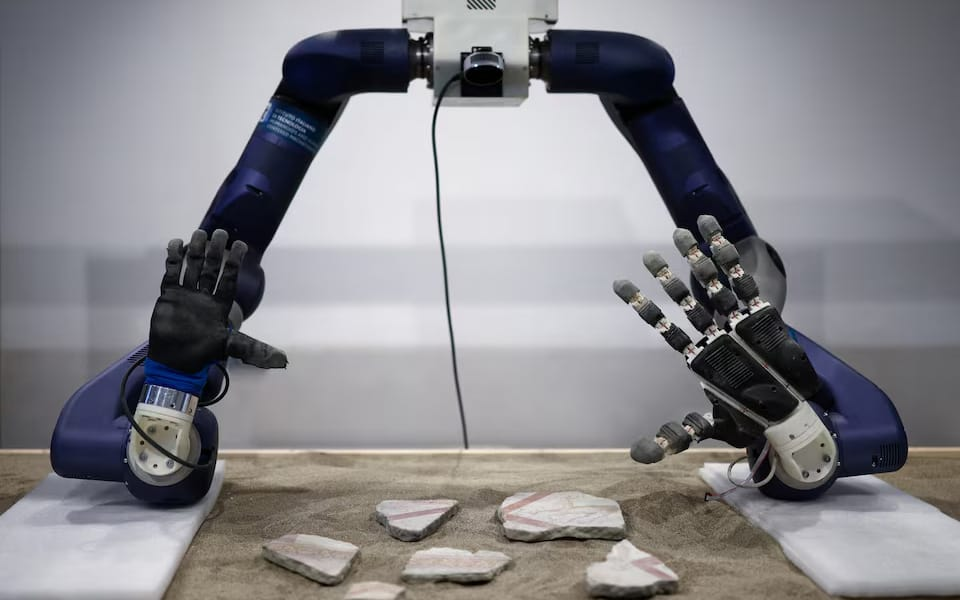
In Pompeii, the EU-funded RePAIR project completed a live test of a dual arm restoration robot that can identify and reassemble fresco fragments using AI.
Built by researchers at Ca’ Foscari University, the system combines visual recognition, 3D reconstruction, and ultra soft grippers to handle fragile pieces without damage.
During testing, the robot worked on replica ruins under real world archaeological conditions, including dust, debris, and uneven lighting that would easily confuse a lab trained system.
Why it matters
Restoration work is a brutal combination of puzzle solving, patience, and risk. A wrong move can destroy irreplaceable artifacts. RePAIR’s real innovation is not just speed, but judgment. The system flags candidate matches, validates them geometrically, and keeps humans in the loop before making physical contact.
If this approach scales, archaeology and cultural heritage work could shift from painstaking manual sorting to AI accelerated reconstruction, while still preserving human oversight over meaning and context.
The Deets
- Dual arm robot with ultra soft grippers designed for fragile fragments
- Vision stack trained to recognize, match, and position fresco pieces
- Human experts review AI suggestions and geometry checks before any move
- Tested in conditions that mimic actual dig sites instead of clean labs
Key takeaway
Archaeology might become the first field where robots restore history faster than they disrupt it.
🧩 Jargon Buster: 3D Reconstruction - Using images or sensor data to build a three dimensional model of an object or scene so a robot can understand how pieces fit together.
More: Robotics Herald
⚡ Quick Hits
- ChatGPT Turns Three With 800M Weekly Users
OpenAI’s flagship chatbot now reportedly reaches about 800M weekly users and has seeped into everything from education to agriculture. The bigger it gets, the more pressure mounts on governments and competitors to keep up. - Kubota’s Hydrogen Tractor Drives Itself
Kubota’s X Vehicle is a driverless, hydrogen-powered tractor with performance comparable to a 100 horsepower diesel engine, using GPS and sensors to farm with zero tailpipe emissions. - James Cameron Calls Generative AI “Horrifying”
The Avatar director argues that performance capture enhances real actors, while genAI that invents characters and performances from scratch erases the actor-director collaboration he cares about. - EU Pushes Child Safety Rules For AI
European lawmakers backed a proposal that would ban under 16s from using social media and AI chatbots without parental consent, setting up yet another regulatory front for AI platforms. - Delivery Robots Face Real-World Pushback
In Chicago, residents are pressuring the city to halt delivery robot pilots from Coco and Serve over safety and accessibility concerns, reminding everyone that sidewalk robots have to navigate politics, not just curbs. - Humanoids Learn To Play Basketball
HKUST and Unitree unveiled what they call the first full size humanoid that can play interactive basketball with humans, a flashy but technically demanding demo for balance, perception, and control. - Ari Emanuel Wants Robot UFC Fights
The TKO CEO says he would like to see Musk’s Optimus robots in UFC style matches, reflecting how quickly humanoid robots have gone from lab curiosity to pop culture storyline.
🛠️ Tools of the Day
- Ripplica
Records your browser workflows once and lets AI agents replay them automatically with no code, turning tedious web tasks into reusable automations.
More: AI Secret - TinyCommand
A no code platform that pulls together forms, data, and AI agents so you can design automated workflows without ever touching an SDK.
More: AI Secret - plok.sh
Instantly converts a GitHub repo’s Markdown files into a fast, themed blog, sidestepping traditional CMS setups for documentation and dev blogs.
More: AI Secret - Unfold
A free tool that builds interactive, personalized animated courses on any topic based on your prompts, ideal for lightweight internal training or education side projects.
More: AI Secret - TRAE (The Real AI Engineer)
A price competitive coding agent focused on software engineering tasks, positioned as a budget friendly alternative to premium dev copilots.
More: AI Secret - KaraVideo
A unified interface that brings multiple AI video models into one place so you can generate and edit clips without juggling tabs.
More: AI Secret - Math V2
DeepSeek’s open source mathematical reasoning model, tuned for solving complex math problems with stronger stepwise reasoning.
More: The Rundown AI - Perplexity (With Memory)
An AI answer engine that now offers persistent memory so it can remember past conversations and preferences over time, making it a stronger research companion.
More: The Rundown AI - GELab Zero 4B
StepFun’s state of the art open source model for computer use, built for agents that need to click, scroll, and type across applications like a human operator.
More: The Rundown AI - Vidi2
ByteDance’s AI video editor with spatio temporal grounding, making it easier to edit clips based on what happens when in the frame.
More: The Rundown AI - Sweep
A top AI coding plugin for JetBrains IDEs that helps you write and refactor code faster directly where you already develop.
More: TAAFT - MagicTrips
An AI powered trip planner that builds custom itineraries based on your preferences, budget, and travel style.
More: TAAFT - Limitless
Captures everything you see, say, and hear so you can search and recall your life and work with AI assisted memory.
More: TAAFT - PodScribe.io
Turns audio from podcasts, meetings, and interviews into structured, searchable knowledge that you can reuse across projects.
More: TAAFT - Sparkle
Lets AI organize your Downloads, Desktop, and Documents folders so you can stop pretending you will clean them “later.”
More: TAAFT - PhoneCaseAI
Lets you design custom phone cases by describing the art you want, then turns that description into a printable design.
More: TAAFT
Today’s Sources: AI Secret, The Rundown AI, Robotics Herald, There’s An AI For That