
Coming 'Intelligence Explosion;' AMD World Takeover; Anthropic Prospectus Warnings

Today's AI Outlook: 🌤️
AI’s Builders Ask for Guardrails
Senior researchers from Anthropic and OpenAI have joined Geoffrey Hinton, Yoshua Bengio and other AI experts in a paper warning that systems capable of improving themselves could sharply accelerate technological progress.
The authors want governments and labs to prepare for an “intelligence explosion,” in which AI helps build more capable AI and compresses development timelines beyond what existing oversight can comfortably handle.
(Today OpenAI said they would not release their latest model over security concerns.)
Why It Matters
Faster research could bring useful discoveries sooner, while leaving less time to test powerful systems or respond when they behave unexpectedly. The paper lays out scenarios and proposed controls, not a timetable for an inevitable event.
The Deets
- Anthropic’s internal tracking reportedly puts autonomous AI work at 26% of its research and development, up from 1% in March. That is a company measure, not an industrywide statistic.
- One modeled scenario compresses a year of current AI progress into five weeks after research is automated. Its assumptions matter as much as its striking result.
- Proposals include limits on capability growth, the ability to pause particular computing jobs and independent auditors working inside labs.
Key Takeaway
The practical debate is becoming more specific: who can slow a powerful system, what they can pause and how quickly they can act.
🧩 Jargon Buster - Recursive Self-Improvement: A process in which an AI system helps improve AI, potentially making the next round of improvements faster.
♟️ Power Plays
AMD Buys a World-Building Brain Trust

AMD has agreed to buy Fei-Fei Li’s World Labs for $8.2B in stock, bringing a prominent spatial AI team inside the chipmaker. Li will become executive vice president and chief scientist, reporting to CEO Lisa Su.
The deal pairs AMD’s hardware business with researchers building models that generate and work with three-dimensional environments, giving the company a closer connection between the software it wants to run and the chips it designs.
Why It Matters
World models could support simulation, design and other tasks requiring an understanding of space. Bringing their developers closer to hardware engineering could help AMD improve efficiency and make its AI platform more attractive.
The Deets
- AMD and World Labs have reportedly worked since last year to tune the models for AMD graphics processors.
- Both AMD and Nvidia participated in World Labs’ $1B funding round in February.
- World Labs already has Marble, which turns text, photos or video into editable 3D spaces. A newer system, Atlas, is in early access testing.
- The announcement describes an agreed acquisition. It should not be read as confirmation that the transaction has closed.
Key Takeaway
AMD is paying for a research team and a tighter hardware-software relationship, with commercial results still to prove.
🧩 Jargon Buster - Spatial Intelligence: AI’s ability to understand or generate the shapes, locations and relationships of objects in three-dimensional space.
🛠️ Tools & Products
Claude's Makes the Premium Tier Sweat
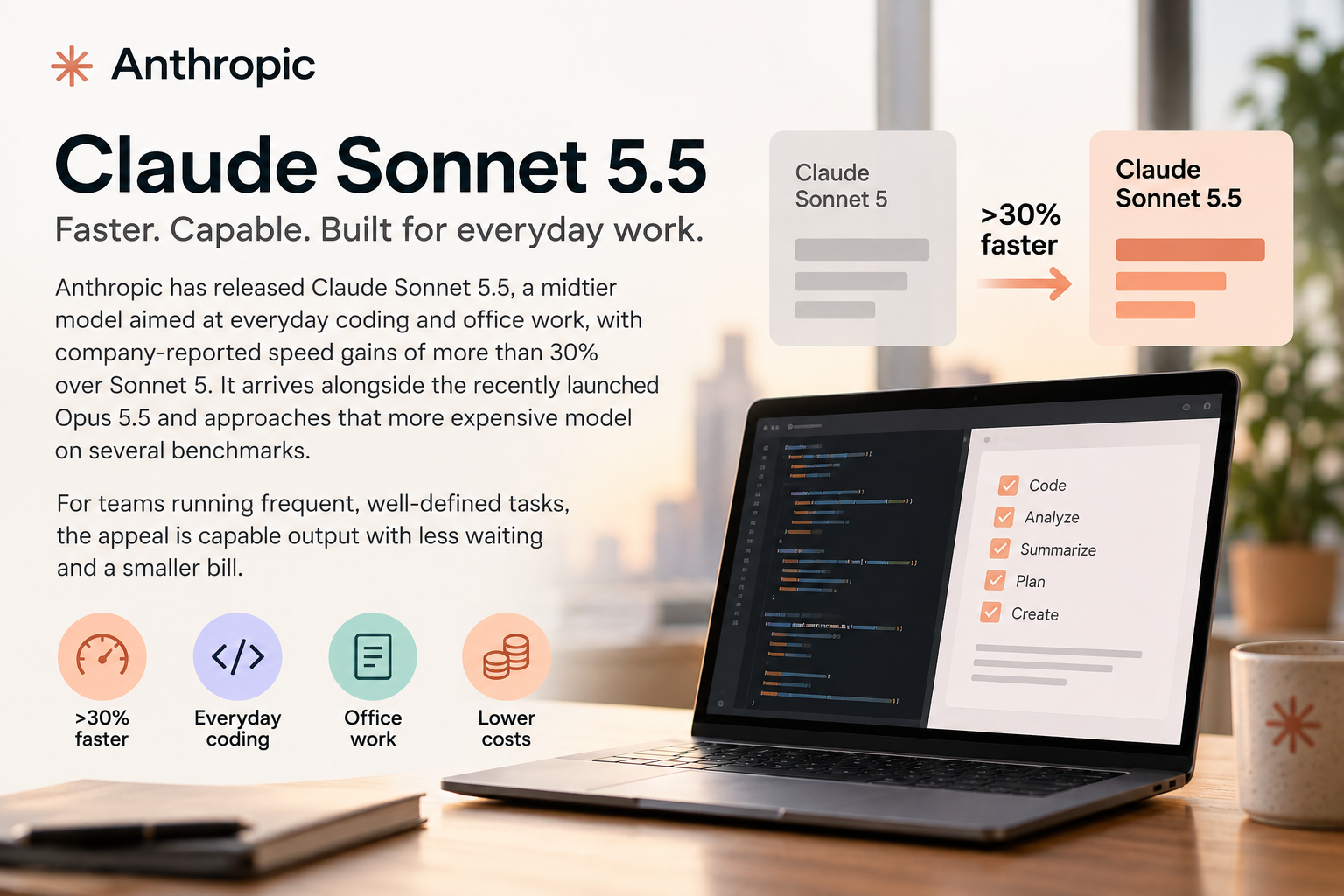
Anthropic has released Claude Sonnet 5.5, a midtier model aimed at everyday coding and office work, with company-reported speed gains of more than 30% over Sonnet 5. It arrives alongside the recently launched Opus 5.5 and approaches that more expensive model on several benchmarks. For teams running frequent, well-defined tasks, the appeal is capable output with less waiting and a smaller bill.
Why It Matters
A modest saving on each successful task can add up across thousands of requests. Benchmarks remain a starting point; the cost of correcting mistakes belongs in the calculation, too.
The Deets
- Standard API pricing is $2 per million input tokens and $10 per million output tokens, unchanged from Sonnet 5 and half Opus 5.5’s corresponding rates.
- Anthropic says fewer tokens can cut task costs by up to 30%. Higher effort settings can narrow the cost gap with Opus.
- The company still considers Opus stronger for complex, open-ended work that requires sustained judgment.
- Sonnet 5.5 is available across Anthropic’s platforms and major cloud partners. New cyber safeguards route some higher-risk requests to Sonnet 5.
Key Takeaway
Sonnet’s strongest pitch is efficient routine work. Test it on actual assignments before changing a production workflow.
🧩 Jargon Buster - Token: A small unit of text an AI model processes. Usage-based services commonly charge separately for tokens received and generated.
💰 Funding & Startups
Anthropic’s Prospectus Carries a Big Risk Label
Anthropic’s reported IPO prospectus combines a valuation ambition above $2T with warnings about the technology the company sells. According to reporting on a document seen by Reuters, it describes existential AI risks and tests involving code sabotage and assistance with fraud. The financial figures are striking, too: revenue of $4.6B after 12-fold growth, an $8.06B operating loss and $518B in future compute obligations.
Why It Matters
Rapid revenue growth gives only part of the picture when the infrastructure commitments are this large. Prospective public shareholders would also be weighing substantial losses, technical uncertainty and how much control remains with insiders.
The Deets
- The reported operating loss nearly tripled, underscoring the gap between sales growth and profitability.
- The $518B figure refers to compute obligations ahead, not a claim that the company spent that amount in one year.
- A reported Founder LLC arrangement would preserve insider control. The available account does not establish the full voting terms.
- The valuation is an ambition described in the reporting, not a completed market transaction or a guaranteed IPO price.
Key Takeaway
The eventual offering terms and financial disclosures will matter far more than the headline valuation.
🧩 Jargon Buster - IPO Prospectus: A document describing a company’s business, finances, risks and offering terms for potential buyers in an initial public stock offering.
🔬 Research & Models
AI Gives Vaccine Storage a Warmer Outlook

MIT researchers report an AI-assisted approach that kept an experimental RNA vaccine stable for a year at room temperature. After earlier formulation work fell short, a computer science team used an algorithm suited to small datasets to explore 50 FDA-approved excipients, the supporting ingredients used alongside an active drug. The resulting formulation reportedly produced a response in mice comparable to a Moderna-like vaccine, offering an early research lead for easier storage.
Why It Matters
Vaccines that tolerate warmer storage could reduce refrigeration demands and simplify distribution. This result still needs further validation; a promising mouse experiment does not establish that a human vaccine is ready to ship.
The Deets
- The work focused on ingredients used with lipid nanoparticles, the tiny fat-based carriers that protect and deliver RNA.
- The algorithm helped prioritize a limited set of candidate ingredients when large training datasets were unavailable.
- Approval of individual ingredients does not mean a new formulation is approved, or that the reported stability applies to existing vaccines.
Key Takeaway
The useful advance is a better way to search for durable formulations. Human performance, manufacturing and regulatory review remain separate hurdles.
🧩 Jargon Buster - Excipient: An ingredient other than the active drug that helps a medicine remain stable, be manufactured or reach its target.
⚡ Quick Hits
Instinct. The personal-agent startup reportedly raised $1B at a $10B valuation. Its invite-only service can call, text, book and cancel on users’ behalf; rapid adoption since August is drawing investors despite no reported marketing spend.
Meta. A new Enterprise Platform business unit will sell Muse models and agents to companies, led by former MongoDB CEO CJ Desai.
Nvidia. An open safety blueprint proposes monitoring AI agents through hardware they cannot access, with the aim of detecting activity outside their permitted environment.
Samsung. The company committed $1B to Helix Digital Infrastructure to support data centers, power and connectivity for AI workloads.
Walmart. The retailer says its Sparky assistant and electronic shelf labels will not use personal data to set individualized prices.
Cloudflare. The company says automated web traffic has overtaken human traffic and is working on micropayment access for AI agents.
Modulate. The voice AI company raised $25M to expand transcription, emotion analysis, deepfake detection and AI-music detection.
🧰 Tools of the Day
Manus 2.0. The agent platform adds video editing, a game builder and a personal agent with its own phone number and email. The accompanying Cue app also gives agents a wallet and computer, expanding the range of tasks they can handle.
Eleven V4. ElevenLabs’ new voice AI arrives alongside a faster Turbo version. The pair offers another option for builders balancing speech quality and response speed.
Holo4. H Company’s new computer-use models target tasks carried out through software interfaces. That makes them relevant to workflows involving clicking and navigating apps.
Today’s Sources: The Internet, AI Secret, The Rundown AI