
Google: Everything Everywhere At Once; Ilya Claims Research Over Compute

Google’s AI Blitz: Gemini 3, Aluminium OS and TPU@Premises
Google is merging ChromeOS and Android into Aluminium OS, an AI-native PC platform launching in 2026. Gemini 3 delivers stronger performance and better design, Nano Banana Pro widens Google’s creative lead and the TPU@Premises program brings Google accelerators into customer data centers.
Why it matters
Google is quietly assembling the most complete full-stack ecosystem: OS + hardware + silicon + cloud + models. Investors noticed - Alphabet gained nearly $1T since October.
The Deets
- Aluminium OS unifies ChromeOS + Android with Gemini models running locally
- Gemini 3 improves UI, adds Dynamic View for interactive visualizations
- Nano Banana Pro hits paid tiers with 2K/4K support coming
- NotebookLM now builds slide decks with custom styles
- TPU@Premises launches enterprise deployments in 2027
- Google expects up to 10 percent of Nvidia’s annual revenue to shift
Key takeaway
Google is done sleepwalking... It’s building a continent-sized moat.
🧩 Jargon Buster: TPU@Premises - Deploying Google’s AI accelerators inside a customer’s own data center.
More: AI Breakfast
Ilya Sutskever Declares the “Age of Scaling” Over
In a rare appearance, Safe Superintelligence founder Ilya Sutskever said the next breakthroughs will come from research, not more compute. He predicts superhuman learning systems could appear in 5–20 years and confirmed SSI is raising at a $32B valuation.
Why it matters
Sutskever helped build the systems that defined the scaling era. If he’s declaring a chapter closed, everyone pays attention.
The Deets
- Scaling dominated 2020–2025; Sutskever says it’s no longer the frontier
- ASI timeline estimate: 5–20 years
- Emphasis on models that “care about sentient life”
- SSI declined an acquisition offer from Meta
- Only one cofounder has departed so far
Key takeaway
The next leap won’t come from bigger clusters. It’ll come from breakthroughs.
🧩 Jargon Buster: Age of Scaling - A period when bigger datasets and more compute reliably produced smarter models.
More: The Rundown AI
🏛️ Power Plays
Musk Swaps Moderators for Grok

Elon Musk laid off roughly half of X’s already tiny trust-and-safety engineering team, leaving fewer than 10 employees. Grok now effectively runs content ranking and moderation as part of Musk’s plan to rebuild X’s infrastructure around automation.
Why it matters
This isn’t a cost cut but rather a governance shift. AI systems are being positioned not just to assist humans, but to replace their oversight entirely.
The Deets
- Team shrinks from 100+ to single digits
- Grok models now handle ranking and moderation end-to-end
- Overhaul led by former Meta and Apple ML veterans
- Part of Musk’s larger “Macrohard” project to rebuild software stacks with AI agents
Key takeaway
Grok isn’t just doing the work. It’s deciding what work exists.
🧩 Jargon Buster: Self-Referential AI Loop - An AI system that evaluates and governs its own outputs.
More: AI Secret
Warner Music Turns AI Lawsuits Into Licensing

Warner Music ended its legal battle with Suno and signed a commercial partnership granting licensed access to its entire catalog. Suno will move AI-generated music behind a paywall, while Warner sold Songkick to the startup.
Why it matters
This signals a shift away from “fight AI” toward “monetize AI.” Rights-cleared models are becoming the default.
The Deets
- Warner licenses catalog for AI-generated tracks
- Suno gains rights to use major artists’ voices and likenesses
- Paid tier required for downloads; free tier limited to listening and sharing
- Songkick sold as part of the deal
Key takeaway
The music industry is reorganizing around AI.
🧩 Jargon Buster: Rights-Cleared Model
An AI model trained on fully licensed data that allows commercial use of outputs.
More: AI Secret
🧰 Tools & Products
OpenAI Rolls Out Shopping Research, Voice Chat and Global Data Residency
OpenAI introduced Shopping Research, a feature powered by GPT-5-Thinking Mini that builds interactive buyer guides with pros/cons, images and side-by-side comparisons. Enterprises get data residency across 12 regions, and ChatGPT’s voice mode is fully integrated into chat.
Why it matters
Shopping is a gateway to commerce while data residency is a gateway to global enterprise adoption.
The Deets
- Handles spec comparisons, tradeoffs and follow-up filtering
- Buyer guides show images, features and real-time refinements
- Uses memory to enhance multi-step shopping
- Data residency now covers conversations, files, GPTs and images
- Voice mode supports real-time interaction without switching screens
Key takeaway
ChatGPT is evolving into a general-purpose digital concierge.
🧩 Jargon Buster: Data Residency - Keeping data physically located in a specific region for regulatory compliance.
More: AI Breakfast
Flux.2 Levels Up Image Generation
Black Forest Labs launched FLUX.2, a family of image models delivering higher consistency across styles and characters, improved world knowledge, and cheaper inference than Google’s top-tier models.
Why it matters
Image generation has reached realism parity - now consistency and control are the battleground.
The Deets
- Supports up to 10 reference images for style/identity
- Combined model for text+image understanding plus spatial model for physics
- 4MP output, stronger typography support
- Pro, Flex, Dev versions now available; Klein open-source model coming
Key takeaway
The next era of image models is about controllability, not just fidelity.
🧩 Jargon Buster: Multi-Reference Generation - Using several example images to preserve character traits across outputs.
More: The Rundown AI
Anthropic: AI Could Double U.S. Productivity Growth
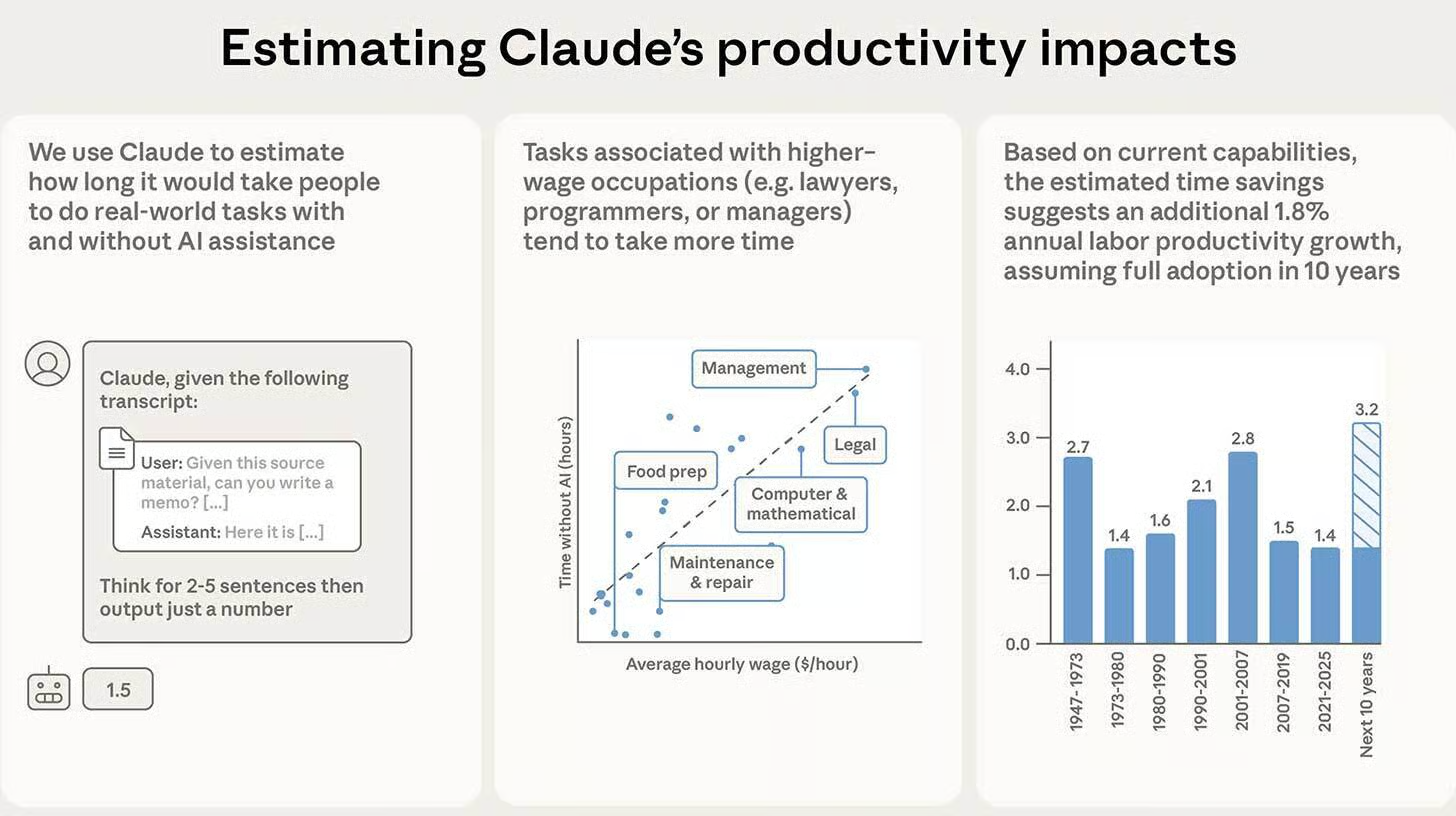
Using 100K Claude interactions, Anthropic found AI cuts task time by ~80 percent and could raise U.S. productivity growth by 1.8 percent annually over the next decade.
Why it matters
It’s one of the clearest empirical cases for AI as an economic multiplier.
The Deets
- Analyzed interactions using Anthropic’s Clio privacy tool
- Biggest gains: curriculum design (96 percent), research (91 percent), admin work (87 percent)
- Software developers account for 19 percent of productivity lift
- Maps tasks to federal labor data to model impact
Key takeaway
AI’s productivity story is real. The displacement story is still TBD.
🧩 Jargon Buster: Total Factor Productivity - A measure of output efficiency independent of labor and capital.
More: The Rundown AI
⚡ Quick Hits
- Palo releases $250/month tool for high-follower creators
- Fleet Space discovers new lithium deposits via satellite-AI
- OpenAI predicts 220M paid ChatGPT users by 2030
- NotebookLM gains deep research + new file types
- Holo 2 powers agentic computer-use models
- Google’s shopping agents now call stores for price checks
- Edible soft robots debut for biological deployments
- Yomi S becomes the first real robot dentist
🧵 Tools of the Day
- TRAE – cost-competitive coding agent
- KaraVideo – hub for all major AI video models
- Momen AI – no-code app builder
- Nebius Token Factory – fast open-source inference
- Wave – auto meeting transcription
- Lingo Champion – language learning via news
- Colossyan – turn PDFs into training videos
- Reflect – backlink knowledge mapping
- Powtoon – AI explainers
- Wobo – automated job applications
- Artbreeder – collaborative image creation
On this day in AI: Norbert Wiener Was Born on this day in 1948. He became the founding father of Cybernetics and his 1948 work laid conceptual foundations that would later influence thinking around artificial intelligence, particularly around modeling cognition, feedback systems, memory association, choice and decision-making in machines
Today’s Sources: AI Breakfast | AI Secret | The Rundown AI