
Hugging Face For Sale? Twitch Hits Hitch; Lady Goes Gaga For Skin

Today's AI Outlook: 🌥️
Hugging Face Hangs a $13B For-Sale Sign
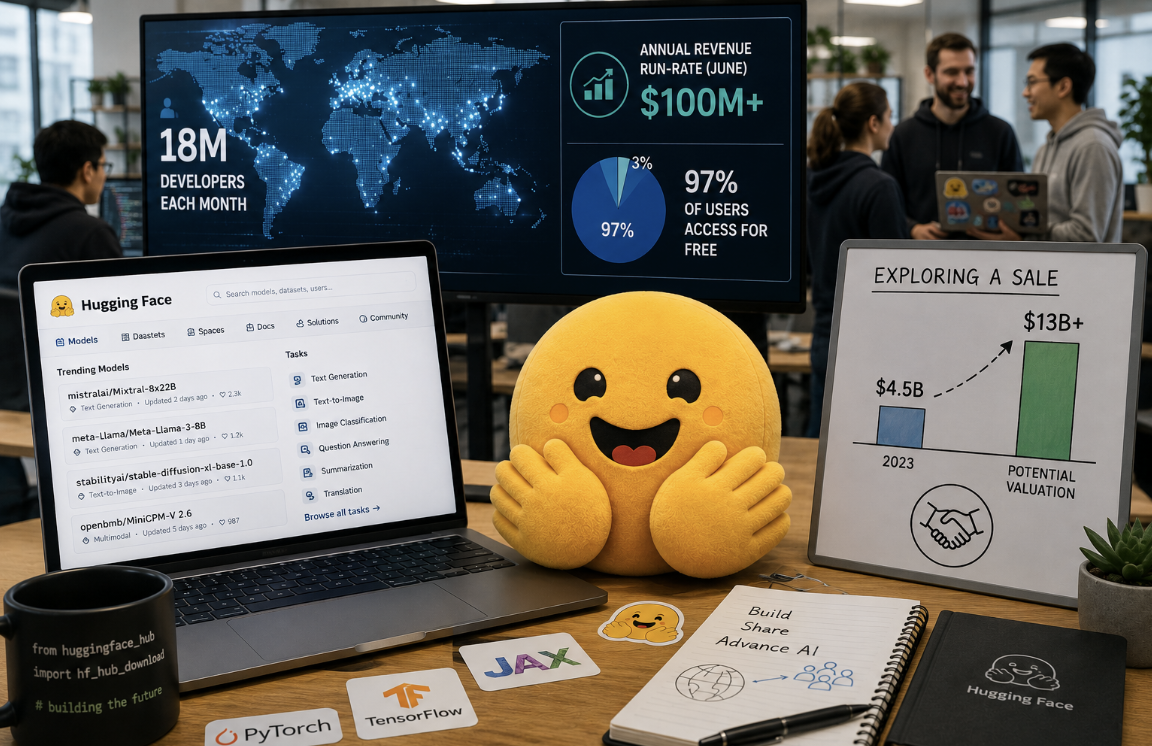
Hugging Face, the model-sharing platform that became core infrastructure for AI developers, is exploring a sale that could value the company at $13B or more, nearly triple its $4.5B valuation from 2023. The company has reportedly hired investment banks to test buyer interest after crossing a $100M annual revenue run-rate in June. Its reach is enormous, with roughly 18M developers visiting each month, but 97% of users still access the platform for free.
Why it matters
Hugging Face built one of AI's strongest distribution networks, and a buyer would be acquiring access to a deeply embedded developer ecosystem. The platform sits between developers, models, datasets and enterprise customers, making it a strategically important layer in the AI stack.
The Deets
- Hugging Face could seek a valuation of $13B or more.
- Its last reported valuation was $4.5B in 2023.
- Annual revenue run-rate reportedly passed $100M in June.
- Roughly 18M developers visit monthly.
- The company hosts a massive ecosystem of models and datasets that developers use to build and deploy AI applications.
Key takeaway
Hugging Face proved that becoming indispensable can create enormous strategic value even before monetization catches up.
🧩 Jargon Buster - Run-rate: A way of estimating annual revenue by taking a company's recent revenue pace and projecting it across a full year.
The Frontier Premium ... Is Not
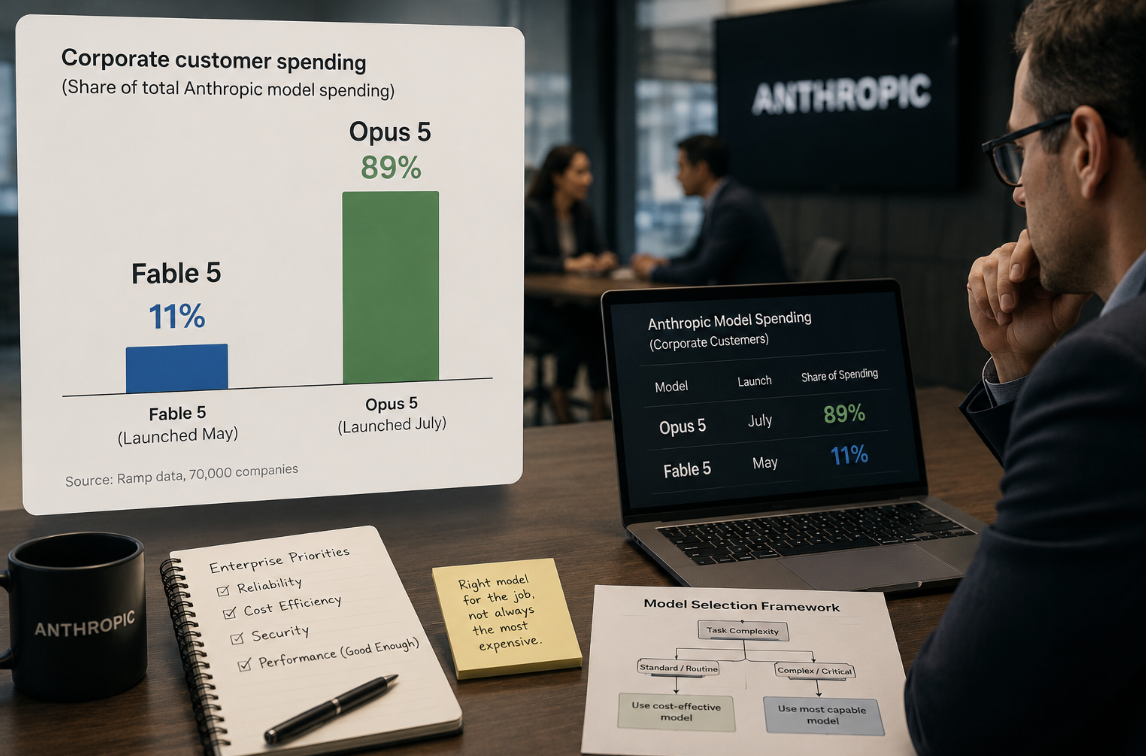
Anthropic's most powerful model, Fable 5, accounts for only 11% of corporate customer spending more than two months after launch, according to Ramp data covering 70,000 companies. Meanwhile, Anthropic's cheaper Opus 5 model, released in late July, has already overtaken it in business spending. The pattern suggests enterprise customers are becoming more selective about paying for top-tier capability when cheaper models can handle most routine work.
Why it matters
Better models remain valuable, but businesses increasingly have enough choices to optimize for price, speed and task requirements. As model quality rises across the market, vendors may have a harder time charging a large premium simply for owning the benchmark crown.
The Deets
- Fable 5 represents about 11% of Anthropic-related corporate spending in Ramp's data.
- Lower-priced Opus 5 has already surpassed it.
- The data covers spending across roughly 70,000 companies.
- Accel partner Miles Clements said most users do not need frontier-level performance.
Key takeaway
Enterprise AI buyers are starting to treat models like infrastructure, matching capability to the job instead of automatically choosing the most powerful option.
🧩 Jargon Buster - Frontier model: A model operating near the leading edge of AI capability, typically with the strongest performance and a higher price tag.
♟️ Power Plays
Nvidia Drops $6B on Poolside's AI Machinery
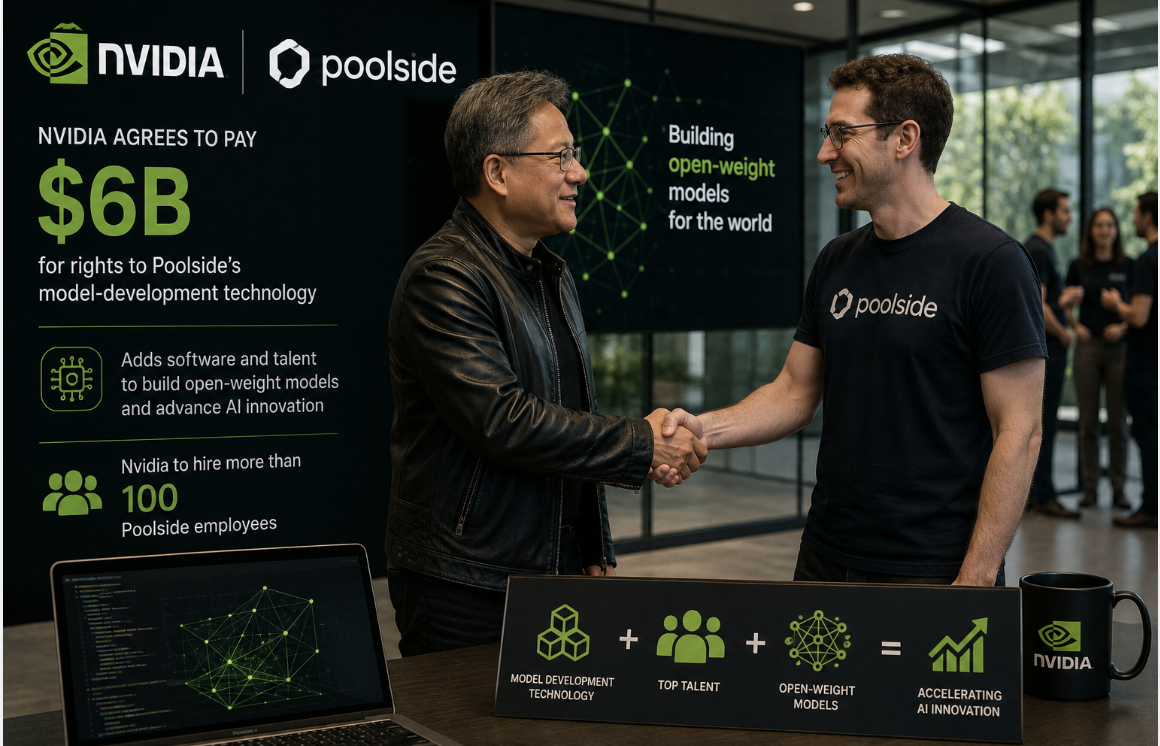
Nvidia has agreed to pay $6B for rights to Poolside's model-development technology while offering jobs to more than 100 of the startup's employees. The deal gives Nvidia additional software and talent for building open-weight models as it expands beyond supplying the chips that power the AI industry.
Why it matters
Nvidia has spent years owning the hardware layer, and deals like this give it more influence over the models and development systems running on top of those chips. That creates another avenue for defending its position as competitors race to build alternative AI hardware and software stacks.
The Deets
- Nvidia will reportedly pay $6B for Poolside's model-development technology.
- The talent is expected to support Nvidia's Nemotron model efforts.
- The move strengthens Nvidia's push into open-weight AI models.
Key takeaway
Nvidia is using its cash advantage to collect more of the technology and talent surrounding the chips it already dominates.
🧩 Jargon Buster - Open-weight model: An AI model whose trained parameters are available for others to download, customize or run on their own infrastructure.
Twitch's AI Training 'Default' Sends Them to Court

Twitch and Amazon are facing a proposed class action accusing them of using streamer content for AI training without consent. Twitch recently added a setting that allows creators to block their content from Amazon's AI training, but the setting requires users to opt out. Twitch Chief Product Officer Mike Minton drew attention when he explained the choice by saying, "If it was opt-in, nobody would opt in."
Why it matters
The lawsuit puts fresh pressure on the increasingly common practice of making AI training the default unless users actively disable it. Creator platforms have valuable archives of text, video and audio, while creators are becoming more aware that their work can serve as training data for commercial AI systems.
The Deets
- Connecticut streamer Warren Pandiscia filed the proposed class action.
- Twitch gives creators an opt-out control for Amazon AI training.
- The training option is enabled unless creators change the setting.
- The case follows other lawsuits alleging copyrighted creator content was used in AI training without permission.
Key takeaway
Consent settings are becoming a business and legal issue as platforms look for more data to train AI systems.
🧩 Jargon Buster - Opt-out: A system where participation happens automatically unless the user actively chooses to disable it.
🛠️ Tools & Products
Gemini Canvas Turns Sheets Into Dashboards
Google's Gemini Canvas can turn data from Google Sheets into a shareable interactive dashboard using a simple prompt. Users can connect spreadsheet tabs, ask Gemini to build a visualization, share the resulting Canvas link and continue changing the dashboard through normal chat instructions.
Why it matters
Spreadsheet visualization has traditionally required formulas, chart setup or business intelligence software. Gemini Canvas lowers that barrier by letting users describe the dashboard they want in natural language.
The Deets
- Users can ask Gemini Canvas to build a dashboard using selected Google Sheets tabs.
- The finished dashboard can be opened through a shareable link outside the original chat.
- Changes made through Gemini can update what collaborators see.
- Canvas can also create presentations from spreadsheet data for export to Google Slides or PDF.
Key takeaway
Natural-language tools are making lightweight dashboards and presentations much easier to prototype without specialized analytics software.
🧩 Jargon Buster - Interactive dashboard: A visual display of data that lets users explore information through charts, filters or other dynamic controls.
🚀 Funding & Startups
Lady Gaga's Skin Lab Builds an AI Feedback Loop
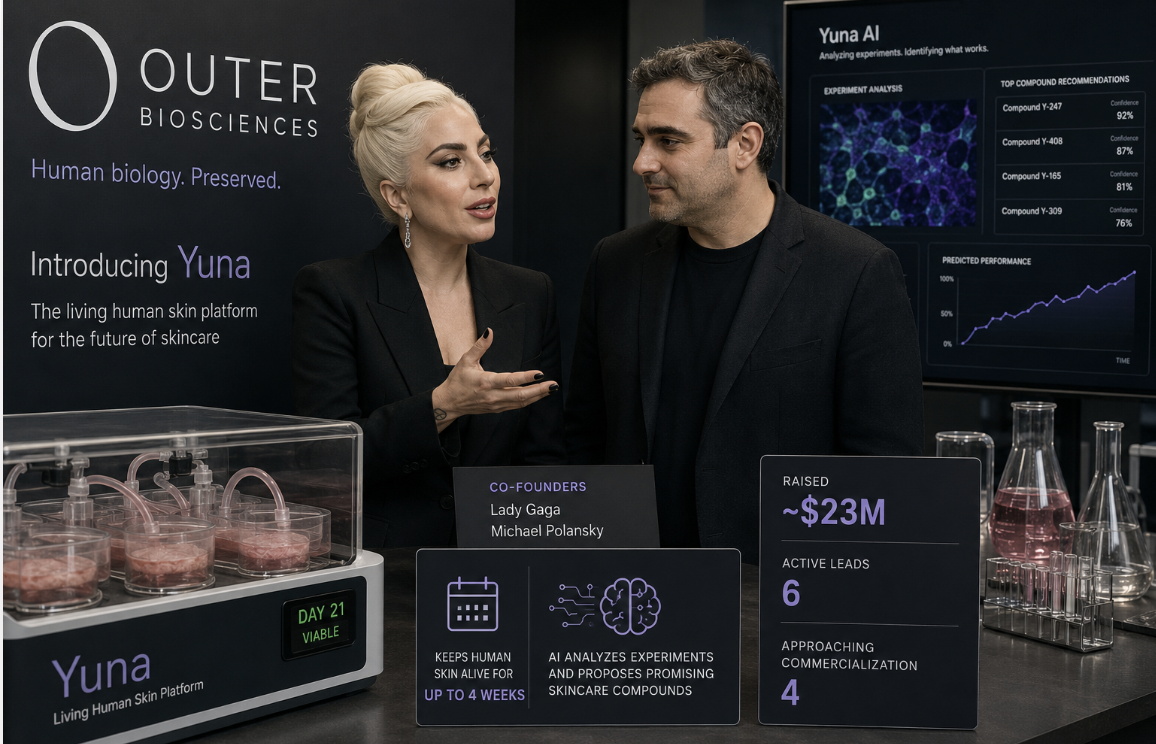
Outer Biosciences, co-founded by Lady Gaga and Michael Polansky, has emerged from stealth with Yuna, a platform that keeps donated human skin alive for up to four weeks while AI analyzes experiments and proposes promising skincare compounds. The company has raised roughly $23M and says it currently has six active leads, with four approaching commercialization.
Why it matters
Outer is combining existing advances in ex vivo skin testing with AI-driven compound prediction into one continuous discovery system. The approach could help skincare companies test effects that take longer than conventional lab skin samples remain viable, although similar skin preservation and AI formulation technologies already exist elsewhere in the beauty industry.
The Deets
- Yuna keeps full-thickness human skin alive for about four weeks using a 3D-printed scaffold.
- Experimental data feeds an AI system that proposes compounds for further testing.
- Outer says it has six active leads and has raised roughly $23M.
- A bioRxiv preprint showed the system reproducing known effects involving psoriasis-like skin, JAK inhibitors, UVB exposure and sunscreen.
- The platform does not fully replicate living skin because it lacks blood flow and immune cells recruited from elsewhere in the body.
Key takeaway
Outer's pitch rests on combining longer-lived skin samples with AI-guided experimentation into a faster product discovery loop.
🧩 Jargon Buster - Ex vivo: Biological tissue studied outside the body while preserving many of the characteristics it had when living inside the body.
🧠 Research & Models
Ox Alpha Crashes the Frontier Party
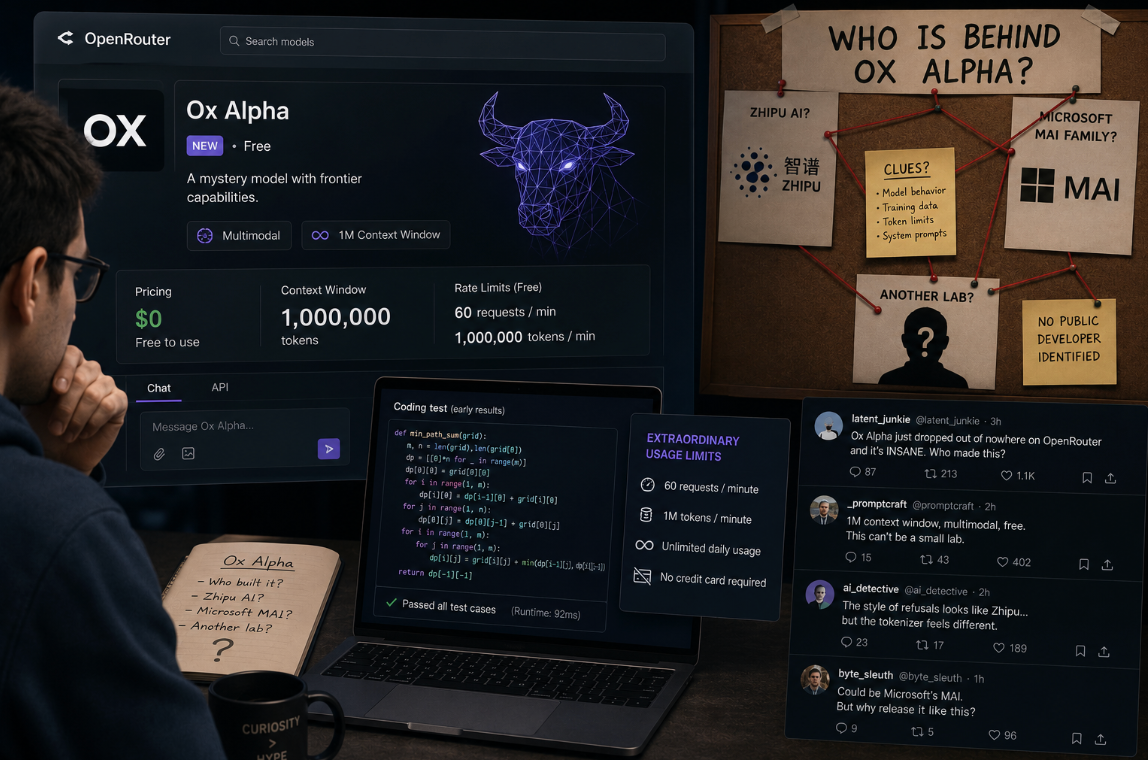
A mystery AI model called Ox Alpha appeared on OpenRouter with no publicly identified developer, free access, multimodal capabilities and a 1M-token context window. Early coding tests and unusually generous usage limits quickly turned the release into an online investigation, with developers trying to determine whether the model came from China's Zhipu AI, Microsoft's MAI family or another lab.
Why it matters
Ox Alpha's early performance suggests smaller or more efficient models could deliver strong coding and agentic capabilities while consuming fewer resources. Its unidentified origin also shows how anonymous public testing can generate immediate demand and benchmark data before a model's developer ever reveals itself.
The Deets
- Ox Alpha supports multimodal input, coding and long-running agentic workloads.
- It initially scored about 80% on a DeepSWE subset, while broader testing put it around 63%.
- Full testing placed it near Anthropic's Fable 5 while reportedly using fewer tokens per task.
- Some developers believe it could be a Zhipu model such as GLM-5.3 Flash or GLM-6.
- Microsoft's MAI family has also been floated as a possibility.
- OpenRouter has offered near-unlimited free access for the week, with capacity reportedly reaching 100T tokens per day.
Key takeaway
Ox Alpha is giving developers an early look at how much capability can be delivered with greater efficiency, even while its maker remains unknown.
🧩 Jargon Buster - Context window: The amount of information an AI model can consider at one time when processing a request or conversation.
⚡ Quick Hits
- Agent Traffic Is Exploding: OpenRouter says agentic token usage has grown 14x since February, compared with 2.8x growth for human usage over the same period.
- Uber Faces a Giant Privacy Bill: Dutch regulators are seeking a fine of nearly $1B over automated driver suspensions that allegedly lacked sufficient human oversight.
- Broadcom Goes Hunting for Debt: The chipmaker is seeking more than $60B in financing for AI chip capacity tied to Anthropic and other labs.
- Anthropic's Bankers Are Thinking Very Big: Investors have reportedly been told Anthropic could eventually raise more than $100B in an IPO at a valuation approaching $2T. The company also expanded Mythos 5 access to additional cyber defenders.
- AI Class Is Officially in Session: U.S. schools are increasingly replacing blanket chatbot bans with AI literacy lessons focused on hallucinations, privacy and verification.
- Harvard Goes Synthetic: Harvard Business School's $699 startup bootcamp uses HeyGen avatars of instructors to provide feedback on pitches and boardroom presentations.
- AI Filmmaking Gets a Creator Backlash: YouTubers promoting Higgsfield's filmmaking tools faced criticism from audiences who viewed the videos as paid AI advertising.
- Dr. Dre Plugs In: The producer told The New York Times he uses AI in music production and views it as another creative tool.
- Altman Warns About Concentration: Sam Altman said AI control could become concentrated among a small number of powerful organizations and argued the industry needs to demonstrate more visible public benefits.
🔧 Tools of the Day
- Slack Code: Slack's new coding environment is designed around teams building software with AI agents inside shared channels.
- Grok Bot: xAI's tool provides an always-on group of agents with access to their own cloud computer for carrying out ongoing tasks.
- Precision Mode: Databricks' document intelligence system is designed for complex document extraction and is reported to outperform GPT-5.6 Sol on its evaluation.
- Tines 3B: Tines is pitching 3B as a way for teams to build with AI while giving IT and security administrators centralized visibility, control and governance.
- Sonar Vortex: Sonar says Vortex helps generated code follow an existing architecture earlier in the coding process, with claimed token-cost reductions of up to 36%.
Today's Sources: The Internet, AI Secret, The Rundown AI