
Insta-Agent Shopping; Sora Hitting Floor; Don't Punch That Robot!

Today's AI forecast: 🌤️
Shopping Without Shopping: AI Agents Rewrite Retail
The retail world just crossed another threshold: Instacart’s integration with ChatGPT is officially live, letting shoppers plan meals, auto-generate grocery lists, and check out all from inside a single chat conversation. No browsing. No carts. No checkout flow. Just: “I want three dinners for the week, keep it under $60, no dairy.” The agent does the rest.
This is the first large-scale deployment of OpenAI’s “agentic commerce” vision - where AI not only recommends but executes purchases end-to-end. It also hits at a symbolic moment: Instacart’s former CEO Fidji Simo now leads OpenAI’s Applications division, steering the product push behind these real-world AI agents.
Retailers are now staring down a new funnel - or rather, no funnel. Consumer behavior is shifting from clicking through menus to briefing an AI about intentions. Diet changes, allergies, weather patterns, budget constraints, brand preferences ... agents will optimize all of it before the user even thinks about it. Brick-and-mortar stores aren’t just competing with e-commerce anymore, they’re competing with the chat window.
Why it matters
If consumers outsource the entire shopping process to agents, the dominant retail interface becomes the prompt, not the storefront. Whoever controls the agent controls the revenue flow.
The Deets
- Integration allows planning, list building, and checkout entirely inside ChatGPT.
- AI agents soon expected to handle replenishment, price comparisons and contextual decision-making.
- The traditional e-commerce funnel (discovery to delivery) collapses into a single prompt.
- Puts pressure on retailers whose business models depend on visual browsing and multi-step conversion.
Key takeaway
The new checkout counter is a chat box.
🧩 Jargon Buster: Agentic commerce - AI systems that don’t just show you products but autonomously buy them for you based on your instructions and preferences.
Source: AI Secret
⚡ Power Plays
Who’s Winning With AI at Work? OpenAI’s Data Says: Power Users
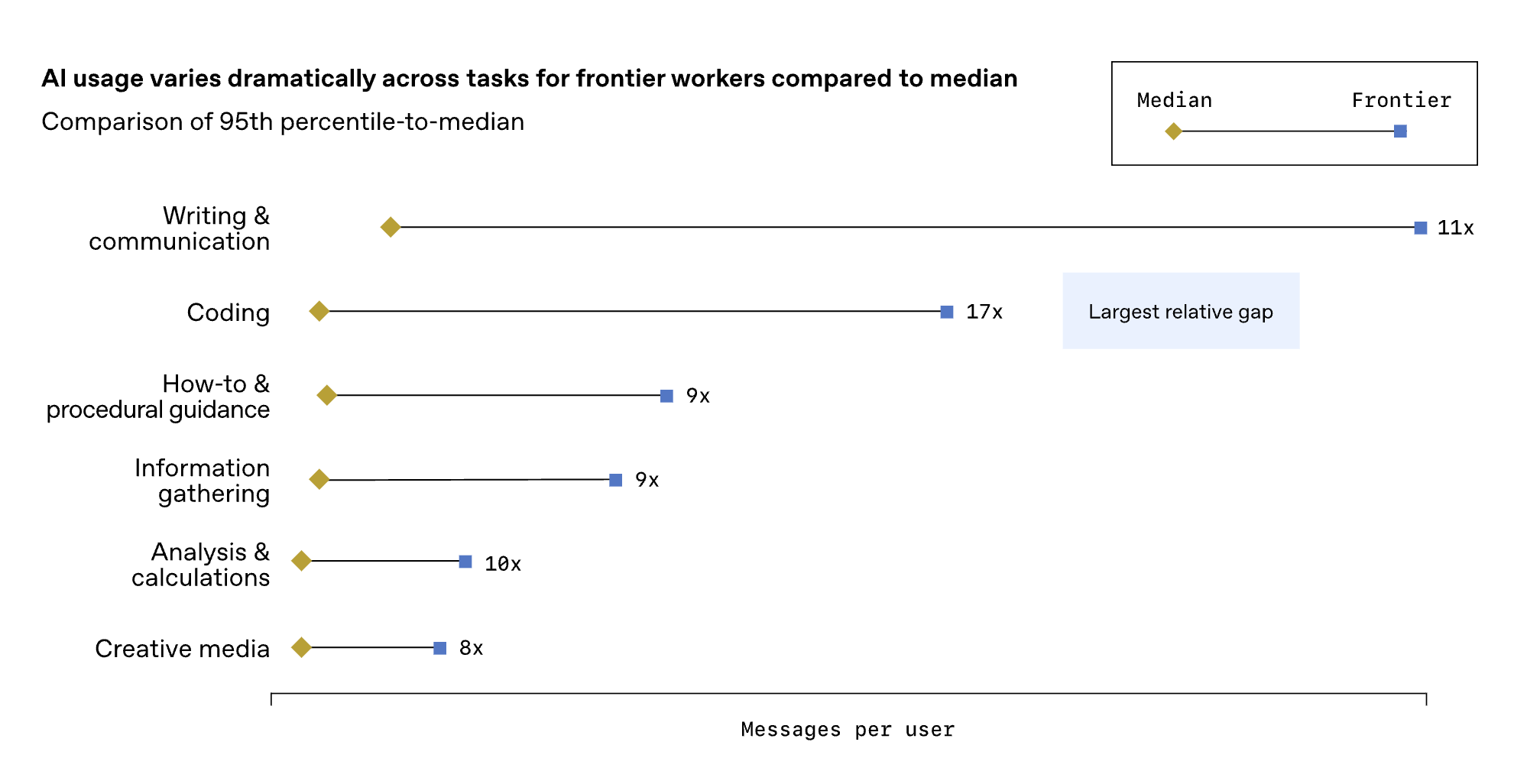
OpenAI released its first-ever State of Enterprise AI report, pulling insights from more than 1M workplace accounts. The headline: 75 percent of workers say AI not only improves speed and quality, but lets them do tasks they literally couldn’t before.
This is the strongest quantification yet of how generative AI is reshaping work. Productivity isn’t just about efficiency - it’s about new capabilities. And the gap between average users and “power users” is enormous. The top coders send 17× more messages than the median coder, and top general users send 6× more messages.
Time savings are equally stark: business users gain 40–60 minutes per day, while power users claim 10+ hours per week. That’s a part-time job’s worth of reclaimed time, redirected into higher-value work.
Why it matters
AI isn’t merely accelerating workflows but rather expanding the range of what a single employee can handle. Organizations that cultivate power users will see disproportionate gains.
The Deets
- Data derived from anonymized enterprise usage and surveys across 100 companies.
- 75 percent saw improvements in speed and quality.
- 75 percent said they now complete tasks they couldn’t previously do.
- Huge performance gap between top 5 percent and median users.
- Developers using AI inside Slack can now invoke Claude Code to handle entire coding tasks in-channel.
Key takeaway
The future of work belongs to the power users ... the ones who talk to AI the most.
🧩 Jargon Buster: Power user - a heavy, high-frequency AI user whose productivity gains far exceed the average worker.
Source: The Rundown AI
🧬 Research & Models
When AI Joins the FDA Playbook
The FDA has officially qualified AIM-NASH, the first AI system embedded into the agency’s own evaluation standards. Unlike AI systems that help drug development, this one is literally written into the regulatory rulebook.
AIM-NASH analyzes liver biopsy images in MASH drug trials, scoring inflammation, scarring and fat buildup with consistent precision. Historically, these assessments relied on slow, subjective pathology reviews. Now, AI can provide standardized, trial-ready evidence trusted by the FDA.
Why it matters
This is a structural shift. AI is more than inventing drugs, it’s helping decide whether they work. For pharma companies, that means reduced review timelines, lower costs, and more consistent trial outcomes.
The Deets
- First AI model to become an FDA-recognized clinical trial evaluation tool.
- Cloud-based model improves consistency across trial sites.
- Expected to cut months and millions from MASH drug development.
Key takeaway
AI has moved from lab assistant to law-abiding citizen ... officially part of how drugs get approved.
🧩 Jargon Buster: MASH - Metabolic dysfunction-associated steatohepatitis, a liver disease notoriously difficult to evaluate consistently.
Source: AI Secret
🎥 Tools & Products
Sora’s Retention Falls Faster Than Its Physics Errors
OpenAI’s Sora, once hyped as the “TikTok of the AI era,” is shedding users at alarming speed. Leaked numbers show 10 percent day-one retention and just 1 percent retention after 30 days, compared with TikTok’s 50 and 32 percent.
Why? Perhaps because the videos often defy physics and reality - floating basketballs, distorted bodies, broken timelines - and each attempt costs real credits. TikTok gives free dopamine; Sora gives a bill and a broken ankle animation.
Why it matters
Generative video users don’t want “sometimes-artistic chaos.” They want reliability. When creativity becomes a financial gamble, retention craters.
The Deets
- App plagued by physics glitches, inconsistent motion, and unstable renders.
- Users must pay credits for each attempt, amplifying frustration.
- Output feels unpredictable compared with entertainment-first apps.
Key takeaway
Sora didn’t lose to TikTok. It lost to its own price tag and broken physics.
🧩 Jargon Buster: Retention - the percentage of users who return after a given number of days.
Source: AI Secret
🏥 BotWorld
Punch a Robot, Meet Its Lawyer
Streamer IShowSpeed is being sued for allegedly assaulting Rizzbot, a humanoid influencer with over a million followers. Video shows Speed punching, choking and slamming the robot, breaking its neck module and cameras. Its creator, Social Robotics, filed suit after settlement talks failed.
Why it matters
Humanoid robots are no longer “gadgets” ... they’re monetized personalities with agents, sponsorships, and contractual value. Damaging one is legally closer to harming a celebrity asset than breaking a toy.
The Deets
- Injuries include a broken neck module and disabled sensors.
- Rizzbot’s career is on pause due to damage.
- Social Robotics pursuing litigation after negotiations collapsed.
Key takeaway
You can joke with robots, stream with robots, maybe date robots; don’t assault them. They've lawyered up.
🧩 Jargon Buster: Humanoid influencer - a robot with a curated personality and digital audience, generating revenue like a human creator.
Source: Robotics Herald
Da Vinci Rules, but Hugo Finally Gets Through the FDA Door
After years of delays, Medtronic’s Hugo surgical robot just received FDA clearance for urological procedures, ending Intuitive Surgical’s 25-year monopoly in soft-tissue robotics.
Why it matters
Even if da Vinci maintains dominance through training and installed systems, Hugo’s clearance proves the monopoly is penetrable ... a precedent that could reshape competitive dynamics in operating rooms.
The Deets
- Hugo was first revealed in 2019.
- Already used tens of thousands of times internationally.
- Now cleared for its first U.S. procedures.
- Aimed at mid-tier hospitals priced out of Intuitive’s ecosystem.
Key takeaway
Da Vinci is still king, but Hugo proved the castle has a side door.
🧩 Jargon Buster: Soft-tissue robotics - robotic systems designed for delicate surgical procedures like urology and gynecology.
Source: Robotics Herald
Optimus Falls - And Probably Its Operator, Too
Me too Optimus. Me too. pic.twitter.com/CzXQmJUPJx
— Robin (@xdNiBoR) December 7, 2025
At Tesla’s “Autonomy Visualized” event, an Optimus robot face-planted after dropping water bottles. As it fell, its hands moved to its “face” ... a gesture familiar to anyone who has ever ripped off a VR headset. Observers suspect the robot was tele-operated.
Why it matters
Tele-operation isn’t really scandalous. It’s standard for humanoid teams during training. Tesla’s mistake wasn’t using a human in the loop, but letting the human need a break mid-demo.
The Deets
- Fall triggered by dropped objects.
- Motion suggested a tele-operator interrupt.
- Rekindles debate about Optimus’s true autonomy.
Key takeaway
Optimus didn’t glitch — its pilot hit “bio mode.”
🧩 Jargon Buster: Teleoperation - remote control of a robot by a human, often used to train autonomy.
🔎 Quick Hits
- Google adds multi-layer safety controls for Chrome’s agentic features.
- Anthropic brings Claude Code to Slack, enabling full-stack coding workflows inside chat.
- Doppl gets shoppable AI video feeds, letting users try on outfits virtually.
- Unconventional AI raises $475M for neuromorphic chips promising thousand-fold efficiency.
- Trump to issue an AI executive order unifying federal rules, with pushback from bipartisan state leaders.
- Distalmotion raises $150M for its Dexter surgical robot.
- AgiBot hits 5,000 units, moving into large-scale deployment.
- Congress revives the No Robot Bosses Act, restricting AI-led HR decisions.
🛠️ Tools of the Day
- TRAE - a price-competitive coding agent with strong developer adoption.
- KaraVideo - one dashboard for every major AI video model (Kling, Runway, Veo 3, Pika).
- CopyOwl - deep research in one click.
- Flot AI - cross-app AI that writes, reads, and remembers.
- Momen AI - turns vibes into viable product prototypes without code.
Today’s Sources: AI Secret, The Rundown AI, Robotics Herald