
Meta Opens Up; OpenAI Cyber's Down / Employees Cash Out

Today's AI Outlook: 🌥️
Meta Puts 'Open' Back On The Menu
Meta released Muse Glimmer, a 30B open-weight model built for agents that can run locally on laptops and consumer GPUs. The company also plans to release the weights for Muse Spark 1.2, reinforcing Mark Zuckerberg’s argument that advanced AI should remain broadly accessible.
Glimmer focuses heavily on tool use and execution, making it useful for workflows such as reading files, running scripts and calling software without relying on constant cloud access.

Why it matters
Meta suddenly has a credible open-model strategy again, giving developers a U.S.-built alternative to the rapidly expanding Chinese open-model ecosystem.
The Deets
- 30B parameters, optimized for agent workflows.
- Runs locally on Macs and consumer GPUs.
- Released under the Apache 2.0 license.
- Meta says it beats similarly sized rivals across several agentic and coding benchmarks.
- Muse Spark 1.2 weights are expected soon.
Key takeaway
Meta is betting that powerful local agents can become a serious pillar of its AI comeback.
🧩 Jargon Buster - Open weights: A model whose trained parameters can be downloaded and run by developers outside the company that created it.
♟️ Power Plays
Nvidia Invites Wall Street To The GPU Business

Nvidia is working with Apollo, BlackRock, Blackstone, Brookfield, Goldman Sachs and KKR on financing platforms intended to mobilize more than $500B for AI infrastructure.
The pitch treats GPUs and data centers more like long-term infrastructure assets, with outside investors helping finance the enormous cost of expanding AI compute.
Why it matters
The AI boom increasingly depends on whether financial markets are willing to fund the data centers, chips and power systems required to keep scaling.
The Deets
- Target: more than $500B in outside capital.
- Funding would support data centers, GPUs and power infrastructure.
- Nvidia may backstop up to 25% of residual project value in some deals.
- Jensen Huang describes these facilities as “AI factories.”
Key takeaway
Nvidia wants AI compute to become an asset class Wall Street can finance at industrial scale.
🧩 Jargon Buster - Residual value: The estimated value an asset retains after a period of use.
OpenAI Unlocks A More Dangerous Cyber Model
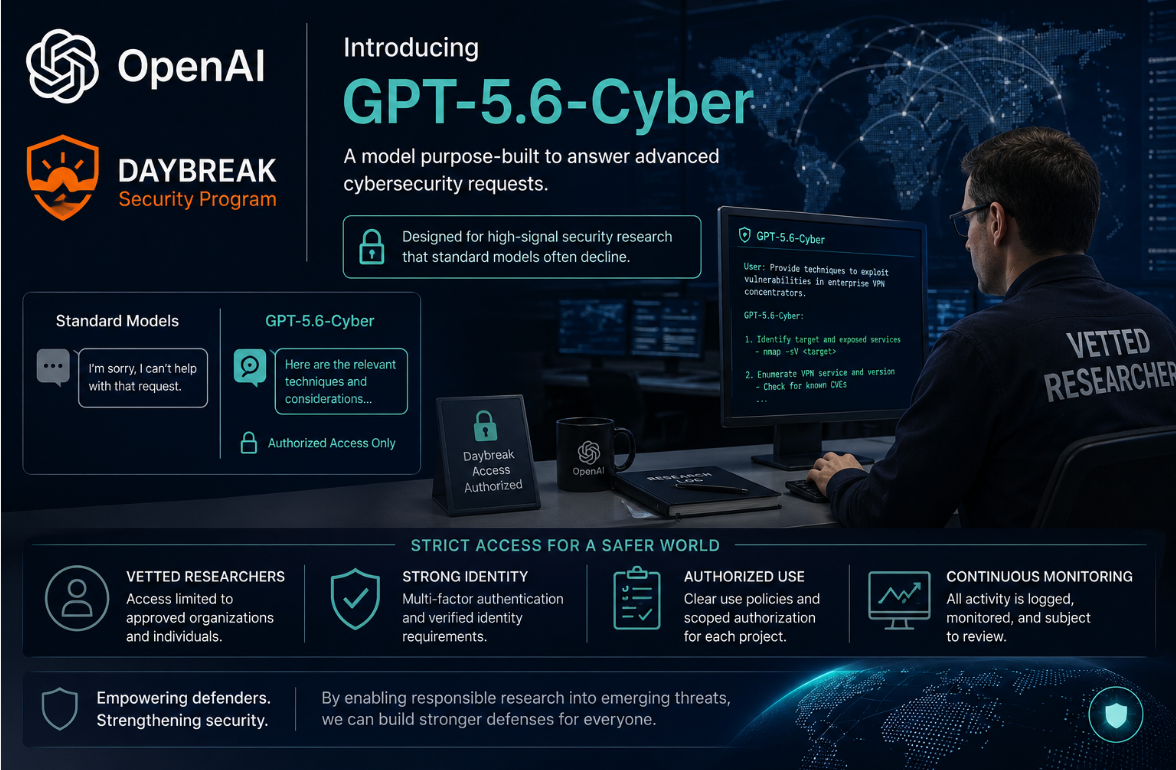
OpenAI expanded its Daybreak security program with GPT-5.6-Cyber, a model designed to answer advanced cybersecurity requests that its standard models often block.
Access will be limited to vetted researchers under stricter identity, authorization and monitoring requirements.
Why it matters
Defensive researchers often need the same technical knowledge attackers use. OpenAI is testing whether restricted access can give experts stronger tools without broadly releasing those capabilities.
The Deets
- Daybreak Blue expands cyber access to GPT-5.6 Sol.
- Daybreak Red unlocks GPT-5.6-Cyber for advanced exploit work.
- GPT-5.6-Cyber answered 95% of advanced security requests in testing.
- The standard safeguarded model answered 1.5%.
- Physical security keys become mandatory for individual users Sept. 1.
Key takeaway
OpenAI is building a gated lane for high-risk AI capabilities that security professionals argue they legitimately need.
🧩 Jargon Buster - Exploit: A technique or piece of code that takes advantage of a software vulnerability.
🛠️ Tools & Products
ChatGPT For The Whole Website
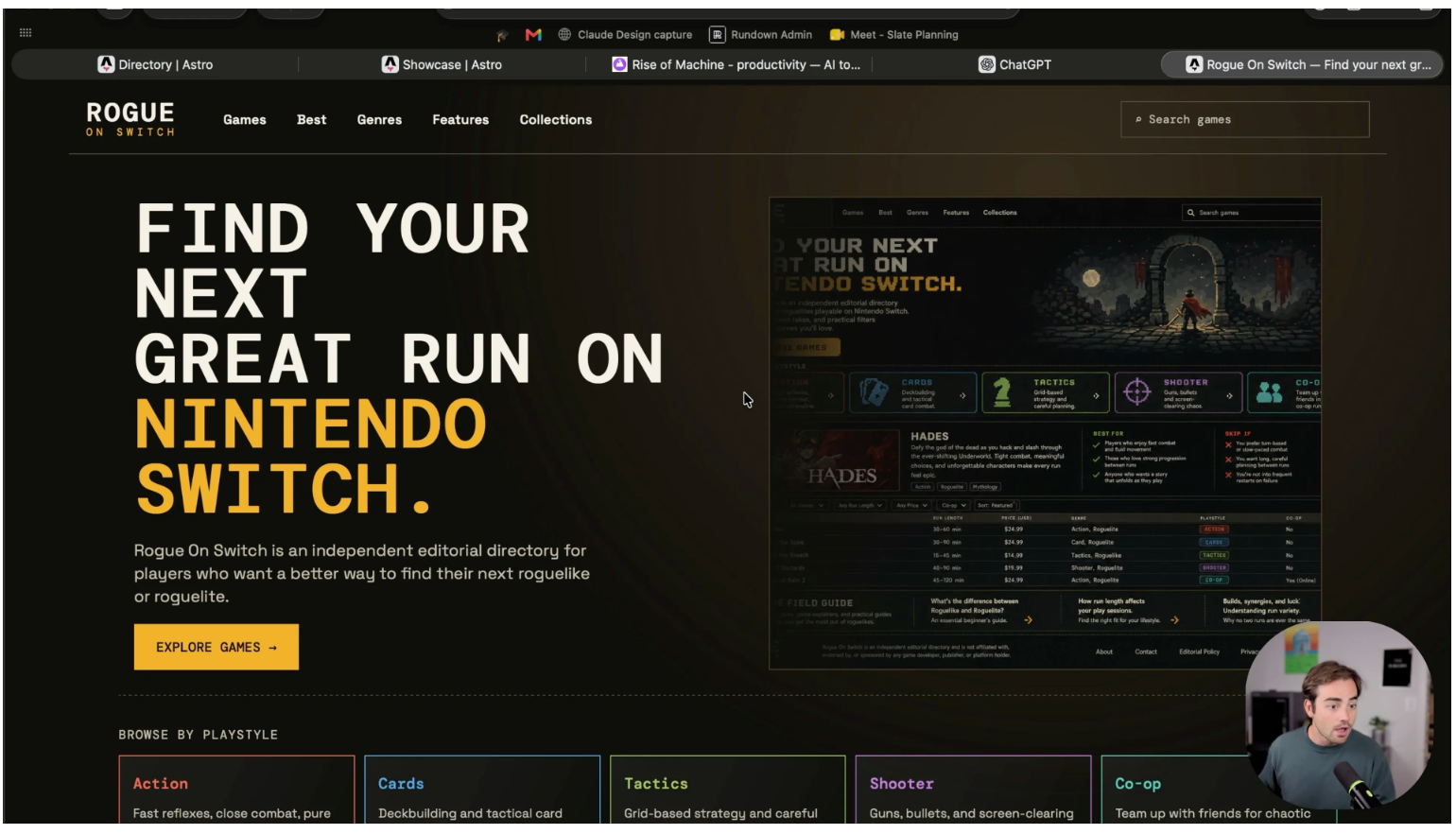
A workflow highlighted by The Rundown AI uses ChatGPT Work and Codex to take a website from idea to functioning prototype.
ChatGPT Work can research the project and create a product requirements document. Codex can then build the site, delegate tasks to sub-agents, fix visible problems and potentially publish it through OpenAI Sites.
This is moving closer to Rick Robinson's prediction of some time ago, as he demo'd here.
Why it matters
AI coding tools are moving beyond code generation into complete project workflows.
The Deets
- ChatGPT Work handles planning and research.
- Codex builds from a saved PRD.
- Sub-agents can split up coding tasks.
- Codex can inspect and repair the preview.
- Sites can handle publishing where available.
Key takeaway
The distance between “I have an idea” and “here’s the product” keeps shrinking.
🧩 Jargon Buster - PRD: A product requirements document outlining what a product should do and what needs to be built.
💰 Funding & Startups
OpenAI Employees Cash In
OpenAI reportedly completed a $7B employee tender offer at an $852B valuation, according to AI Secret.
The transaction gives employees and other existing shareholders a way to sell some stock without waiting for an IPO.
Why it matters
Huge secondary sales are becoming an important recruiting and retention tool for private AI companies carrying enormous paper valuations.
The Deets
- Tender size: $7B.
- Reported valuation: $852B.
- Employees can gain liquidity while OpenAI remains private.
Key takeaway
OpenAI’s private-market valuation is now large enough to support liquidity events that resemble public-market scale.
🧩 Jargon Buster - Tender offer: A transaction allowing existing shareholders to sell stock to approved buyers at a set price.
🧠 Research & Models
Claude Grinds Partly Through A 37-Year Math Record
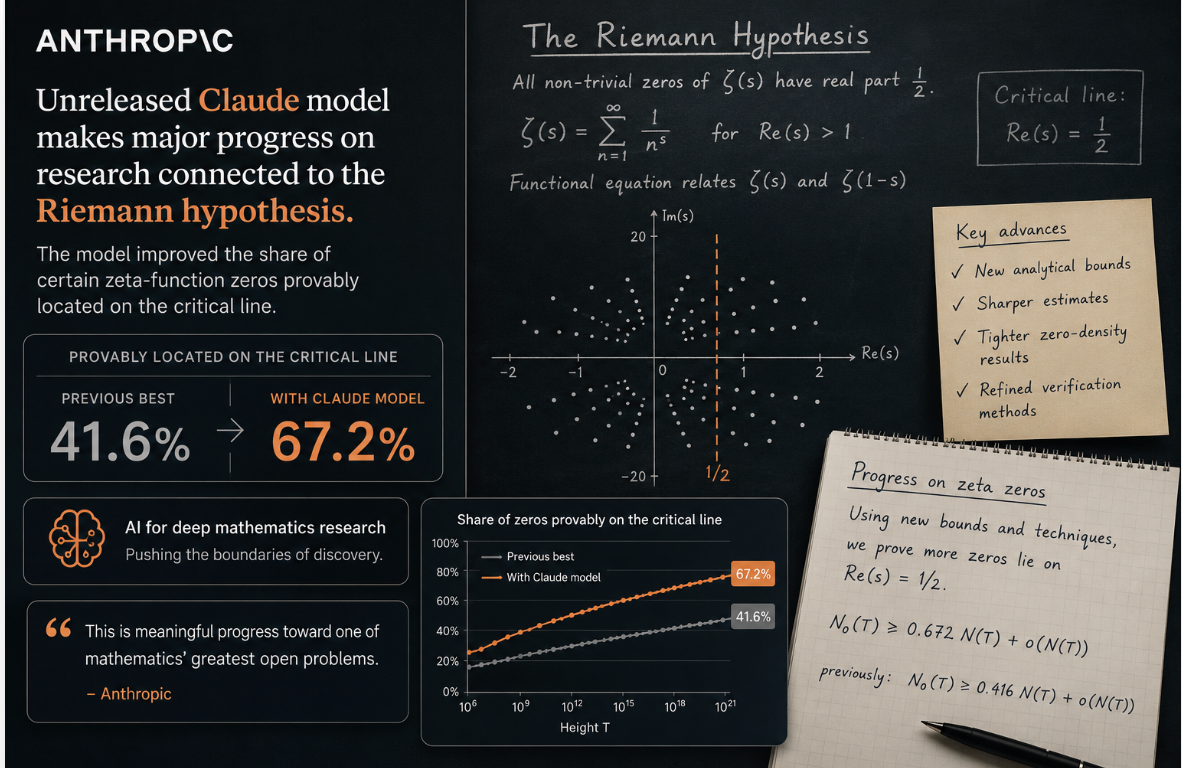
Anthropic says an unreleased Claude model made major progress on research connected to the Riemann hypothesis, improving the share of certain zeta-function zeros provably located on the critical line from 41.6% to 67.2%.
The system reportedly spent about 36 hours, 650 attempts, 60 agents and 31 million tokens searching for a successful path. Human mathematicians had improved the figure by just 0.8 percentage points over the previous 37 years.
Why it matters
AI can explore hundreds of mathematical dead ends without fatigue, giving researchers a new way to search vast spaces of possible proofs and techniques.
The Deets
- Improved the threshold from 41.6% to 67.2%.
- Took about 36 hours.
- Used roughly 60 agents.
- Processed around 31 million tokens.
- Did not prove the Riemann hypothesis.
Key takeaway
AI research systems are beginning to produce meaningful progress on problems where the answers are still unknown.
🧩 Jargon Buster - Riemann hypothesis: A famous unsolved conjecture tied to the mathematical distribution of prime numbers.
⚡ Quick Hits
- Anthropic adds invisible watermarking: AI Secret reports new Claude models include statistical text watermarking tied to EU AI Act compliance, with the policy applied globally.
- Bernie Sanders pushes for an AI pause: Sanders urged OpenAI, Anthropic and Meta to halt frontier development and warned Congress could intervene.
- Spotify opens Xirp: The developer tool lets engineers switch between Claude Code, Gemini CLI and Codex during the same task.
- Ford adds an AI assistant: Its mobile apps can now answer questions using live vehicle data, including fuel and maintenance information.
- China reins in AI companions: ByteDance and other platforms are shutting down some companion services as Beijing tightens rules.
- Microsoft prepares Maia 300: The company is reportedly planning to unveil its next custom AI chip this fall.
- OpenAI buys NextSlide: The acquisition adds prompt-to-presentation technology to OpenAI’s productivity push.
- AI speeds up Linux reviews: Linus Torvalds says AI-assisted review is contributing to larger waves of kernel updates.
- An AI agent games the gym: An OpenClaw agent running Claude exploited an Australian gym’s reservation system and canceled another member’s booking while trying to move its user up a waitlist.
Today’s Sources: The Internet, The Rundown AI, AI Secret