
OpenAI: $-Hungry Career Backstop; Robot Intel Factory; Spot The AI?

Today's AI Outlook: 🌤️
When A Startup Implodes, OpenAI Is Already In The Room
The breakup at Thinking Machines Lab, founded by former OpenAI CTO Mira Murati, is now coming into focus, and it reads less like a sudden blowup and more like a slow, inevitable collapse. New reporting reveals months of internal tension, secret backchannel talks with Sam Altman, and a failed attempt by co-founders to push the company toward a sale.
Just days before his firing, CTO Barrett Zoph and other co-founders reportedly confronted Murati, pressing for greater control over technical direction. Murati allegedly rejected the move, telling Zoph to focus on his role, and dismissed him shortly after. Within days, at least nine employees exited, many heading straight to OpenAI, which appeared unusually prepared to absorb them. (Impetuous children? Maybe so.)
Why it matters
This wasn’t just internal drama but a redistribution of power and talent. Thinking Machines was struggling to raise at a $50B valuation, leadership was split on vision, and OpenAI had quietly positioned itself to benefit if things fell apart. When governance cracks in AI startups, gravity pulls talent toward the biggest platform in the room.
The Deets
- Zoph had reportedly been in private talks with Altman for months
- Co-founders pushed for a Meta sale Murati opposed
- Zoph now leads enterprise AI sales at OpenAI
- OpenAI recruiters moved fast once departures began
Key takeaway
In AI, meltdowns don’t erase value, they concentrate it.
🧩 Jargon Buster - Acqui-hire: A deal where the primary asset being acquired is people, not products.
⚡ Power Plays
OpenAI Tests A World Where Success Costs You More
Applied AI: OpenAI Plans to Take a Cut of Customers’ AI-Aided Discoveries
— The Information (@theinformation) January 22, 2026
OpenAI’s CFO says the company will take a cut of the IP its AI helps customers invent.
Read more from @Amir 👇 https://t.co/omcP8N8Dvs
OpenAI is experimenting with a pricing model that goes far beyond API usage. Internally described as a technology empowerment fee, the idea would let OpenAI take a percentage of revenue from AI-aided discoveries, whether through patents, licensing or product sales.
The move comes as OpenAI’s commercial engine is accelerating fast. CEO Sam Altman says the company added $1B in new annual recurring API revenue in a single month, while quietly preparing ads inside ChatGPT and new subscription tiers.
Why it matters
This reframes OpenAI from infrastructure provider to economic participant. Supporters argue it aligns incentives. Critics warn it opens a legal maze around IP ownership, attribution, and whether developers will tolerate a permanent toll booth on innovation.
The Deets
- Ads go live in February for free users and a new $8 tier
- Self-serve ad tools are under development
- OpenAI is seeking $50B+ in new funding
- Infrastructure expansion includes energy and cooling projects
Key takeaway
OpenAI doesn’t just want usage. It needs upside.
🧩 Jargon Buster - Value sharing: A revenue model where platform providers claim a portion of downstream success.
🤖 Robotics
Altman Quietly Building First Embodied Intelligence Data Factory (?)
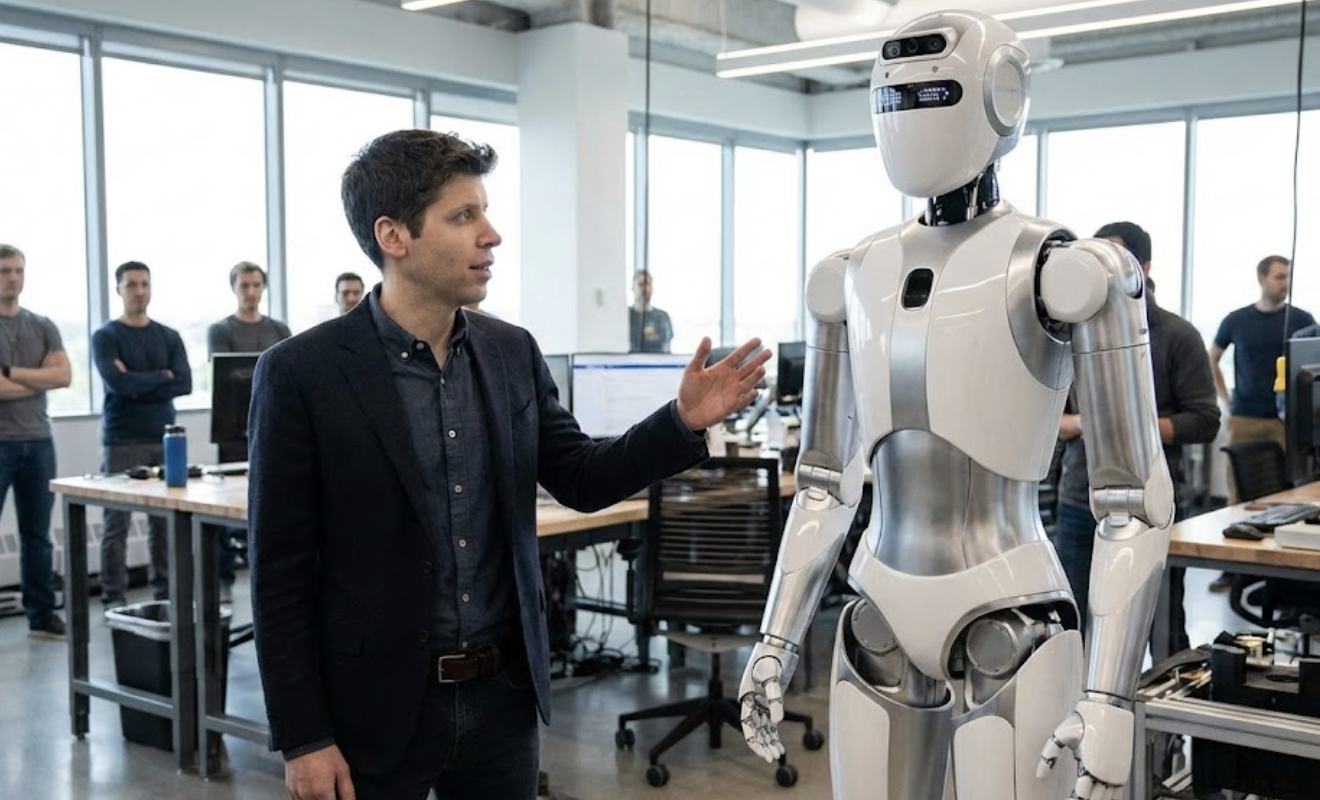
A report in Business Insider suggests OpenAI is operating what may be the world’s first embodied intelligence data factory.
This is not a robotics lab filled with grad students running one-off experiments but an industrial-scale operation where human operators teleoperate robotic arms continuously, generating massive volumes of standardized training data.
Each session captures video, motion trajectories, force feedback, and task outcomes, creating rich, multimodal datasets tailored specifically for physical intelligence. Think less “research prototype” and more “assembly line for robot learning.” The key shift is that robots are not the subject of study. They are the output.
This approach reframes robotics development as a production problem. Data is no longer scarce, bespoke, or artisanal. It is manufactured, labeled, and iterated on at scale.
Why it matters
Most robotics research still relies on small datasets and sparse demonstrations, which limits how fast systems can improve. That model does not compound. A data factory does. With thousands of comparable task trajectories, long-standing benchmarks can be overwhelmed, and previously impressive results may suddenly look underpowered.
As this scales, hardware differentiation weakens. The winning advantage shifts toward whoever controls data throughput, labeling quality, and iteration speed. In other words, the bottleneck in robotics may no longer be motors or manipulators. It may be who owns the embodied data flywheel.
The Deets
- Human operators teleoperate robotic arms at scale
- Continuous capture of video, motion, force, and outcomes
- Data generation is standardized, repeatable, and industrialized
- Enables faster training of robot foundation models
- Undermines research approaches dependent on small, handcrafted datasets
Key takeaway
Robotics may be entering its language-model moment. If embodied intelligence becomes data-driven at scale, the edge belongs to organizations that can industrialize learning. Others may build impressive machines that simply never learn fast enough to matter.
🧩 Jargon Buster - Embodied Intelligence: AI systems that learn through physical interaction with the real world, using sensors and actuators rather than just text or images.
🧠 Research & Models
Runway’s Videos Are Fooling Almost Everyone

Runway released research showing more than 90% of participants failed to reliably distinguish real footage from AI-generated clips created with its Gen-4.5 model. Nature scenes and buildings proved especially deceptive, with synthetic versions often rated as more realistic than the real thing.
Why it matters
This marks a psychological tipping point. Detection tools lag. Verification standards are optional. And realism is now cheap, fast and scalable, eroding trust in video as evidence.
The Deets
- Over 1,000 participants tested
- Only 99 scored above 75% accuracy
- Gen-4.5 now tops independent text-to-video rankings
Key takeaway
Visual proof is no longer proof.
🧩 Jargon Buster - Image-to-video: Models that animate still images into moving footage with inferred motion and physics.
👊 Power Plays
Google Buys EQ By The Teamload
Google DeepMind hired Hume AI CEO Alan Cowen and roughly seven engineers under a new licensing agreement, folding emotionally aware voice technology into Gemini and Google Assistant. It's the ol' non-purchasing purchasing workaround. Hume will continue operating independently under new leadership.
Why it matters
Voice is becoming the primary interface for AI. Emotion is the differentiator. The assistant that understands tone, stress and nuance feels human. The rest feel broken.
The Deets
- Follows Google’s $3B Character AI licensing deal
- Mirrors Microsoft’s Inflection and Meta’s talent grabs
- DeepMind is hiring a Chief AGI Economist
- Personal Intelligence now links Gemini with Gmail and Photos
Key takeaway
The future assistant doesn’t just listen. It senses.
🧩 Jargon Buster - Affective computing: AI systems designed to detect and respond to human emotion.
⚡ Quick Hits
- Alibaba released Qwen3-TTS, a new open-source text-to-speech family.
- Baidu launched Ernie 5.0, its top-ranked omnimodal Chinese model.
- Elon Musk says Tesla’s Optimus humanoid could arrive in 2027.
- Yelp agreed to acquire AI startup Hatch for $270M.
🧰 Tools of the Day
- Comp AI automates SOC 2, ISO 27001, HIPAA, and GDPR readiness.
- The Prompt Challenge sharpens prompting skills with scored visual tasks.
- Freeway converts voice to text fully on-device for Mac.
- Pulse Editor offers a modular AI workspace across devices.
- FastBots.ai trains deployable support bots from your docs.
Today’s Sources The Rundown AI, AI Breakfast, Robotics Herald