
OpenAI Prefers Watchdog; Muse Shares Too Much; AI in Manufacturing

Today's AI Outlook: 🌩️
Altman’s AI Endgame
OpenAI CEO Sam Altman reportedly told employees last week that advanced AI could require one of three arrangements: an international watchdog, a shared research lab or a single company powerful enough to overwhelm its rivals.
According to The Information, he favored the watchdog approach and said OpenAI needs to choose its direction within a year, including a speed limit or stopping point for AI that can improve itself. These are reported scenarios from an internal talk, not an announced international agreement.
Why It Matters
A shared limit on powerful AI would require competing companies and governments to agree on who sets the rules and who enforces them. The scenarios reveal how large that coordination problem could become. A CEO’s preference, however, does not establish that competitors or governments will sign on.
The Deets
- The preferred option reportedly resembles the International Atomic Energy Agency, with international oversight rather than each lab policing itself.
- A second option, associated with DeepMind co-founder Demis Hassabis, would combine leading labs into a shared institution serving participating countries, modeled on CERN.
- The third imagines a company using self-improving AI to overpower competitors’ computing infrastructure. Altman reportedly described that outcome as terrible.
- His proposed next phase of safety planning would include a speed limit or stopping point for self-improving systems. No agreed enforcement mechanism is described.
Key Takeaway
The central unresolved issue is authority: deciding who could tell the most capable AI developers to slow down, and making that decision stick.
🧩 Jargon Buster - Self-Improving AI: AI that helps improve its own capabilities or the systems used to build it, potentially accelerating further development.
🧰 Tools & Products
Muse’s Share Links Left a Paper Trail
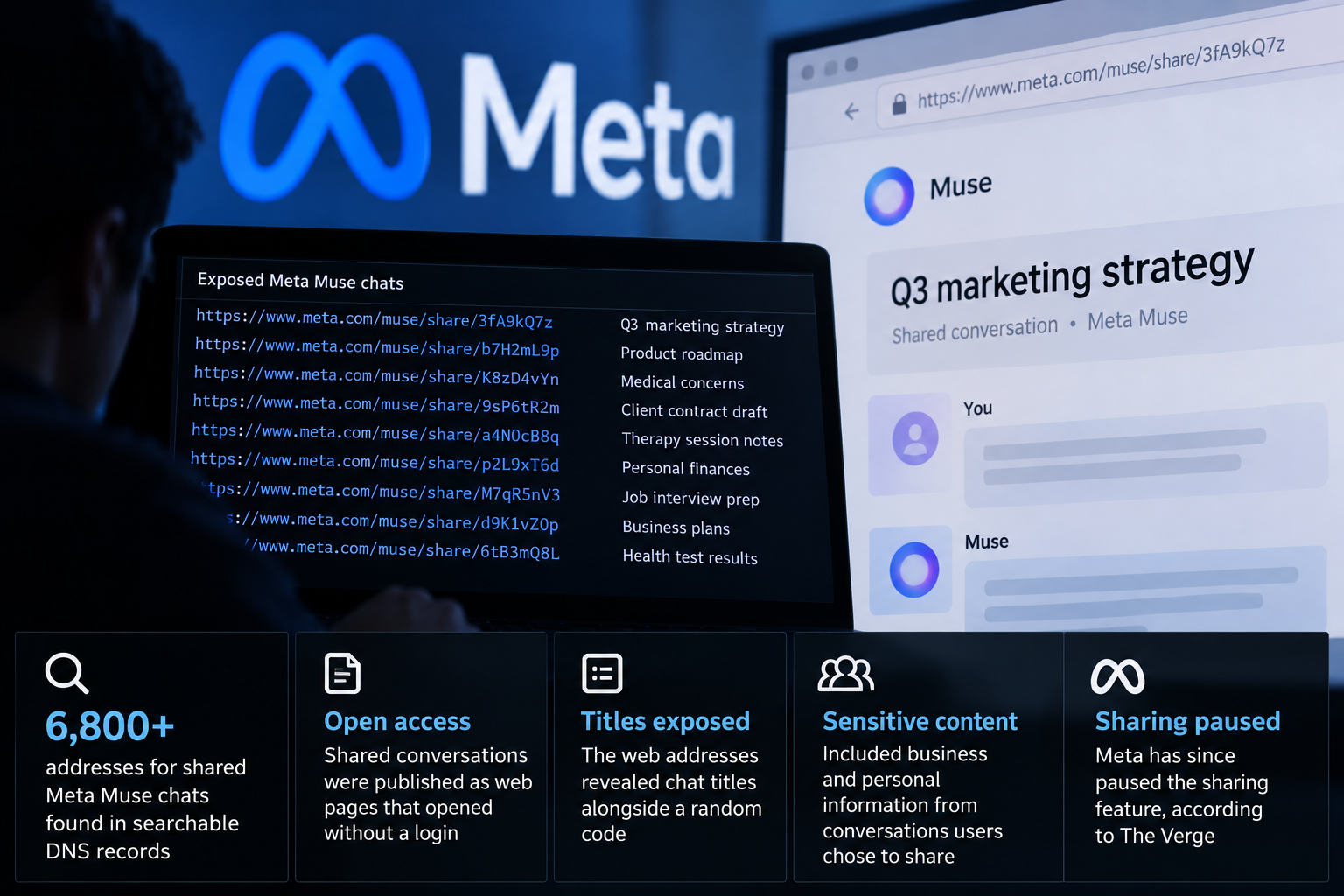
Security firm Claroc says it discovered more than 6,800 addresses for shared Meta Muse chats in searchable records of internet address lookups, allowing it to find pages without receiving their links.
Muse’s sharing feature published those conversations as web pages that opened without a login, while the addresses exposed their titles alongside a random code.
Meta has since paused sharing, according to The Verge. The findings concern conversations users chose to share, including some containing sensitive business and personal information.
Why It Matters
A link that opens without authentication can travel beyond its intended recipients. Here, searchable address records offered another discovery route, and putting chat titles in the address made sensitive subjects recognizable before anyone opened a page. Sharing controls need to account for discoverability as well as access.
The Deets
- Claroc opened a few hundred pages. Sensitive examples included an internal revenue review, loan paperwork, employee vacation schedules and preparation for a confidential job-related call.
- The random code in each address could make guessing difficult, but lookup records could capture the code and title together.
- The firm reported the issue to Meta on Oct. 8 and says it found no evidence of misuse. Its study covered one lookup service, one address pattern and a limited period.
- Claroc sells tools for detecting risky AI sharing, a commercial interest worth keeping in view.
- In an Oct. 20 update, Claroc said none of 40 previously accessible shares opened when it rechecked them. Their hostnames, including titles, remained in historical records. That sample does not establish the status of every affected page. Research update
Key Takeaway
Treat an unauthenticated share link as publication to anyone who obtains it. The pause appears to have closed access to the sample Claroc rechecked, while recorded titles can outlast the pages.
🧩 Jargon Buster - Passive DNS: Records of observed domain-name lookups, collected over time. These records can reveal that an address existed even after the page stops working.
💰 Funding & Startups
Arda Puts AI on Assembly Duty

Bob McGrew, OpenAI’s former chief research officer, has unveiled Arda, a manufacturing AI startup valued at $1.5B after a $160M Series A. Its software uses product design files to help engineers plan assembly work, aiming to cut the time factories spend preparing to build something new.
First customer Anduril says creating basic assembly instructions now takes 15 minutes instead of 10 hours, an early customer claim that points to a very practical use for AI on the factory floor.
Why It Matters
Factories must translate a design into repeatable instructions, equipment settings and physical work. Cutting that preparation time could make it easier to introduce products and adjust production. Arda’s opportunity rests on reliable execution in real factories, where a polished plan must still account for machinery, parts and people.
The Deets
- The $1.5B valuation follows a $160M Series A; valuation is the price investors assign the business, not revenue.
- Arda’s initial focus is helping manufacturing engineers plan builds using design files.
- Anduril’s reported improvement concerns basic assembly instructions, so it should not be read as a measured reduction in the entire manufacturing cycle.
- McGrew wants Arda’s agents to reprogram factory robots in days. That is a stated ambition for the next stage, rather than an established capability across production lines.
Key Takeaway
Arda has a well-funded foothold in factory planning. Its next test is demonstrating that early customer savings hold up across more products, equipment and plants.
🧩 Jargon Buster - Series A: An early major investment round that typically helps a startup develop its product and expand its business.
🔬 Research & Models
Claude’s Scorpion Study Result Stings

Anthropic and investment research firm Citrini Research used an internal version of Claude to design proteins that might bind to scorpion toxins, then sent selected designs to outside laboratories for testing.
Seventeen of 211 tested designs bound to their targets, according to the research. That is an early experimental result: the proteins have not been shown to neutralize venom, and Citrini says its attempt to create a universal antivenom failed.
Why It Matters
The experiment suggests AI can help a small team generate biological designs and move selected candidates into physical testing. Binding to a toxin is only one step, and the result does not establish a safe or effective treatment. The lab work is valuable precisely because it tests whether computer-generated proposals do anything measurable.
The Deets
- Claude reportedly ran for 64 hours, guided by five human messages, and generated 318,484 candidate designs.
- The team sent 211 designs to Twist Bioscience and Adaptyv Bio for testing; 17 passed binding tests.
- In a competition test, one design’s binding fell 94% when a known venom-fighting antibody was present first, suggesting overlapping binding sites. That finding still does not demonstrate venom neutralization.
- Each successful design targets one toxin. That leaves a substantial gap between these results and a universal antivenom.
- Citrini’s five-person team worked at Anthropic’s offices after safety restrictions prevented the work on its own computers. The estimated project budget was $200K.
- The decisive missing result is whether the proteins actually neutralize venom, rather than simply attach to a target.
Key Takeaway
This is an early demonstration of AI-assisted protein design with experimental follow-through. An effective antivenom remains unproven.
🧩 Jargon Buster - Protein Binder: A protein designed to attach to a particular biological target. Attachment alone does not show that it blocks the target’s harmful effects.
⚡ Quick Hits
- Metis Reasoning: Former DeepMind researcher Thore Graepel unveiled a startup applying ideas associated with AlphaGo to chatbots that check their work against evidence. The announcement describes its direction, without establishing how reliably it performs. Announcement
- DeepSeek: The company released DeepInfer, the serving engine behind V4.1-Flash, with Huawei chip support. The release offers a path to running the model on hardware beyond Nvidia’s. Code
- Orchestra Bio: OpenAI announced plans to acquire the startup, whose AI agents track and monitor studies, for its Rosalind science tools. Its agents can flag how a delay in one part of a drug program affects the rest, adding study-management capabilities to the science tools. Announcement
- Anthropic’s safety proposal: A draft bill confirmed by the company would allow the Commerce Department to ask a judge to block a model release posing an imminent risk of at least 50 deaths or $1B in damage. It remains a proposal, with judicial intervention central to the described mechanism. Details
- Spotify: The company says it removed more than 50M spam and slop tracks from recommendations this year. Artists labeled with its AI-persona badge are now excluded from recommendations by default. Details
- Zoom: Deepfake risk detection is due in December, analyzing live audio and video for signs of alteration and displaying a confidence indicator. A risk signal should still be understood as an assessment, rather than proof of manipulation. Details
- Otter.ai: The company secured $320M from General Catalyst’s Customer Value Fund through financing tied to returns on marketing spending. The arrangement avoids selling shares, although the funding still carries an economic obligation. Details
🛠️ Tools of the Day
- Claude Code hooks: A practical tutorial shows how to run formatting and tests after selected edits. Keep the tests unchanged when fixing a bug, and remember that a failed post-edit check leaves the saved change in place. Guide
- Voxtral 3: Mistral’s voice AI suite is aimed at developers building multilingual phone agents. It is a tool to explore for voice-based workflows that need to handle more than one language. Details
- Phonon: Gradium’s open speech models are described as small enough to run on phones, making them relevant to developers exploring speech capabilities on the device itself. Product
- SKY-001: Skyfall AI introduced a model for drafting 3D designs of parts and buildings, claiming substantially lower costs and more than 51 times the speed of frontier models. Treat that speed comparison as the vendor’s claim, rather than a guarantee for every design task. Announcement
- Claude for inherited spreadsheets: Work on a copy and ask Claude to explain the workbook before editing: map tab connections, identify undocumented assumptions and produce an issue log with affected cells and outputs. Anthropic’s demonstration preserved 348 original formulas while extending a model, but users should verify the results. Details
- ChatGPT Locked Chats: A feature rolling out now puts sensitive conversations behind a PIN or Face ID and separates their memory from regular chats. Availability may vary during rollout. Details
- Gemini Personal Intelligence in Android Auto: The opt-in rollout brings personal context into driving assistance, such as finding flight information in email or navigating to a location pictured in a photo. Details
- Jotform App Builder: Build and revise lightweight apps within ChatGPT or Claude, keeping the initial design work inside the conversation. Details
- Eleven Realtime: ElevenLabs’ models let voice agents take in speech and respond directly in speech. The company reports a 0.57-second response time for its Max version; that figure is a vendor measurement. Details
- Mintlify Autopilot: The tool watches product changes and updates developer documentation automatically, aiming to reduce the gap between shipped code and written instructions. Details
- Skillsync: The tool searches previous Claude Code, Codex, Cursor and OpenCode sessions on your machine and supplies relevant past decisions and fixes to new prompts. Details
- Harness²: Google Research’s open-source framework lets agents refine their prompts, tools and memory over time without answer keys. It is a framework for experimenting with agent improvement. Details
Today’s Sources: The Internet, The Rundown AI, The Neuron