
OpenAI Profitability Debate; Orchestration v Scaling; Fuzzy Robots Sell Out

Today's AI forecast: 🌥️
DeepSeek Math V2 Breaks the Frontier Monopoly
DeepSeek released DeepSeek-Math-V2, an open-source MoE model that just hit gold-medal performance on IMO 2025, solved 5 of 6 problems, and scored 118/120 on the 2024 Putnam, beating top humans. It also crushed GPT-5 on IMO ProofBench and nearly matched Google’s proprietary Gemini Deep Think.
The secret is a generator-verifier system: one model proposes a proof, the other critiques every step with confidence scores, forcing refinement.
Why it matters
This is research-grade mathematical reasoning, open to the public. It widens access to verifiable, self-debugging logic - exactly what’s needed in engineering, safety-critical systems, and agentic workflows.
The Deets
- 61.9% on IMO ProofBench
- Generator receives step-by-step critique, not just output scoring
- Promotes disciplined reasoning over “lucky final answers”
Key takeaway
Open-source models can now reason at the elite level—and teach themselves how to think.
🧩 Jargon Buster: Generator-Verifier Loop - A system where one model proposes reasoning and a second checks each step for correctness.
More: The Rundown AI
⚔️ Power Plays
OpenAI vs HSBC: The $207B Profitability Showdown

Sam Altman is telling investors OpenAI will turn cash-flow positive by 2029. HSBC says: absolutely not. Their projection shows a $207B shortfall by 2030, calling OpenAI “a money pit with a website on top.”
Why it matters
This is a clash of worldviews.
- Altman: more GPUs create exponential demand.
- HSBC: compute bills scale linearly and debt markets have limits.
The Deets
- Altman frames compute as an acceleration engine
- HSBC treats it like a utility meter
- Both use similar growth inputs with wildly different outcomes
Key takeaway
Altman is betting on curves. HSBC is betting on math.
🧩 Jargon Buster: Amortization - Spreading major costs (like GPU clusters) over time instead of paying them all upfront.
More: AI Secret
China’s AI Giants Train Abroad To Reach the Markets They Can’t Enter
Alibaba and ByteDance are training their frontier models in Southeast Asian data centers to access Nvidia GPUs and get closer to the U.S. market without entering it.
Why it matters
This is globalization disguised as evasion—aligning with Western infrastructure to better target Western enterprise buyers.
Key takeaway
If you can’t cross the border, build your model right next to it.
🧩 Jargon Buster: Export Curbs - Restrictions preventing countries (like China) from acquiring certain chips.
More: AI Secret
🛠️ Tools & Products
Nano Banana Pro Turns One Photo Into a Full Instagram Feed
Nano Banana Pro can generate a 9-image, aesthetic-consistent Instagram grid from one inspiration photo and a product image - Rundown University shows how.
Why it matters
Brands don’t need photographers for every angle or environment - they need one good reference and a model that knows vibes.
The Deets
- Upload inspiration + product
- Use Pro mode in Gemini
- Ask for a 9-image feed with varied settings
- Regenerate or isolate shots as needed
Key takeaway
It’s now possible to batch-produce “studio-quality” feeds from your couch.
🧩 Jargon Buster: Aesthetic Alignment - How closely a generated image sticks to a desired visual style.
More: The Rundown AI
🧬 Research & Models
NVIDIA Says the Future Is Orchestration, Not Scaling
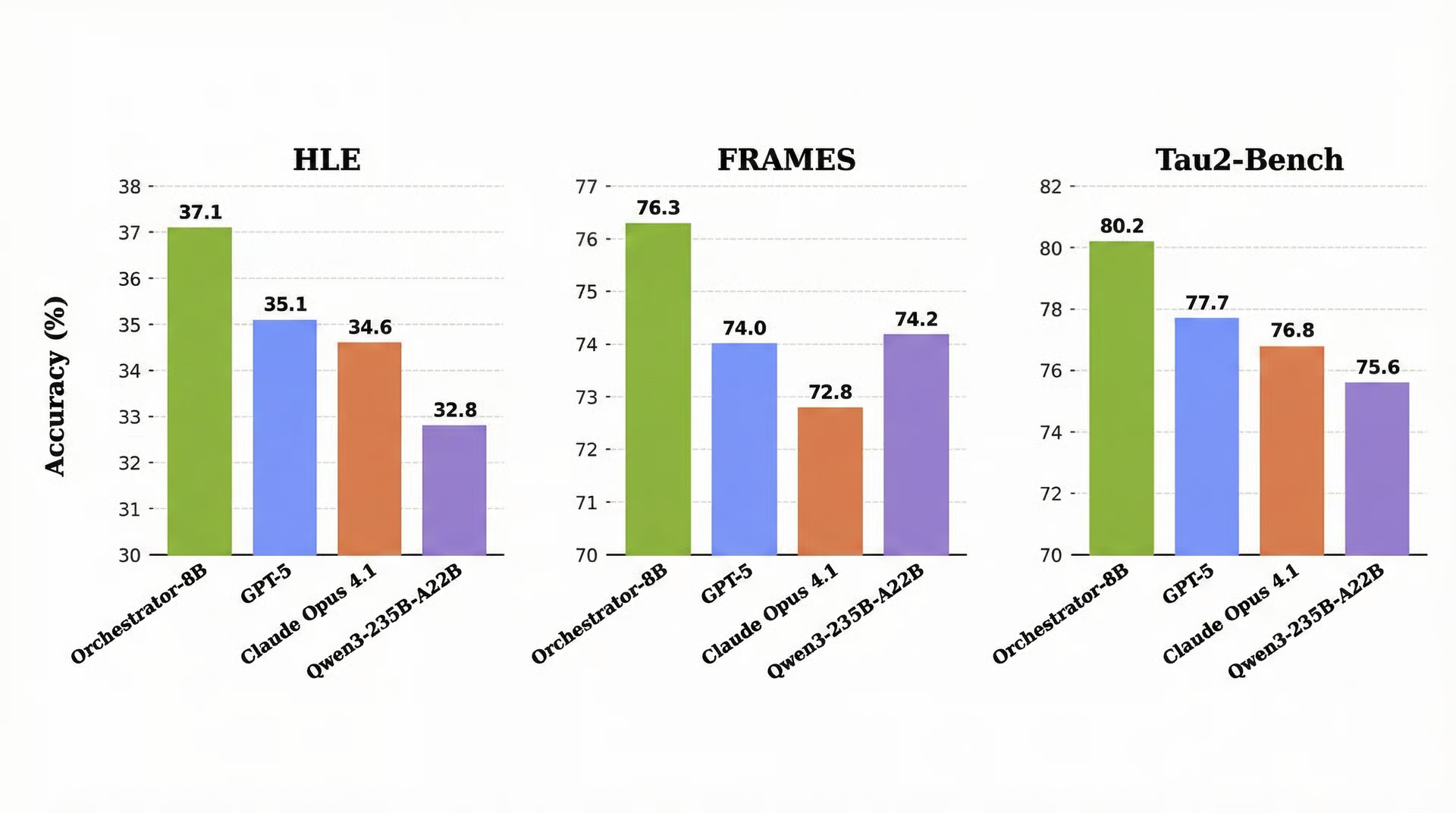
NVIDIA partnered with HKU to release ToolOrchestra, training small models to decide when to think and when to call external tools.
Why it matters
An 8B model using orchestration outperformed GPT-5 and Claude Opus 4.1 on Humanity’s Last Exam while being faster and 2.5x more efficient.
The Deets
- Orchestrator chooses between internal reasoning and external tools
- Handles unseen tools surprisingly well
- Avoids the costly “always call the biggest model” anti-pattern
Key takeaway
The winning model might be small - but very good at delegating.
🧩 Jargon Buster: Orchestrator - A model that decides which tool or model should handle each step of a task.
More: The Rundown AI
xAI’s Grok 5 Pushes Toward Autonomous Pixel-Level AI
Let’s see if @Grok 5 can beat the best human team @LeagueOfLegends in 2026 with these important constraints:
— Elon Musk (@elonmusk) November 25, 2025
1. Can only look at the monitor with a camera, seeing no more than what a person with 20/20 vision would see.
2. Reaction latency and click rate no faster than human.…
xAI unveiled a system that reads raw video of a computer interface, not APIs, and still operates within 150ms - clicking, typing and navigating like a human.
Why it matters
This could generalize across every computer interface without custom integrations, effectively turning Grok into a universal operator.
Key takeaway
API-free agents aren’t science fiction anymore—they’re screen-watching interns with superhuman reaction times.
🧩 Jargon Buster: Pixel-Driven AI - Models that understand and act directly from visual input instead of APIs.
More: AI Breakfast
Karpathy’s LLM Council: The Multi-Model Debate Era Begins
As a fun Saturday vibe code project and following up on this tweet earlier, I hacked up an **llm-council** web app. It looks exactly like ChatGPT except each user query is 1) dispatched to multiple models on your council using OpenRouter, e.g. currently:
— Andrej Karpathy (@karpathy) November 22, 2025
"openai/gpt-5.1",… https://t.co/gKvRibPLVe pic.twitter.com/yljZu0Vr8n
Andrej Karpathy, former Tesla AI and OpenAI leader, released LLM Council, a lightweight orchestration layer where multiple frontier models debate and synthesize answers under a “Chairman.”
Why it matters
Models are becoming modular and swappable; the moat is shifting to orchestration, governance and observability.
Key takeaway
The future of AI might look less like “one model to rule them all” and more like a panel of experts arguing toward the truth.
🧩 Jargon Buster: Governance Layer - Systems ensuring agents behave safely, consistently, and audibly across decisions.
More: AI Breakfast
🤖 Robotics
Huawei Teams With Fuzozo After 50,000 Emotional Robots Sell Out

Startup Fuzozo sold 50,000+ Fuzai emotional companion robots in 3 months. Huawei immediately partnered to launch the nearly identical “Smart Hanhan,” blending Huawei’s Xiaoyi model with Fuzozo’s emotional engine.
Why it matters
Huawei gets human emotion data at scale. Fuzozo gets manufacturing muscle.
Key takeaway
Fuzozo sold feelings; Huawei bought the data rights.
🧩 Jargon Buster: Emotional Robotics - Robots designed to respond to and simulate human emotional cues.
More: Robotics Herald
Infineon & HTEC Give Robots a Reflex-Driven 360° AI Head

A new humanoid “Awareness Head” uses radar, depth sensors and microphones to decide what to pay attention to - not just record it.
Why it matters
It shifts intelligence into the head itself, creating real-time spatial intuition that cuts latency and makes robots more autonomous.
Key takeaway
Robots finally have a head that reacts first and explains later.
🧩 Jargon Buster: Sensor Fusion - Combining multiple sensor inputs to create a unified understanding of the environment.
More: Robotics Herald
CMU Teaches Robot Dogs To Feel Weight Shifts
A Unitree Go1 was outfitted with LocoTouch, enabling it to feel object movement on its back and adjust balance—carrying a rolling cylinder 60 meters across uneven terrain.
Why it matters
This is the proprioception layer that turns robot dogs from gimmicks into real field workers.
Key takeaway
Once a robot feels weight shift, it becomes a coworker, not a gadget.
🧩 Jargon Buster: Proprioception - a system’s awareness of its own body position, movement, and balance.
More: Robotics Herald
⚡ Quick Hits
- Perplexity launches AI virtual try-on for shopping
- DeepSeek OCR early impressions suggest massive training throughput
- Google limits free access to Gemini 3 Pro, reduces Nano Banana Pro features
- Amazon employees warn aggressive AI expansion threatens jobs and climate
- NotebookLM adds Deep Research and new file types
- Nvidia stops bundling VRAM with GPUs due to memory crunch
- MIT says AI can already handle millions of U.S. jobs
- Slop Evader browser extension blocks AI-generated content pre-2022
- Tencent shrinks OCR into a 1B-parameter VLM
- Humanoid robots showrooms launch in Riyadh with 10,000-unit preorder
🧵 Tools of the Day
- TRAE – price-competitive coding agent
- KaraVideo – unified interface for all AI video models
- Heardly – speed-reading best books with AI
- Momen AI – “vibe to viability” no-code builder
- Open Deep Research – automated research reports via multi-agent workflows
- Better Agents – CLI that standardizes agent building best practices
- Compounding Engineering Plugin – Claude plugin for cumulative workflow acceleration
- InsightTube – AI-powered learning from videos
- Links v2.0 – privacy-first link manager with iCloud sync
- NoSho – auto-fill last-minute business availability
Today’s Sources - The Rundown AI, AI Secret, AI Breakfast, TLDR AI, Robotics Herald