
OpenAI Strikes Back: 5.2, Disney Deals; Stable Robots

Today's AI forecast: 🌤️
Disney Hands OpenAI the Keys to the Kingdom
Disney just crossed a line no other legacy media giant has dared to cross this cleanly. The company signed a three-year licensing deal with OpenAI and took a $1B equity stake, officially allowing OpenAI’s Sora users to generate videos using more than 200 Disney-owned characters across Disney, Marvel, Pixar, and Star Wars. Mickey, Vader, and the Avengers are now legally usable inside an AI video model, with select fan creations even streaming on Disney+.
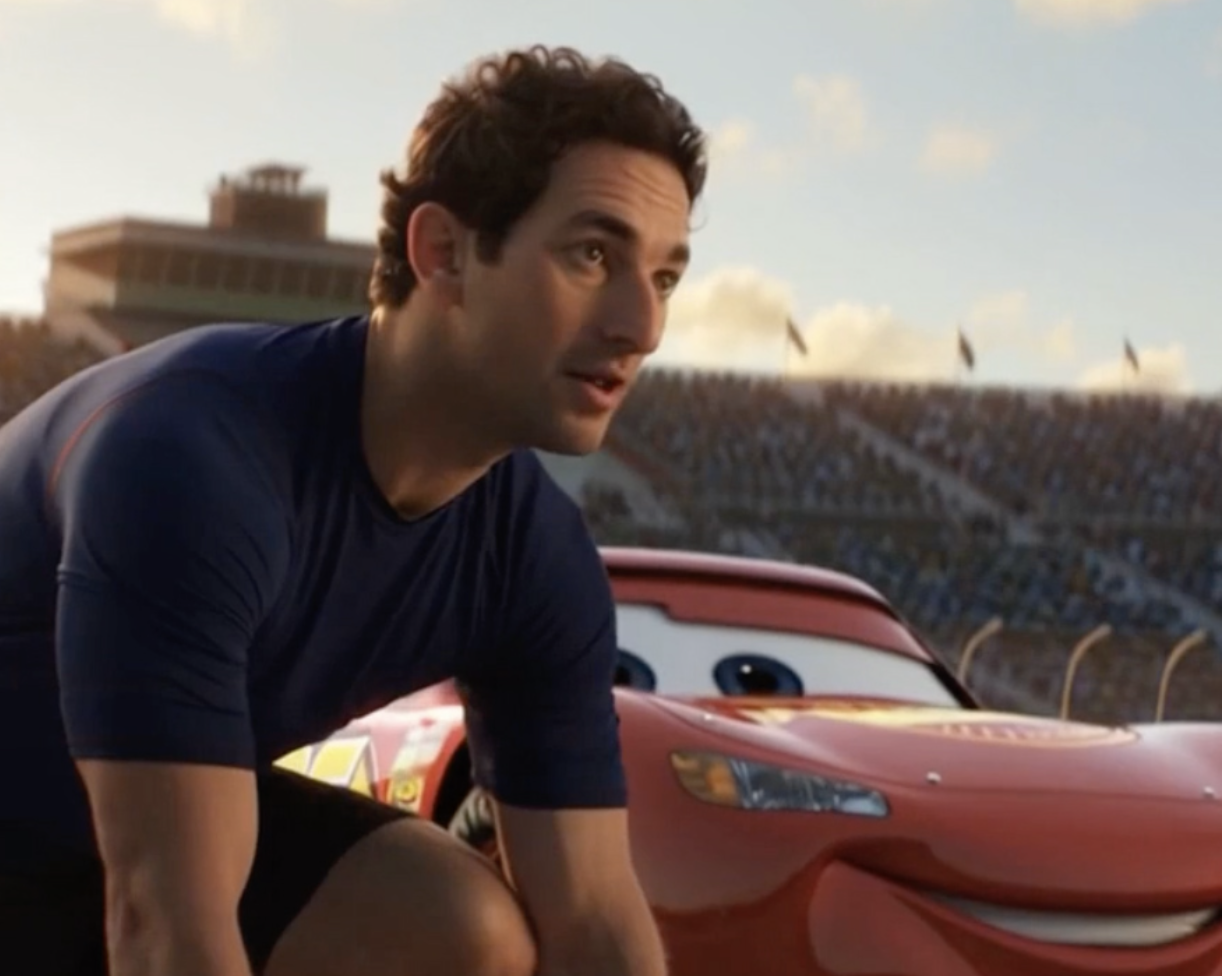
Behind the scenes, Disney is also rolling out ChatGPT internally, integrating OpenAI APIs across its products, and making AI part of its enterprise backbone. At the same time, Disney sent a cease-and-desist to Google, accusing it of generating unauthorized Disney IP at “massive scale.” The message was unmistakable: license with us, or lawyer up.
Notably, the deal excludes talent likenesses and voices, neatly sidestepping the thorniest Hollywood labor battles while still unlocking massive IP value.
Why it matters
CEO Bob Iger hinted AI was coming to Disney+. This move goes much further. Disney is not fighting generative AI anymore; it is choosing sides. For OpenAI, the payoff is enormous. It gains exclusive access to the most valuable fictional universe on Earth, while competitors face tighter enforcement and fewer safe IP options.
This deal reshapes the IP landscape. AI companies are learning that permission scales faster than litigation.
The Deets
- $1B equity investment into OpenAI
- Three-year licensing agreement
- 200+ characters available in Sora
- Select AI creations streaming on Disney+
- Google hit with a cease-and-desist the same day
Key takeaway
Disney just turned AI from an existential threat into a licensed distribution channel.
🧩 Jargon Buster - Licensing deal: A legal agreement that grants explicit permission to use intellectual property, usually in exchange for money or equity, instead of gambling on fair use.
Source: The Rundown AI
⚔️ Power Plays
OpenAI Drops GPT-5.2 and Strikes Back at Gemini
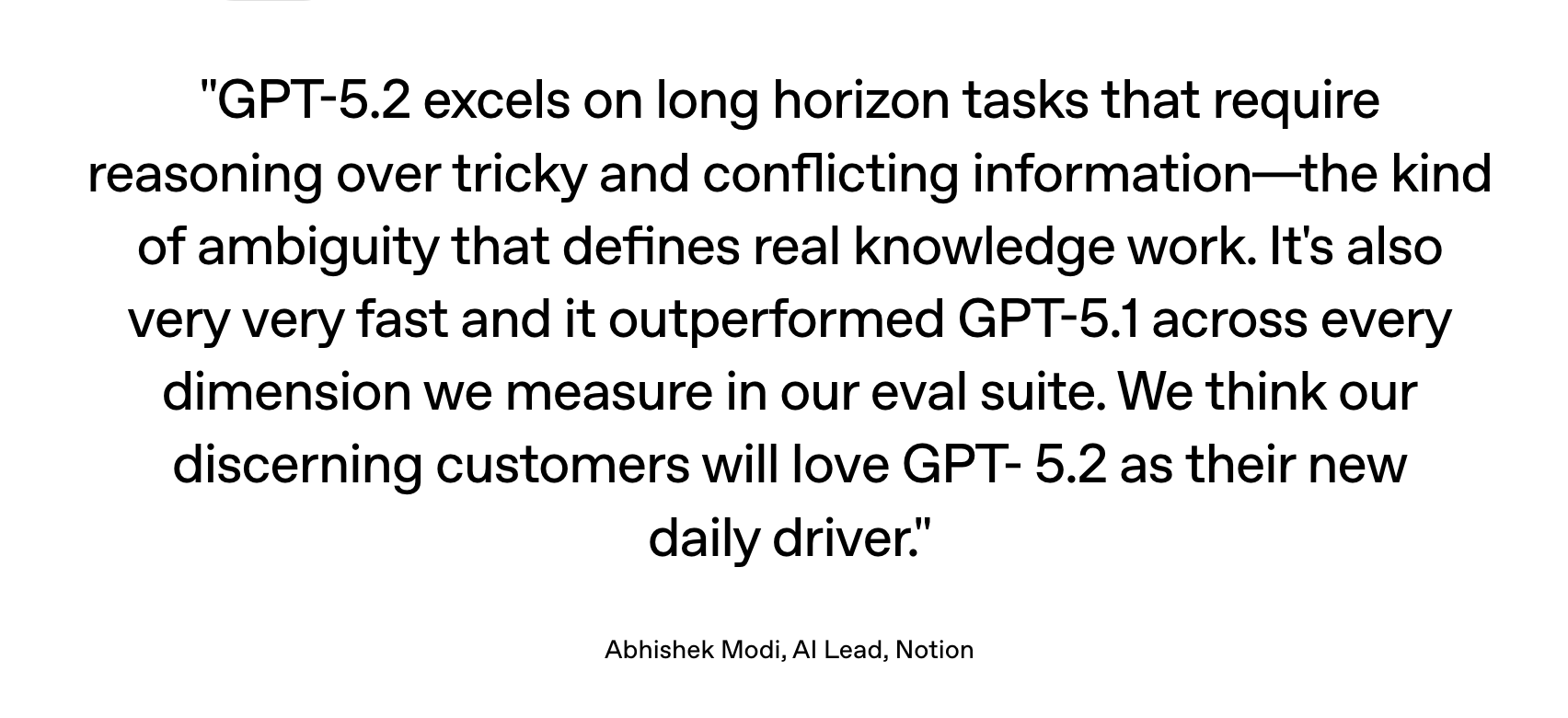
OpenAI released GPT-5.2, its newest flagship model family, calling it the company’s most capable system yet for professional knowledge work. The launch comes just weeks after internal chatter suggested OpenAI was losing ground to Google’s Gemini 3, which had briefly topped public leaderboards.
GPT-5.2 ships in three tiers: Instant, Thinking, and Pro, targeting everything from quick queries to complex, high-stakes reasoning. Across benchmarks, it improves on hallucinations, coding, vision, long-context reasoning, and tool use. On GDPval, a benchmark built from real-world professional tasks, GPT-5.2’s Thinking tier matched or beat industry experts 71% of the time, up from 39% with GPT-5.
Multiple reports suggest OpenAI pushed the release despite internal requests to delay for more polish. The codename says it all: “Garlic.” This was a defensive launch, and a loud one.
Why it matters
The real signal is not leaderboard bragging. It is who the model is being compared against. GPT-5.2 is no longer framed as junior-level automation. It is positioned as expert-grade output for contracts, audits, analysis, and planning. That quietly turns “productivity tool” into “organizational rewrite.”
The Deets
- Three tiers: Instant, Thinking, Pro
- 71% expert-level parity on GDPval
- Released amid Gemini 3 pressure
- Improved hallucination and tool use metrics
Key takeaway
The race is no longer about beating other models. It is about beating professionals.
🧩 Jargon Buster - GDPval: A benchmark evaluating AI performance on realistic tasks across major economic sectors, rather than synthetic test questions.
Source: The Rundown AI, AI Secret
🧠 Research & Models
Google Opens Its Deep Research Agent to Developers
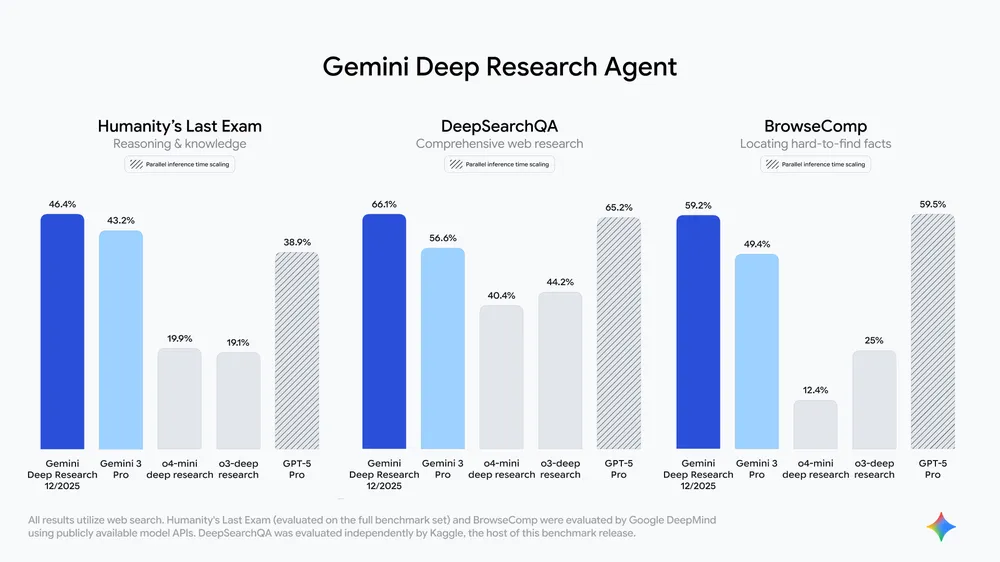
Google released an upgraded Deep Research agent, now available to developers through a new Interactions API, with consumer rollouts coming to Search, NotebookLM, and the Gemini app. Powered by Gemini 3 Pro, the agent plans searches, reads results, identifies gaps, and loops until it reaches an answer.
Google also open-sourced DeepSearchQA, a 900-task benchmark designed to stress-test multi-step web research. The company claims state-of-the-art scores, including 46.4% on Humanity’s Last Exam and 66.1% on DeepSearchQA, outperforming its own base Gemini 3 Pro model.
Why it matters
Deep research agents are becoming table stakes. Google’s edge is distribution and tooling. By opening this agent to developers, it turns a first-party research feature into a platform primitive that can live inside third-party apps.
The Deets
- New Interactions API for devs
- Native MCP support for external tools
- Open-sourced DeepSearchQA benchmark
- Consumer rollout coming soon
Key takeaway
Research is shifting from search results to autonomous synthesis loops.
🧩 Jargon Buster - MCP: Model Context Protocol, a standard for connecting AI models to external tools and data sources.
Source: The Rundown AI
🤖 Tools & Products
Voice Agents Go From Demo to Deployment
Cartesia published a step-by-step guide showing how businesses can build and deploy AI voice agents that handle calls, take orders, and answer customer questions using natural speech. Users can spin up an agent, assign a voice, test it via phone, and promote it to production with real performance metrics.
Why it matters
Voice agents are moving out of novelty territory. With low latency and production phone numbers, they are starting to replace basic call center workflows.
The Deets
- Sonic 3.0 voices for low latency
- Text-to-Agent workflow
- Live phone testing and metrics
- Production-ready deployment
Key takeaway
If your business still treats calls as human-only, that assumption is expiring fast.
🧩 Jargon Buster - Voice agent: An AI system that can hold spoken conversations in real time over phone or voice interfaces.
Source: The Rundown AI
🦾 Humanoids & Bots
Oli Shows Rare Humanoid Stability on Real Terrain
LimX Dynamics released new footage of its full-size humanoid robot Oli calmly walking across sand, loose gravel, flexing planks, and scattered rubble without safety tethers. The robot maintains continuous balance with no stop-start corrections, relying on a 31-joint control stack, dual depth cameras, and a dedicated motion tracking unit.
LimX is positioning Oli as an open development platform, offering a modular SDK and simulation support rather than a closed commercial product. The footage emphasizes sustained locomotion, not a staged or choreographed demo.
Why it matters
Stable walking on deformable terrain is the hardest unsolved problem in humanoid robotics. Many robots can walk on flat floors. Very few can handle shifting sand or rubble without falling. These environments expose weak control logic instantly. Oli’s performance stands out because it shows continuous stability, not a lucky sequence of steps.
The Deets
- Full-size humanoid robot
- 31-joint control system
- Dual depth cameras and motion tracking
- No tethers or safety rigs
- Open SDK and simulation support
Key takeaway
If a humanoid can treat rubble like normal ground, it becomes deployable outside the lab.
🧩 Jargon Buster - Deformable terrain: Surfaces like sand, gravel, or loose debris that shift under load and are difficult for robots to balance on.
Source: Robotics Herald
Vine Robot Solves What Grippers Won’t
Engineers from MIT and Stanford developed a soft robotic system inspired by garden vines that grows around objects instead of squeezing them. These inflatable robotic tendrils extend, twist, wrap, and lock into closed loops that can cradle items ranging from fragile glassware to the human body.
In medical use cases, the robot can slide under a patient in bed, reconnect to its base, and lift them using a winch, functioning like a pneumatic hammock. Smaller versions can mount onto robot arms for cluttered pick-and-place tasks.
Why it matters
Traditional grippers face a tradeoff between strength and delicacy. This design bypasses that problem by relying on geometry instead of force. By enveloping objects rather than gripping them, the robot reduces damage risk and improves safety, especially in eldercare and medical settings.
The Deets
- Inflatable vine-like tendrils
- Wrap-and-lock closed loop design
- Suitable for fragile and human handling
- Scales from medical lifts to industrial picking
Key takeaway
When gripping fails, wrapping can be the smarter solution.
🧩 Jargon Buster - Soft robotics: A field of robotics focused on flexible, deformable materials rather than rigid mechanical structures.
Source: Robotics Herald
⚡ Quick Hits
- TIME named the “architects of AI” as its 2025 Person of the Year, spotlighting Jensen Huang, Sam Altman, Dario Amodei, and Elon Musk.
- Microsoft’s Copilot usage data shows people use it more for health, relationships, and personal advice than work tasks.
- LimX Dynamics released new footage of its humanoid robot Oli walking stably across rubble and sand without tethers.
- Japan is deploying robot wolves to scare bears away from rural communities, proving field robotics still favors usefulness over flash.
Today’s Sources: The Rundown AI, AI Secret, Robotics Herald