
OpenAI: There's An App For That; Grok Raises Voice; Robot Fail
Today's AI forecast: 🌥️
ChatGPT Gets An App Store
OpenAI is rolling out an in-app directory for ChatGPT that lets users connect third-party apps directly into conversations and trigger real-world actions. Think less “chatbot” and more operating system.
Developers can submit apps for review, publish them inside ChatGPT, and eventually monetize them. For users, this means workflows that jump from text to action without tab hopping, API wrangling or context loss.
This is not a side feature. It is OpenAI formalizing what power users already do manually: chaining tools, prompts and actions into something that actually gets work done. By embedding apps natively, ChatGPT becomes the interface layer rather than just the brain behind it.
Why it matters
If successful, this turns ChatGPT into a distribution platform, not just a product. The moment developers start optimizing for discovery inside ChatGPT instead of the open web, the gravity shifts. App stores create ecosystems, ecosystems create lock-in, and lock-in creates leverage.
The Deets
- Apps can connect directly to conversations
- Actions can trigger real-world tasks
- Dev submission and review is live
- Monetization is planned, not yet active
Key takeaway
ChatGPT is evolving from assistant to action hub, and OpenAI is quietly laying the rails for its own platform economy.
🧩 Jargon Buster - Action layer: The part of an AI system that doesn’t just generate text, but actually does things like booking, buying, or updating software.
Source: TAAFT
⚡ Power Plays
Google’s Speed Play With Gemini 3 Flash
Google quietly launched Gemini 3 Flash and made it the default model across Gemini, Search AI Mode, AI Studio and Vertex. No hype cycle, no premium gate. Flash delivers frontier-level reasoning at a fraction of the cost and latency, handling video, audio, sketches and code in real time.
Benchmarks show Flash matching or beating Gemini 3 Pro while running 3x faster and costing about ¼ the price. On multimodal benchmarks, it scored 81.2%, putting direct pressure on GPT-5.2.
Why it matters
This is Google turning intelligence into infrastructure. When users stop choosing models and just get fast, capable AI by default, distribution wins over raw performance. Google is not chasing OpenAI’s headlines; it’s erasing the decision layer entirely.
The Deets
- Default model across Gemini and Search
- Faster, cheaper, multimodal by default
- Optimized for always-on agents and tools
- Designed for frequency, not flex
Key takeaway
Cheap, fast intelligence beats flashy intelligence when it’s embedded everywhere people already work.
🧩 Jargon Buster - Latency: The delay between input and response. In AI agents, low latency matters more than peak intelligence.
Sources: TAAFT, AI Secret, The Rundown AI
Real-Time Voice Comes to Grok’s API
xAI opened access to Grok’s real-time voice API, enabling developers to build conversational agents with streaming speech input and output. Multiple personas are available, with toggles for live web search and X data during conversations.
This moves Grok into infrastructure for voice-first applications, from assistants to live agents.
Why it matters
Real-time voice is the missing layer for natural interaction. Once latency drops low enough, text-first interfaces start to feel outdated.
The Deets
- Streaming speech in and out
- Multiple voice personas
- Optional live web and X search
- Developer access now open
Key takeaway
Voice agents are shifting from demos to deployable products.
🧩 Jargon Buster - Speech-to-speech: AI systems that listen, reason, and respond in voice without converting everything to text first.
Source: TAAFT
🛠️ Tools & Products
FLUX.2 [max] Brings Pro-Grade Image Generation
FLUX.2 [max] launched with a focus on high-end image generation for professionals. The model targets quality, control, and consistency rather than novelty outputs.
Why it matters
Image generation is maturing. The value is shifting from “cool” to “commercially usable.”
The Deets
- Pro-grade image quality
- Designed for production workflows
- Competes directly with top-tier image models
Key takeaway
The image model wars are now about reliability, not surprise.
🧩 Jargon Buster - Consistency: The ability of a model to produce predictable, repeatable results across prompts.
Source: TAAFT
NotebookLM Now Connects Directly to Gemini
Google’s NotebookLM now plugs directly into Gemini, tightening the loop between research, synthesis, and reasoning.
Why it matters
This turns NotebookLM into a living research environment instead of a static notes tool.
The Deets
- Direct Gemini integration
- Faster synthesis and analysis
- Reduced context switching
Key takeaway
Research tools are becoming reasoning environments.
🧩 Jargon Buster - Context window: The amount of information an AI can consider at once.
Source: TAAFT
🤖 Research & Models
Robots, Reality Checks and Expendable Machines
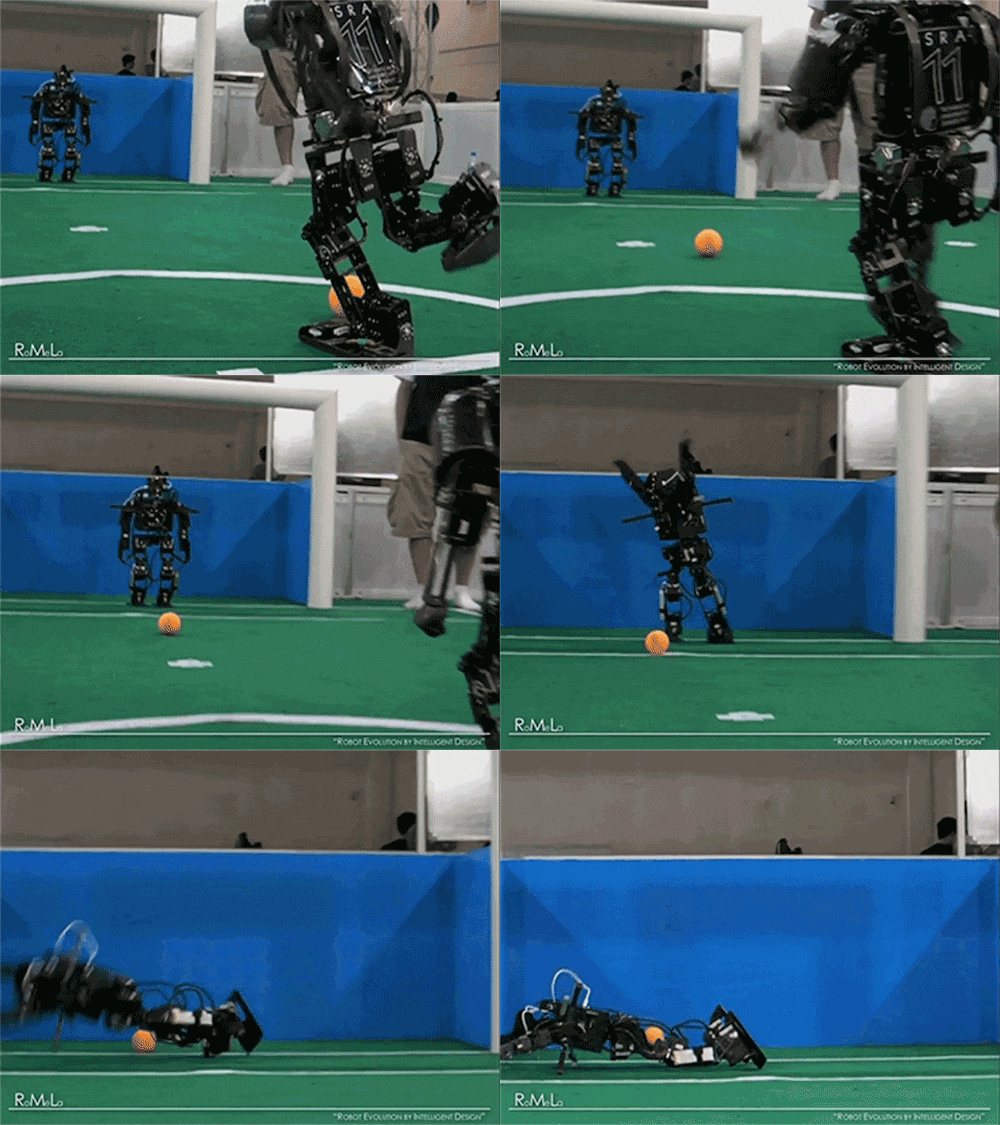
A viral clip shows NBA star Kyrie Irving lightly pushing a humanoid robot that immediately collapses, exposing how fragile many “advanced” humanoids still are.
In contrast, a San Francisco startup called Foundation plans to deploy up to 50,000 humanoid robots by 2027 for military and high-risk industrial use, leasing them at roughly $100,000 per year as expendable frontline units.
Meanwhile, EPFL researchers introduced HERMES, a wind-powered spherical robot that rolls like a tumbleweed and briefly flies when stuck, cutting energy use nearly in half.
Why it matters
Robotics is splitting into two paths: fragile demos seemingly optimized for viral videos, and rugged systems designed for attrition. The latter will define real-world deployment.
The Deets
- Humanoid demo fails under minimal force
- Phantom MK-1 designed for combat-adjacent roles
- HERMES uses wind for passive propulsion
- Built for hazardous, energy-scarce environments
Key takeaway
Embodiment is not about looking human. It’s about surviving physics.
🧩 Jargon Buster - Embodiment: Giving AI a physical form that can interact with the real world.
Source: Robotics Herald
🚀 Funding & Startups
Notion Turns AI Into IPO Fuel
Notion is staging a $300M tender offer at an $11B valuation, with ARR above $600M. Roughly half of that revenue now comes from AI-driven features integrated directly into the core product.
Why it matters
Notion did it right - rather than selling AI as an add-on it rebuilt the product around it. That discipline is translating into durable revenue and IPO readiness.
The Deets
- AI folded into core pricing
- No per-prompt tax
- Increased enterprise deal size
- Higher product stickiness
Key takeaway
The most successful AI businesses make AI invisible, not optional.
🧩 Jargon Buster - Tender offer: A transaction allowing employees or investors to sell shares before an IPO.
Source: AI Secret
⚡ Quick Hits
- Instacart faces FTC scrutiny over AI-powered pricing disparities.
- Google integrated its Opal vibe-coding tool into Gemini for no-code app creation.
- Coursera announced an all-stock acquisition of Udemy to boost AI education scale.
- Mozilla confirmed Firefox will pivot toward an AI-first browser strategy.
Today's Sources: TAAFT, AI Secret, The Rundown AI, Robotics Herald