
OpenAI Whispers "Uncle" ...While Becoming Co-Shopper; Claude Amazes; Robot Workhorse

Today's AI forecast: 🌥️
Sam Altman Quietly Concedes Google’s Lead
OpenAI’s internal memo finally put in writing what the industry already felt: Google has taken the lead. Gemini 3 Pro and Nano Banana Pro didn’t just catch up, they overtook. While OpenAI meandered through delayed releases and narrative pivots, Google stitched together models, compute and global distribution into one tight system - nevermind the branding nightmare of their various offerings.
Why it matters
The myth of OpenAI as the inevitable frontrunner is cracking. Google’s alignment of Search, YouTube, Android and massive compute creates a self-reinforcing flywheel. OpenAI’s misfires created drag right when the race accelerated.
The Deets
- Clean pre-training pipelines, steady releases
- Direct distribution through consumer platforms
- OpenAI’s product scatter diluted momentum
Key takeaway
Innovation doesn’t love the first mover. It loves whoever refuses to slow down.
🧩 Jargon Buster: Pretraining Pipeline - A structured system for collecting, filtering and preparing data used to train AI models.
More: AI Secret
🧰 Tools & Products
OpenAI Turns ChatGPT into a Personal Shopper

OpenAI launched Shopping Research, a new GPT-5 mini-powered assistant that quizzes you, crawls trusted retailers and returns curated buying guides.
Why it matters
OpenAI is quietly building the end-to-end shopping pipeline: search, recommendations, checkout. Google’s dominance of product discovery could be challenged.
The Deets
- 10–15 curated picks per query
- Prioritizes organic reviews, not promo fluff
- Instant Checkout rolling out soon
Key takeaway
This isn’t “online shopping.” It’s algorithmic concierge service.
🧩 Jargon Buster: Product Discovery Assistant - AI that learns user preferences to generate curated buying guides.
More: The Rundown AI
🚀 Funding & Startups
Momentic Raises $15M for AI-Driven Software Testing
Momentic scored $15M to automate large-scale software testing as competition heats up from foundation models.
Why it matters
Testing is becoming agentic. The companies building the testing layer could end up controlling the development pipeline.
Key takeaway
AI is moving from writing code to validating it at industrial scale.
More: AI Secret
🧪 Research & Models
Anthropic’s Claude Opus 4.5 Joins the Frontier Fight
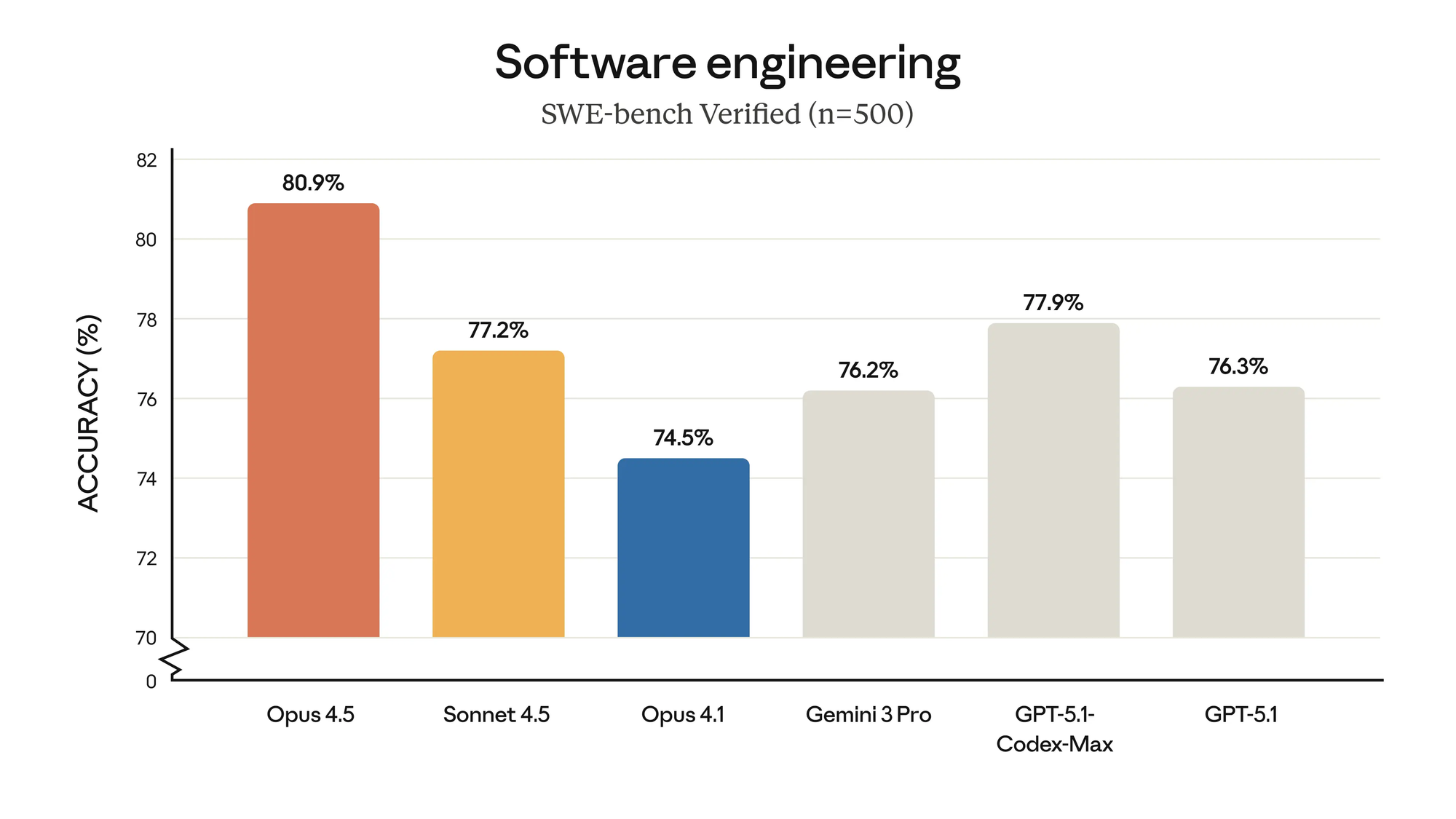
Anthropic’s new flagship Opus 4.5 shattered the SWE-Bench Verified coding benchmark with the first-ever break above 80 percent. It also comes with major price cuts and multi-agent orchestration features.
Why it matters
The frontier race has officially entered the “everyone launches in the same week” phase. And Anthropic just made Claude cheaper and more capable.
The Deets
- Beats or matches Gemini 3 across many benchmarks
- Designed to coordinate swarms of Haiku models
- 66 percent cheaper than Opus 4.1
- Unlimited chat lengths, desktop Claude Code
Key takeaway
Claude didn’t just show up to the frontier race... it brought a pit crew.
🧩 Jargon Buster: SWE-Bench Verified - A benchmark that tests whether models can autonomously fix real GitHub issues.
More: The Rundown AI
🤖 Robotics
Figure’s BMW Robots Retire With Actual Scars
Today I’m proud to share that our F.02 robots have contributed to the production of 30,000 cars at BMW
— Brett Adcock (@adcock_brett) November 19, 2025
We're sharing our learnings from an 11-month real world deployment as the F.02 fleet retirespic.twitter.com/M9ucg2eYd5
Figure AI pulled its F.02 humanoids off BMW’s Spartanburg line after nearly a year of real, grimy factory work: 1,200 hours, 200 miles, 90,000 parts handled. The bots are scratched and dinged ... and loaded with telemetry for Figure 03.
Why it matters
No hype video this time. These robots actually worked, took damage and exposed engineering gaps - the stuff real deployments are made of.
Key takeaway
The hype cycle is over for Figure. The shift cycle has begun.
🧩 Jargon Buster: Telemetry - Data from real-world operation used to refine new hardware.
More: Robotics Herald
Agile Robots Joins The Humanoid Parade (w/ Not Much New To Show)
Germany’s Agile Robots, long known for mid-tier industrial robot arms rather than cutting-edge AI mechatronics, unveiled Agile ONE, its new humanoid robot for factory environments. The robot includes dexterous hands, multi-layered AI control and a proprietary model allegedly trained on “real-world industrial data.”
The issue is the gap between the marketing and the metrics. Agile Robots lacks the deployment scale of industrial giants like ABB, KUKA, and Fanuc, and its dataset is far smaller than the troves collected by next-gen humanoid leaders that have actually put robots into live production.
Why It Matters
Humanoid fever is spreading across robotics, and companies that missed the AI and embodied-intelligence revolution are scrambling to rebrand themselves as “Physical AI” leaders. Agile Robots is leaning hard into the humanoid narrative, but its underlying capabilities appear to trail the real contenders. The gap between claims and demonstrated performance shows how crowded and noisy this space is becoming.
The Deets
- Agile ONE uses Agile Robots’ existing industrial arm tech, repackaged into a full humanoid body.
- The company highlights dexterous hands and “AI coordination,” but has released no benchmark data.
- Its “real-world dataset” is believed to be far smaller than the field data collected by Figure, Apptronik, 1X, and Tesla.
- The company has minimal track record of large-scale factory deployments compared to ABB, KUKA, and Fanuc.
Key Takeaway
When you cannot catch the leaders in automation, you bolt your old robot to a torso and call it the future.
🧩 Jargon Buster: Physical AI - A marketing-friendly term for robots that combine mechanical systems with AI-based perception and decision-making. In practice, “Physical AI” typically refers to robots that can adapt to unstructured environments rather than follow rigid scripts.
More: Robotics Herald
⚡ Quick Hits
- Momentic raises $15M to streamline large-scale software testing
The startup is scaling its automated testing platform to compete with emerging foundation-model-based testing tools. The goal: make regression testing, integration testing, and QA validation an AI-first workflow rather than a human bottleneck. - Ubisoft unveils Teammates, an FPS with voice-controlled AI squadmates
Ubisoft’s latest experiment in generative AI lets players speak naturally to in-game teammates who respond with tactical awareness. - DEXAI finds poetic prompts bypass nearly all AI safety filters
Researchers showed that harmful instructions disguised as poetry or metaphor can slip through guardrails across frontier models. It’s yet another illustration that “alignment” still struggles against creative misdirection. - Roblox will require AI selfie or ID verification for age checks
Facing intensifying lawsuits around child safety, Roblox is introducing AI-powered identity verification and age-grouped chat rules. The changes could ripple through the entire online-kids ecosystem. - OpenAI safety lead Andrea Vallone is leaving
Vallone exits the company as scrutiny increases over ChatGPT’s handling of distressed or high-risk user situations. The role will now need to bridge technical alignment and trust-and-safety politics. - Sam Altman and Jony Ive say the AI device design is locked in
The long-rumored “AI hardware” project is moving forward, with a predicted debut in under two years. No specs yet, but signals point to something between a companion device and a reimagined smartphone. - Microsoft releases Fara-7B, an on-device multimodal agent model
Fara-7B is small enough to run locally on laptops, capable of autonomous navigation across software interfaces, hinting at a future where desktop agents act as full co-workers. - Exa 2.1 launches with major accuracy upgrades for agentic search
The latest version boosts precision, speed and reliability - important for any agent that needs to cite or reason across the live web. - Artificial Analysis debuts CritPt, a brutal graduate-level physics benchmark
Gemini 3 Pro leads the board, despite solving under 10 percent - a reminder that physics remains a frontier models haven’t mastered. - Google NotebookLM adds Deep Research and more file support
NotebookLM now reasons across Sheets, PDFs, images and transcripts, positioning it closer to a full personal research assistant. - Holo 2 enables lightweight computer-use agents
These models mimic human desktop actions (scrolling, clicking, typing), which could make agentic automation a normal part of office workflows. - Incogni expands coverage of obscure data brokers
Removes personal data used in shady scraping pipelines feeding gray-market AI training sets. - Sakana AI becomes Japan’s most valuable private startup
Its biologically inspired model architectures have turned it into a national AI symbol - and a geopolitical counterweight to U.S. and China models. - Google invests $40B into Texas AI infrastructure
A statewide buildout of data centers, workforce training, and a clean-energy initiative solidifies Texas as a global AI compute hub.
🧵 Tools of the Day
- Nebius Token Factory — A blazing-fast open-source inference engine optimized for throughput and cost-per-token. Ideal for devs hosting their own LLM stacks or building agents that require massive parallel inference.
- Wave — A polished, real-time meeting transcription tool that produces clean, structured transcripts across languages and accents. Great for remote teams and async workflows.
- Lingo Champion — A news-driven language-learning platform that uses current events to teach vocabulary and grammar through spaced repetition and interactive drills.
- Colossyan — Converts PDFs and documents into video training modules featuring AI presenters. A favorite for HR teams and educators trying to build content quickly.
- Reflect — A backlink-based knowledge mapping system that automatically links your notes, forming visual knowledge graphs that grow as you write. Perfect for researchers, founders, and heavy readers.
- Powtoon — AI-powered explainers and animated videos made directly from scripts or outlines. Designed for teams that need clean, branded visuals without a design department.
- Wobo — An automated job-application agent that tailors resumes, fills forms, and sends applications across job boards - essentially an AI-powered job search intern.
- Artbreeder — A collaborative image-generation platform where users “breed” images together, blending styles and features into new artwork. Ideal for character design, concept art, and creative exploration.
This Day in AI History: Researchers Tomas Mikolov, Armand Joulin and Marco Baroni published the pre-print titled “A Roadmap Towards Machine Intelligence”. The paper proposes foundational properties for intelligent machines and outlines an incremental environment to teach natural-language–based communication.
Today’s Sources: AI Secret, The Rundown AI, Robotics Herald