
Tinder Vibing On Your Pics; Chatty Maps; AI Malware

OpenAI Walks Back “Backstop” Talk While Enterprise Adoption Surges
What’s Happening: After CFO Sarah Friar referenced a federal “backstop” at WSJ Tech Live, OpenAI clarified it does not seek bailouts for private firms. Hmmm.
Sam Altman said the market should decide outcomes, not guarantees, while reporting 1M enterprise customers and rapid seat growth for ChatGPT for Work. New capabilities include interrupting long-running queries and injecting context mid-stream.
Why It Matters: OpenAI’s massive capex and energy footprint invite policy scrutiny. Reaffirming a no-bailout stance lowers political temperature while the company pursues multi-cloud deals and regional JVs.
Key Takeaway: Scale pressure is real, but the public posture is clear: growth should be financed commercially, not via federal guarantees.
🧩 Jargon Buster: Backstop - a guarantee that limits losses on private investment, often through public credit or risk sharing.
More: AI Breakfast, The Rundown AI
Kimi K2 Thinking Tops Frontier Models In Open Benchmarks
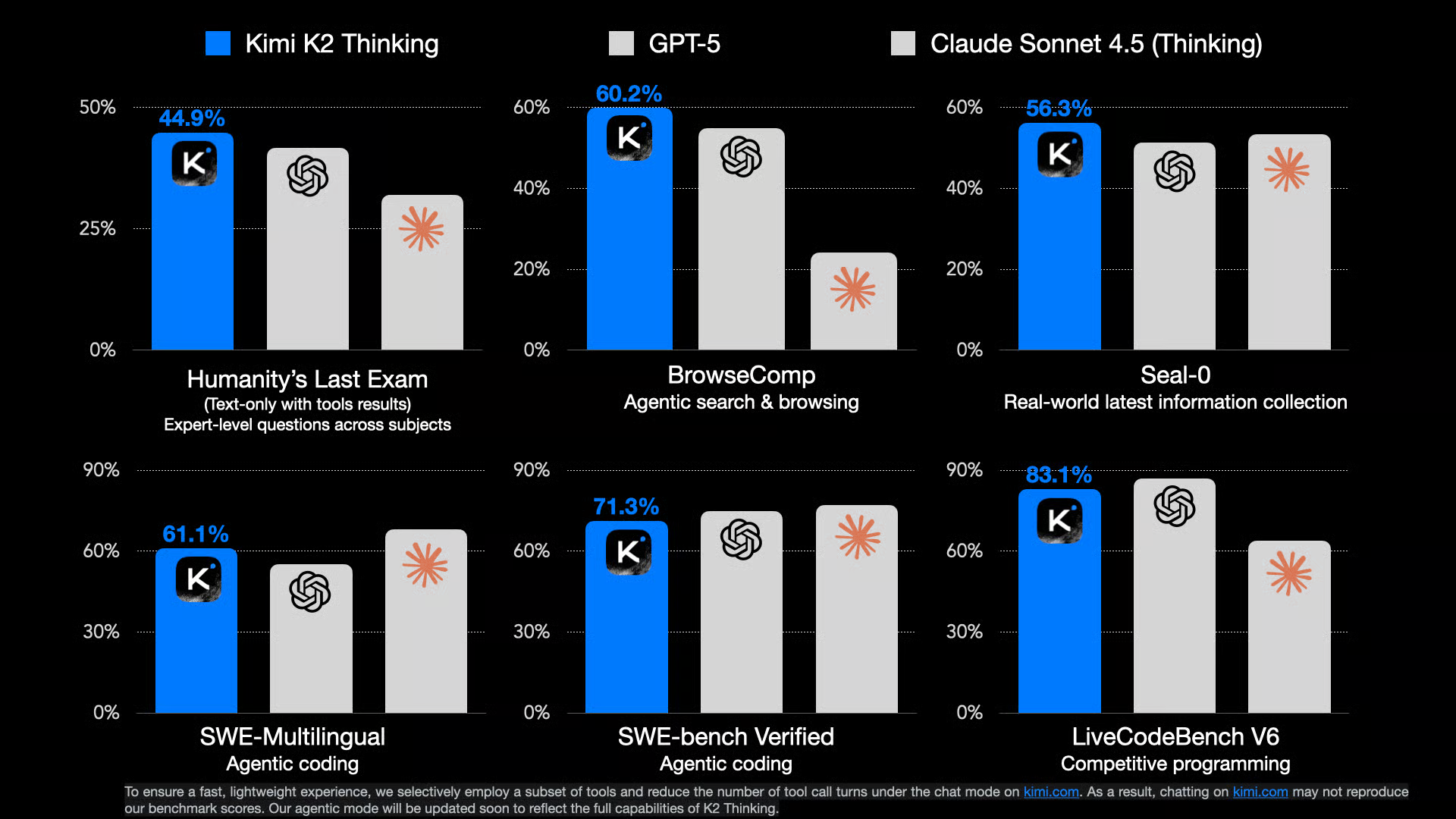
What’s Happening: Moonshot AI unveiled Kimi K2 Thinking, an open-weight reasoning model that claims parity or wins versus GPT-5, Claude Sonnet 4.5, and MiniMax-M2 on coding, browsing, and agentic tasks. It uses a trillion-parameter Mixture-of-Experts with ~32B active parameters per token, supports 200 to 300 tool calls per job, and maintains a 256k-token context with INT4 options for long, multi-step workflows.
Benchmark highlights include state-of-the-art scores on SWE-Bench Verified and LiveCodeBench, plus competitive results on BrowseComp and Seal-0. The release includes visible reasoning traces and a commercial-friendly open-weight license.
Why It Matters: K2 narrows the capability and cost gap between closed and open ecosystems, giving teams a credible path to agentic apps without vendor lock-in. It also signals accelerating open-source competition from China, validating comments that the country is “nanoseconds” behind the United States.
The Deets:
- Reported training spend under $5M
- License modeled on MIT with light attribution for high-scale use
- Early demos show autonomous coding loops and structured analysis across hundreds of tool calls
- Companion Kimi K2 Slides generates editable decks.
Key Takeaway: Open models are no longer merely adequate, they are becoming the practical default for tool-using agents and long-context coding.
🧩 Jargon Buster: Open-weight model - weights are downloadable for local or hosted use, often permissive for research and commercial deployment.
More: AI Breakfast
🧭 Products & How-To
Create Polished Presentations With AI
What’s Happening: Kimi K2 Slides turns a single prompt into a complete presentation, handling structure, layout and branding with exportable PPTX files.
Why It Matters: Presentation generation is becoming a standard compile target for model ecosystems, shrinking concept-to-deck time from hours to minutes.
The Deets: Preset Mode for structured decks, Adaptive Mode for creative layouts, embedded fonts on export, typical 14 to 18 slides in 5 to 10 minutes.
Key Takeaway: Deck creation is now an orchestration problem, not a design grind.
🧩 Jargon Buster: Template-conditioned generation - guiding output using predefined layout and style constraints.
More: The Rundown AI
🔐 Security, Platforms & Consumer
Google’s AI Malware Report Creates Defensive Gold Rush
What’s Happening: Google’s Threat Intelligence Group detailed strains like PROMPTFLUX and PROMPTSTEAL that dynamically rewrite code through Gemini APIs or rival models, mutate to evade detection, and even generate new exploits via open-source LLMs.
Why It Matters: Offense is already AI-native. The next wave of startups will build model firewalls, prompt sandboxes and LLM-aware detection layers that slot into enterprise security stacks.
The Deets:
- Automated refactoring, rapid payload mutation, and exploit generation using public weights.
- CISOs are evaluating agent containment and policy-aware inference guards.
Key Takeaway: AI broke traditional malware economics, so security will become the next scaled AI market.
🧩 Jargon Buster: Prompt-layer sandbox - a policy-enforced wrapper that constrains and audits model inputs and tool calls.
More: AI Secret
Tinder Tests Camera-Roll “Chemistry” To Decode Your Vibe
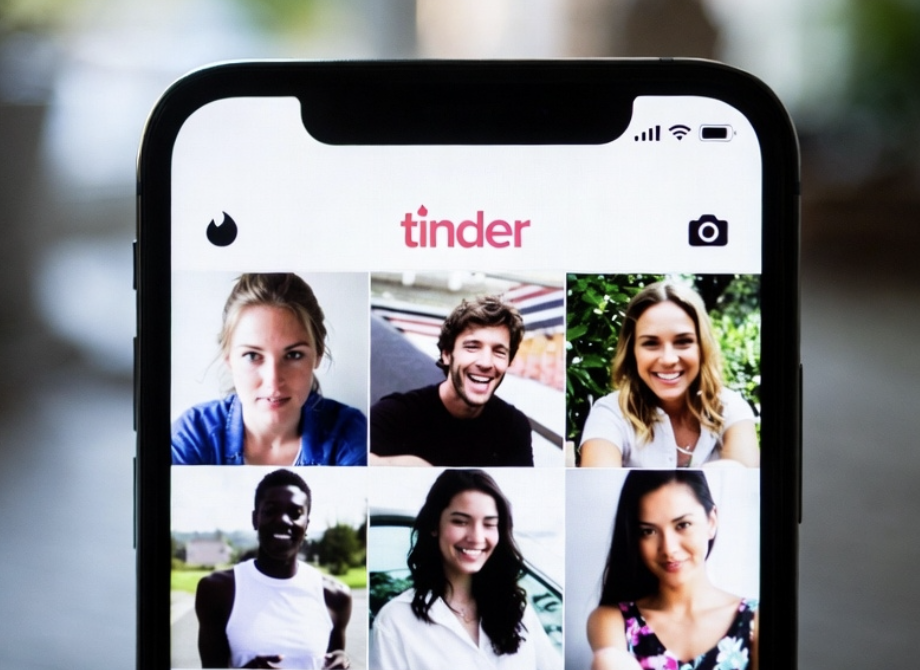
What’s Happening: Tinder is piloting an opt-in feature that scans a user’s camera roll to infer interests and personality cues, aiming to reduce swipe fatigue and improve match quality.
Why It Matters: Emotional and personal data become training fuel for recommender systems. The feature may boost engagement, but it raises new privacy and consent questions.
The Deets:
- Already live in New Zealand and Australia
- Part of Match Group’s push to reverse paid user declines
- Resembles broader trends in parasocial AI experiences
Key Takeaway: Better matches, higher stakes for privacy.
🧩 Jargon Buster: On-device inference - running models locally to limit data exposure, often paired with private cloud options.
More: AI Secret
Maps Becomes A Gemini-Based Co-Driver
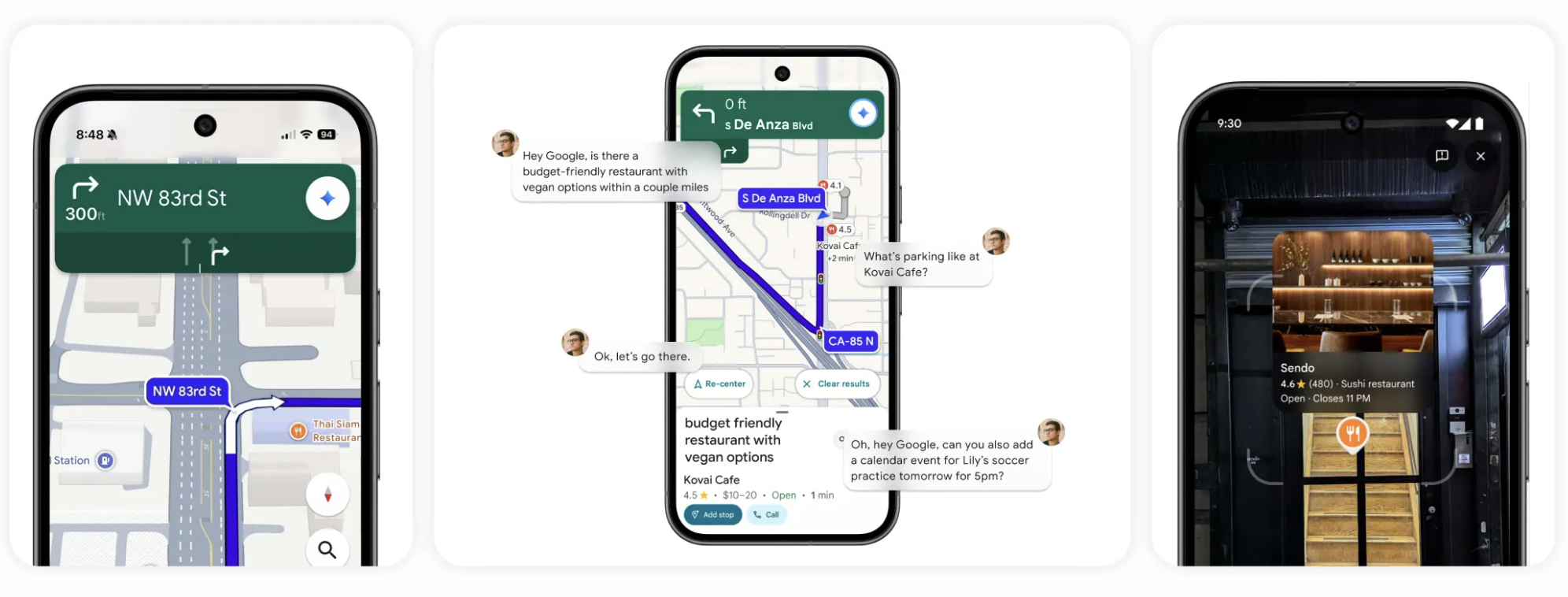
What’s Happening: Google integrated Gemini into Maps for conversational, landmark-aware guidance that fuses Street View and Lens. Think: “turn right after the Shell station,” with calendar-aware stop planning.
Why It Matters: Navigation is shifting from passive instructions to an interactive assistant, which pressures in-car systems that rely on fixed UIs.
The Deets:
- U.S. rollout on iOS and Android starts this month
- Ties into Gemini Deep Research and broader Chrome and Workspace upgrades.
Key Takeaway: The interface for the physical world is becoming a dialogue.
🧩 Jargon Buster: Conversational navigation - natural-language driving assistance that references visual landmarks and user context.
More: AI Secret
🤖 Robotics
“Made In France-ish”: Humanoid Reveal Draws Skepticism
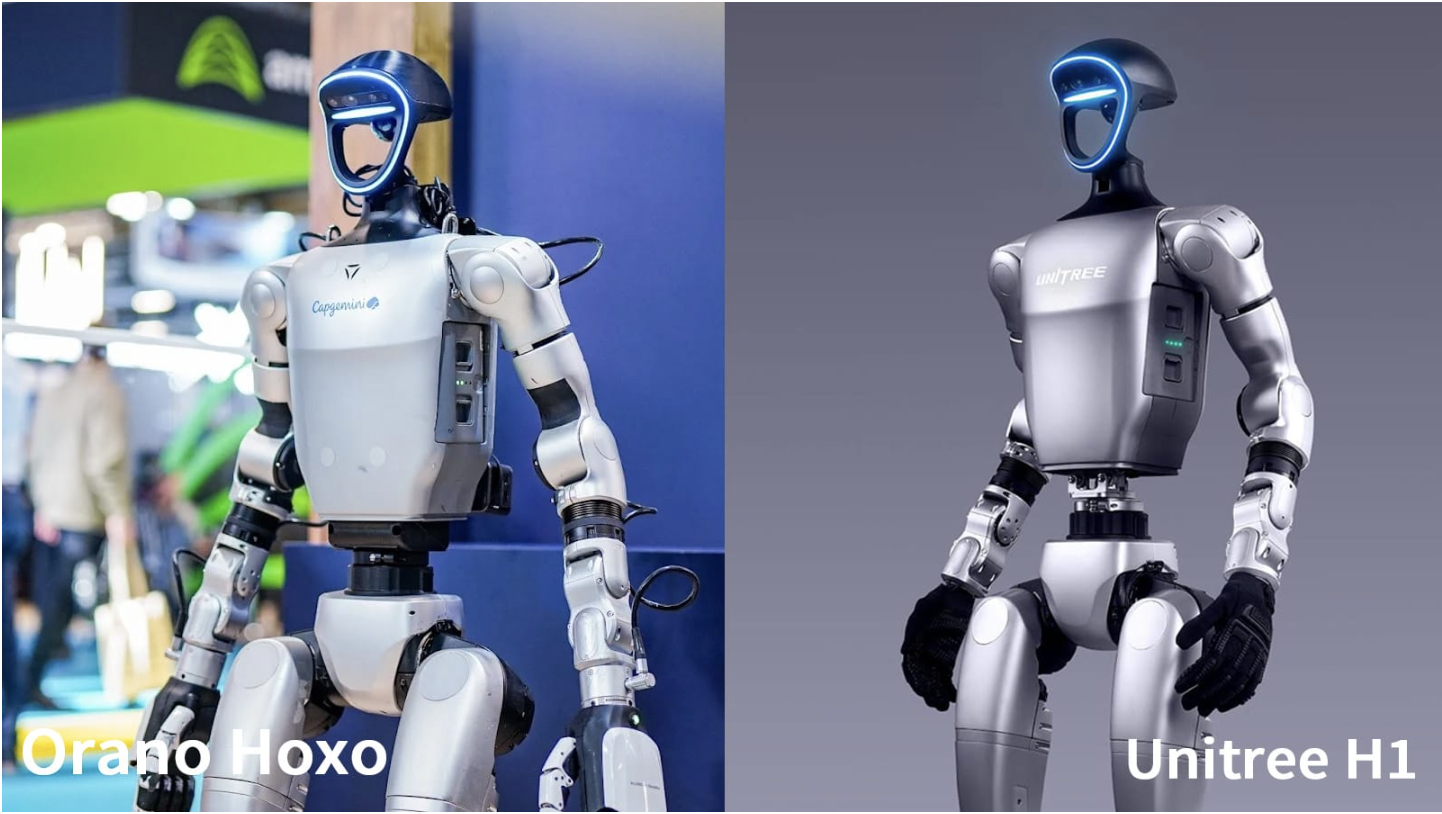
What’s Happening: Capgemini and Orano announced Hoxo, billed as an AI humanoid for nuclear training and high-risk tasks at Orano’s Melox site. Observers note the robot looks identical to Unitree’s H1, suggesting a systems integration effort on off-the-shelf hardware rather than a new French platform.
Why It Matters: In enterprise robotics, value often sits in perception, autonomy, and digital-twin workflows, not the chassis. If Hoxo is a re-skinned H1, the story is software and safety processes, not a breakthrough body.
The Deets:
- Positioned for training, inspection and basic manipulation
- Imagery and demos appear staged rather than production-grade
- Debate centers on transparency and real task readiness.
Key Takeaway: Integration can be innovation, but claims should match capabilities.
🧩 Jargon Buster: Digital twin - a live, simulated replica of assets or environments used for planning, training, and control.
More: Robotics Herald
🧮 Research & Models
Google Unveils AlphaEvolve, Ironwood TPUs And Gemini Tooling
What’s Happening: Google introduced AlphaEvolve, a discovery engine that iteratively proposes and tests ideas in math, with Gemini Deep Think for reasoning and AlphaProof for Lean-verified proofs.
On the hardware front, seventh-generation Ironwood TPUs deliver up to 4× training and inference throughput with 9,216-chip superpods, 9.6 Tbps interconnects, and 1.77 PB HBM. Gemini tools expanded across Opal mini-apps, File Search for turnkey RAG, Deep Research across Gmail, Drive, and the web, and conversational Maps.
Why It Matters: High-trust reasoning plus scaled silicon is the recipe for the next capability jump. Tooling that simplifies RAG and agent building lowers the barrier for production systems.
The Deets:
- Anthropic commits to large Ironwood fleets
- Axion Arm VMs handle preprocessing with 2× price-performance gains
- Opal now in 160+ countries
- Chrome adds AI Mode
- Vertex Agent Builder supports context memory, self-healing plugins, and governance dashboards.
Key Takeaway: Google is pushing on both pillars, faster chips and verified reasoning, while productizing the stack across Cloud and consumer apps.
🧩 Jargon Buster: Formal verification - machine-checked proofs that an algorithm satisfies specified properties.
⚡ Quick Hits
Shopify cites 7× AI-driven traffic and 11× order growth since January, linking gains to agentic commerce features. AI Secret
A UK court dealt a blow to Getty, ruling Stable Diffusion is not an infringing copy. AI Breakfast
Nvidia’s Jensen Huang reportedly said China is “nanoseconds” behind the U.S. in AI leadership. The Rundown AI
On This Day in AI History: In 2004, Cyc marked 20 years of hand-built common-sense reasoning, seeding ideas for knowledge graphs, the semantic web and neuro-symbolic hybrids that still influence modern AI.
Today’s Sources Robotics Herald, AI Secret, The Rundown AI, AI Breakfast