
U.S. Wakes to Robots; Google Glass Redux; Memory Ring

Today's AI forecast: 🌤️
DeepSeek’s Forbidden GPU Pipeline Shows Where AI Power Really Lives
For months, the AI rumor mill has whispered that DeepSeek was cooking its next frontier model on hardware the U.S. doesn’t want Chinese labs anywhere near. Now The Information has receipts: thousands of Nvidia Blackwell GPUs reportedly found their way into DeepSeek’s training clusters despite explicit export bans. Investigators call it smuggling, engineers call it “Tuesday.”
Nvidia, for its part, denies involvement, but the broader silence is telling. Everybody knows the uncomfortable truth: the frontier runs on Nvidia silicon, and if you can’t legally get it, you’re not building a frontier model. While governments debate “AI sovereignty,” GPU sovereignty is what actually decides who gets to play at the top of the leaderboard.
The incident also lands in the middle of geopolitical tension over compute control. As the U.S. tightens restrictions, labs are finding creative (read: illegal) supply chain workarounds, while major cloud providers scramble for inventory. The AI era isn’t just about models anymore; it’s about borders, logistics, and who can get GPUs across them.
Why It Matters
The real moat in AI isn’t data or architecture. It’s compute. And this episode underscores how fragile and asymmetric that supply chain is. Whoever controls GPU access shapes the trajectory of global AI power.
The Deets
- DeepSeek reportedly training next-gen model on thousands of Nvidia Blackwell GPUs, despite U.S. export bans.
- U.S. officials investigating; DeepSeek allegedly tapped parallel import routes to acquire chips.
- Nvidia denies any wrongdoing and says it complies with export controls.
- Story aligns with broader hardware shortages and escalating compute geopolitics.
Key Takeaway
AI supremacy isn’t an intellectual race. It’s a supply chain drama where the star performer is a GPU.
🧩 Jargon Buster - Blackwell GPU: Nvidia’s latest high-end AI processor, effectively the golden ticket for training frontier models.
Source: AI Secret, The Rundown
💼 Power Plays
The U.S. Finally Getting in Robotics Race

After months of focusing on AI policy, the Trump administration is now drafting a full-blown national robotics strategy. Think executive orders, task forces, private-sector consultations and a sudden uptick in meetings where someone says “geopolitical stakes” every 10 minutes.
Commerce Secretary Howard Lutnick is meeting with leaders from Boston Dynamics and Apptronik, making the case that robotics is the next front in the tech contest with China. The U.S. currently trails China’s 1.8M industrial robots by a factor of four, and that gap isn’t closing on vibes alone.
A national strategy could bring tax incentives, subsidies, procurement commitments and a regulatory path that positions robots as essential infrastructure, not novelty hardware. But with that legitimacy comes scrutiny: labor debates, safety rules, and defense expectations.
Why It Matters
Robotics is shifting from startup territory to national-interest territory. That changes who gets funded, who gets regulated, and who gets left behind.
The Deets
- 2026 executive order and interagency robotics task forces in development.
- Aims to counter China’s massive industrial automation lead.
- Could legitimize commercial humanoids with federal backing.
- Robotics industry bracing for more oversight and government-driven milestones.
Key Takeaway
Robotics just went from “cool demo” to “national strategy.” The next term sheet may come with a flag.
🧩 Jargon Buster - Industrial robot density: A measure of robots deployed in manufacturing; a key indicator of a nation’s automation maturity.
Source: Robotics Herald
🛠️ Tools & Products
Mistral Drives Local AI Coding Into the Mainstream With Devstral 2
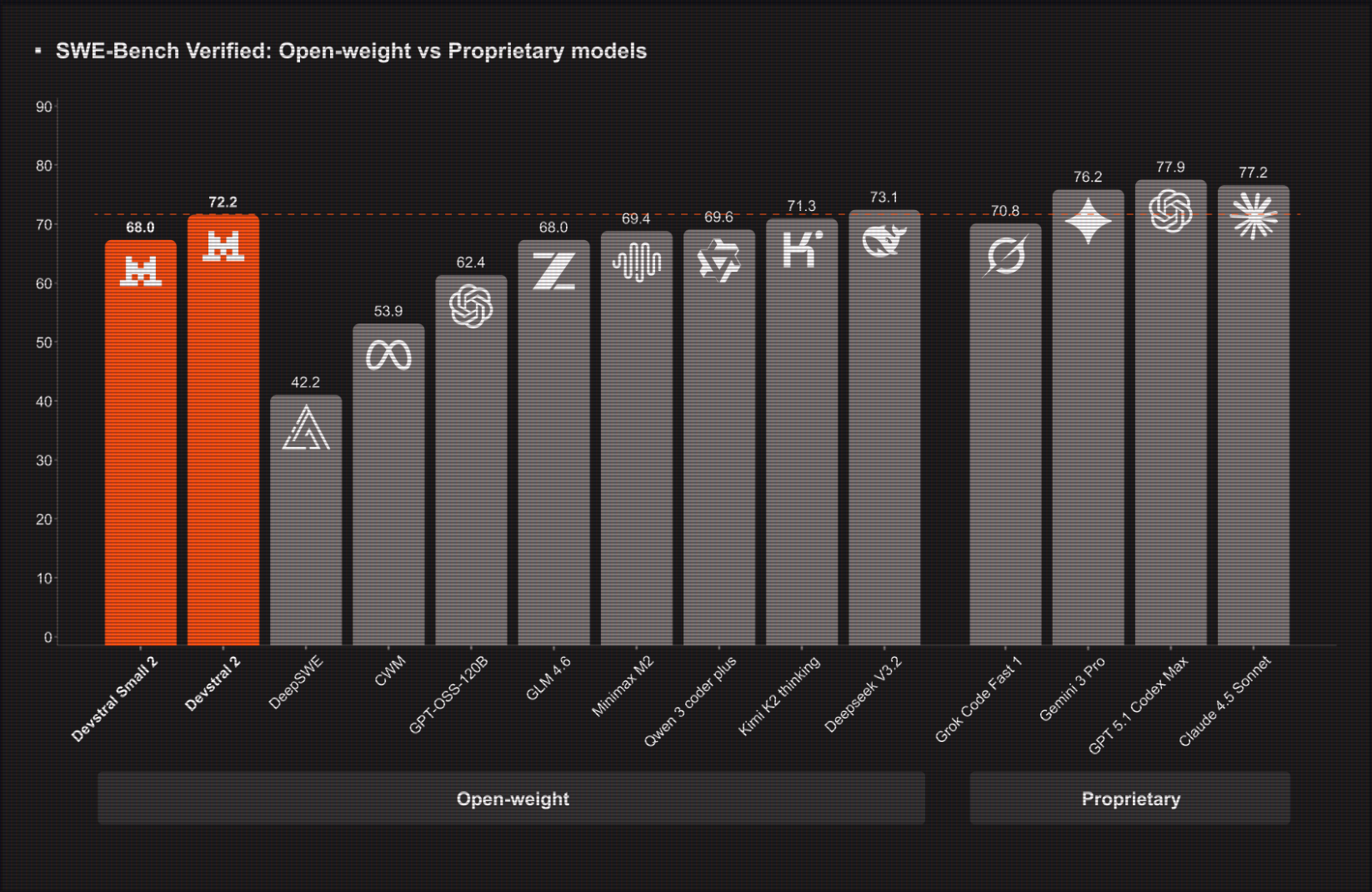
Mistral just dropped Devstral 2, a new family of code-focused models designed for everything from laptop-based work to full-scale agentic development. The lineup includes a 123B flagship and a surprisingly powerful 24B Small version that runs locally on a single GPU or even a well-spec’d laptop. Both come with 256K context windows and benchmark performance that embarrasses larger models from just a year ago.
But the real plot twist is Vibe, a terminal-native orchestration interface that turns coding into a chat-driven workflow. It’s not just autocomplete; it’s a real-time project command center.
Why It Matters
AI coding isn’t just cloud-based anymore. Devstral 2 makes high-level reasoning and private, on-device coding workflows feasible for enterprises and indie developers alike.
The Deets
- Devstral 2 lineup includes 123B and 24B variants with shared architecture.
- 24B Small runs offline; beats many 70B models on SWE-Bench.
- 256K context windows for long-form reasoning and project awareness.
- Vibe CLI introduces real-time terminal-native AI orchestration.
Key Takeaway
AI-assisted coding just went from something you call to something you own.
🧩 Jargon Buster - SWE-Bench: A benchmark evaluating whether models can fix real software bugs in open-source repos.
Source: AI Secret, The Rundown
Google’s XR Glasses Rise From the Ashes of Glass
Google is previewing its new Android XR smart glasses, powered by Gemini, marking a comeback attempt a decade after the Google Glass flameout.
Two prototypes are in the works: one voice-only, and one with a built-in display. Both use Gemini to perceive surroundings, translate text, recognize landmarks, and recall what users saw earlier.
Developer previews hit in 2025, with a commercial launch slated for 2026. Internally, Google reportedly sees XR as the platform that finally bridges its AI breakthroughs with a hardware form factor consumers might actually want to wear.
Why It Matters
Gemini 3 proved Google could build an AI that reasons. XR is its shot at giving that intelligence a physical interface. This is Google’s clearest path toward a post-smartphone future.
The Deets
- Two glasses prototypes: display and voice-only.
- Multimodal reasoning via Gemini; strong translation and perception features.
- Dev kits in 2025; public launch in 2026.
- Positioned as Google’s first meaningful hardware push since Pixel AI features.

Key Takeaway
Gemini gave Google a brain. XR is its body.
🧩 Jargon Buster - XR (Extended Reality): Tech that merges digital content with the physical world through wearables.
Source: AI Secret
$75 AI Ring Tries to Become Your Brain’s External Memory

Pebble’s original team is back, and this time they want to live on your index finger. Core Devices just launched the Index 01, a $75 AI smart ring that records voice notes and turns them into structured reminders, tasks and calendar entries using on-device AI.
Instead of trying to replace your phone like the Humane Pin or Rabbit R1, Index 01 goes minimalist: one button, one job, no subscriptions, no internet and no charging.
The ring sits on your index finger and uses a thumb-activated button to start recording. Notes sync to your phone, where a local LLM handles transcription and summarization. It runs up to two years on built-in batteries and captures up to five minutes of audio per note. The company’s bet is that wearables work best when they’re quiet, durable, and laser-focused.
Why It Matters
The last wave of AI hardware overreached, shipping half-baked “phone replacements” that needed cloud inference to perform basic tasks. Index 01 is the opposite strategy: one useful workflow executed cleanly through local processing. If successful, it could reposition AI wearables not as gadgets but as cognitive prosthetics.
The Deets
- Built by former Pebble creators under Core Devices.
- $75 price point with no subscription and no internet required.
- Thumb-activated recording; worn on the index finger.
- Local LLM handles transcription and task parsing.
- Two-year battery life; five-minute maximum continuous recording.
Key Takeaway
AI hardware may finally be learning that less ambition equals more adoption.
🧩 Jargon Buster - Local LLM: A small language model running entirely on your device, keeping data private and eliminating cloud dependency.
Source: The Rundown AI
Open-Source AI Crushes the Putnam as Research Labs Race Toward Math Reasoning

Nous Research unveiled Nomos 1, a 30B-parameter reasoning model that scored 87/120 on the 2025 Putnam Contest, one of the world’s most brutal collegiate math exams. The performance places it second among nearly 4,000 human competitors and beats far larger models when evaluated under the same reasoning harness.
Nomos uses a dual-phase strategy with worker models solving problems, critiquing themselves, and competing in a tournament-like bracket. Eight problems were solved perfectly. Importantly, Nous open-sourced both the model and the harness.
Why It Matters
AI has struggled with formal math for years. Now smaller, open models are not only solving research-grade problems but beating elite human competitors. That redefines what “frontier” even means.
The Deets
- 30B parameters; solves Putnam at near-gold-medal level.
- 87/120 score; eight perfect solutions.
- Two-phase reasoning pipeline with self-critique and selection.
- Outperforms Qwen 3 (24/120) under identical setup.
- Harness fully open-sourced.
Key Takeaway
Reasoning breakthroughs are no longer exclusive to giants. Open labs are catching up fast.
🧩 Jargon Buster - Putnam Contest: A notoriously difficult annual math competition for top U.S. and Canadian undergraduates.
Source: The Rundown
🔬 Research & Models
MIT’s Micro-Factory Lets You Talk Objects Into Being
MIT researchers unveiled a speech-to-reality micro-factory that lets users speak an object into existence. Say “Build me a stool,” and a robotic arm assembles one using modular lattice blocks. The system fuses five levels of intelligence: speech recognition, language understanding, generative 3D design, geometric reasoning, and robotic assembly.
The result: a one-square-meter factory that listens, reasons, and builds without human tooling, CAD expertise, or traditional supply chains.
Why It Matters
Fabrication is becoming conversational. This collapses the entire design-to-manufacturing pipeline into a single prompt, hinting at construction sites powered by local, reconfigurable micro-factories rather than massive centralized operations.
The Deets
- Converts spoken prompts into structural designs.
- Uses lattice blocks for modular, reconfigurable fabrication.
- Fully autonomous reasoning chain from language to assembly.
- Positions robotics as a real-time generator of physical goods.
Key Takeaway
We’re entering a world where manufacturing is less “built by hand” and more “generated by instructions.”
🧩 Jargon Buster - Geometric reasoning: Algorithms that convert abstract designs into physically valid structures robots can assemble.
Source: Robotics Herald
⚡ Quick Hits
- Google launches a ₹399 (~$5) AI Plus plan in India with expanded model access and 200GB of storage. More…
- Microsoft invests CAD $19B into Canadian AI and cloud infrastructure. More…
- Meta is reportedly going all-in on Avocado, a frontier model set for 2026. More…
- Inito raises $29M for AI-designed antibodies expanding at-home diagnostics. More…
- Aetherflux targets 2027 for its first orbital data center. More…
- Serve Robotics and Uber Eats expand sidewalk robots to Fort Lauderdale. More…
- Samsung invests in Alva Industries to secure ironless actuators. More…
🧰 Tools of the Day
- Devstral 2: Mistral’s next-gen coder models with a 123B and 24B version, plus the new Vibe CLI for real-time development. More…
- Stitch: Google’s Gemini-powered tool that turns rough ideas into polished UI designs. More…
- Nomos 1: The open-source math model that just placed second on the Putnam. More…
- Purpose: An AI mentor for personalized, deep guidance. More…
- KaraVideo: One interface to rule all AI video models. More…
- Momen AI: Turns app ideas into functional prototypes with no code required. More…
Today’s Sources: - AI Secret, The Rundown AI, Robotics Herald