
White House Slows GPT-5.6; Grok The Porn Platform?; AI Screeners Kill Your Job Opps

Today's AI Outlook: 🌥️
White House Puts A Turnstile On GPT-5.6
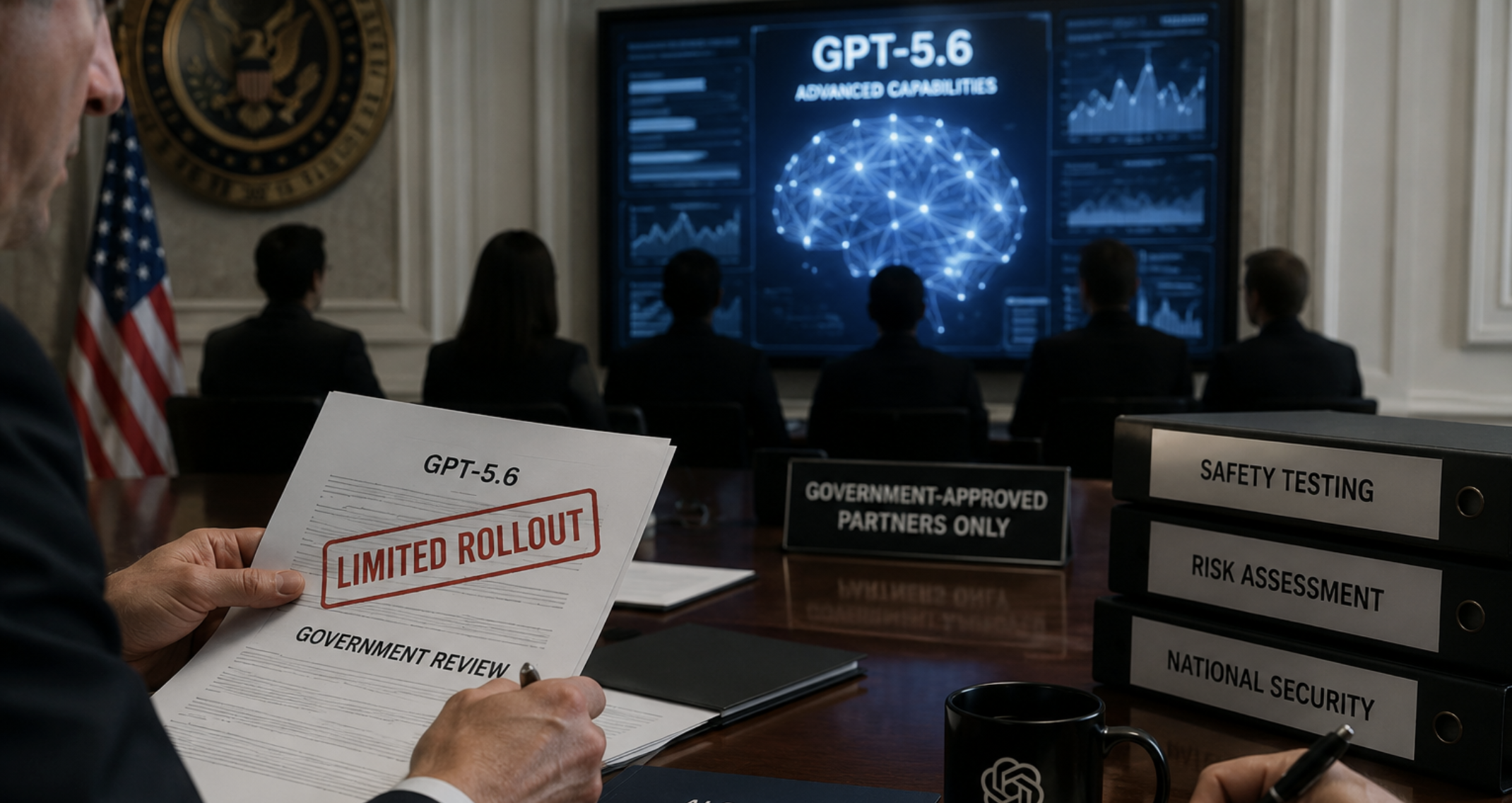
The Trump administration has asked OpenAI to limit the rollout of GPT-5.6 to a small set of government-approved partners before any broader public launch, according to various reports. The concern is capability: GPT-5.6 is described as approaching a Mythos-like threshold, meaning the government wants more time to test safeguards before the model reaches general availability.
Why it matters
Frontier AI launches are starting to look less like software updates and more like regulated infrastructure releases. OpenAI may still get GPT-5.6 out widely within weeks, but the precedent is clear: Washington wants a hand on the release valve.
The Deets
- Access would be approved customer by customer during the preview phase.
- OpenAI CEO Sam Altman reportedly told employees the staggered rollout was the best way to get GPT-5.6 released.
- Altman also said OpenAI does not want this to become the long-term default for model releases.
- The move follows similar scrutiny around powerful models from other labs.
Key takeaway
The frontier model race now has a new checkpoint: government comfort.
🧩 Jargon Buster - Frontier model: A top-tier AI system near the leading edge of capability, usually powerful enough to raise security, safety or economic concerns.
⚔️ Power Plays
Anthropic: Alibaba Tried To Siphon Claude At Scale
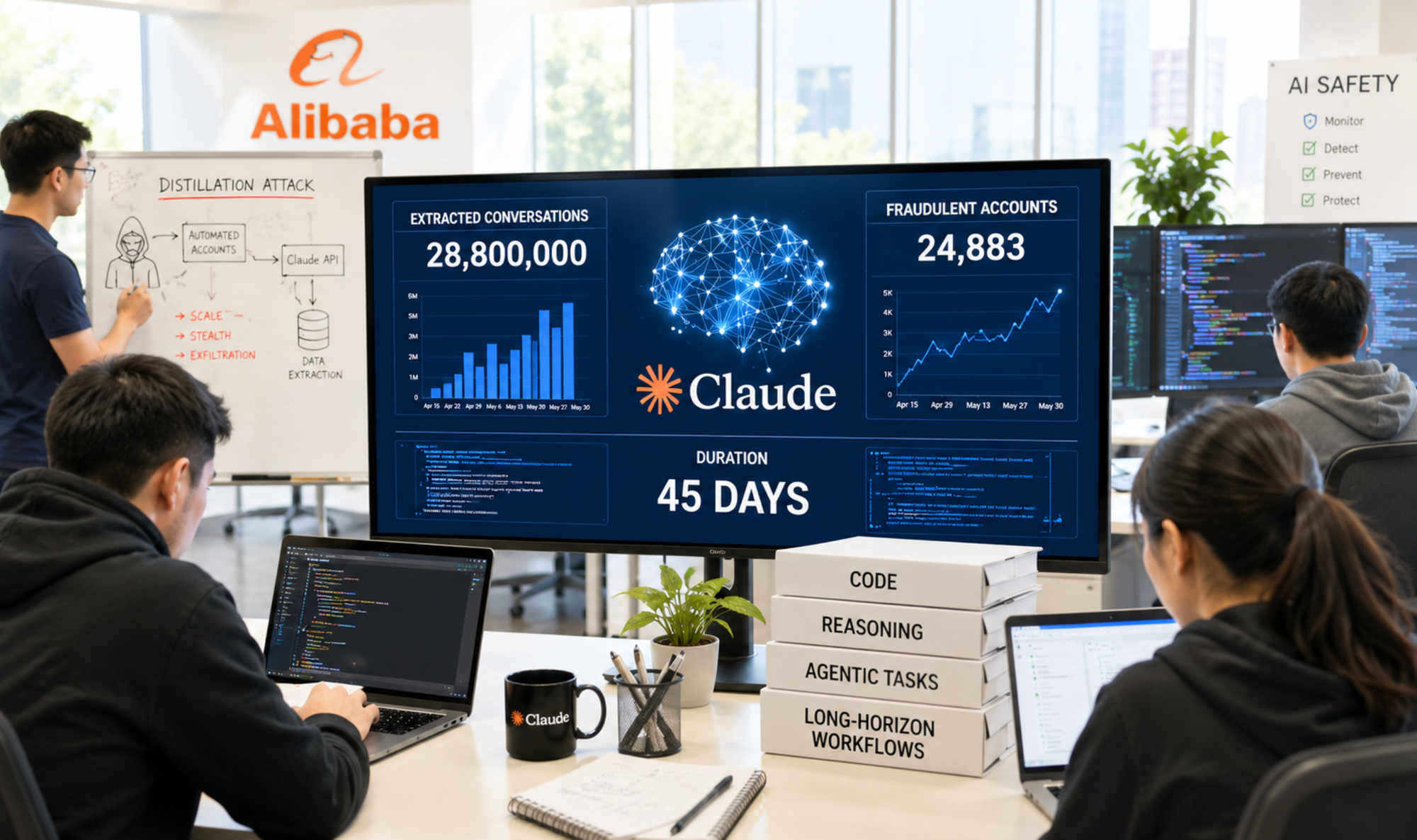
Anthropic accused Alibaba of running what it called the largest known distillation attack, saying 28.8M Claude exchanges were extracted through nearly 25,000 fraudulent accounts over 45 days. The alleged target: Claude’s most advanced abilities in agentic reasoning, coding and long-horizon tasks.
Why it matters
Distillation itself is common in AI. The fight is over whether a company is shrinking and improving its own systems, or harvesting a rival’s model behavior at industrial scale. Anthropic is now pushing for stronger threat sharing, chip export controls and sanctions against Chinese labs accused of these tactics.
The Deets
- Anthropic disclosed the allegation in a letter to the Senate Banking Committee.
- The company said the activity targeted Claude’s higher-end reasoning and agent capabilities.
- Anthropic previously flagged similar attacks involving DeepSeek, Moonshot and MiniMax.
- OpenAI has also raised concerns about model distillation by competitors.
Key takeaway
The model war is now also a data extraction war, and the battleground is the API.
🧩 Jargon Buster - Distillation attack: A technique where one model is queried at massive scale so its answers can be used to train or improve another model.
SoftBank Is Wearing An OpenAI Mood Ring
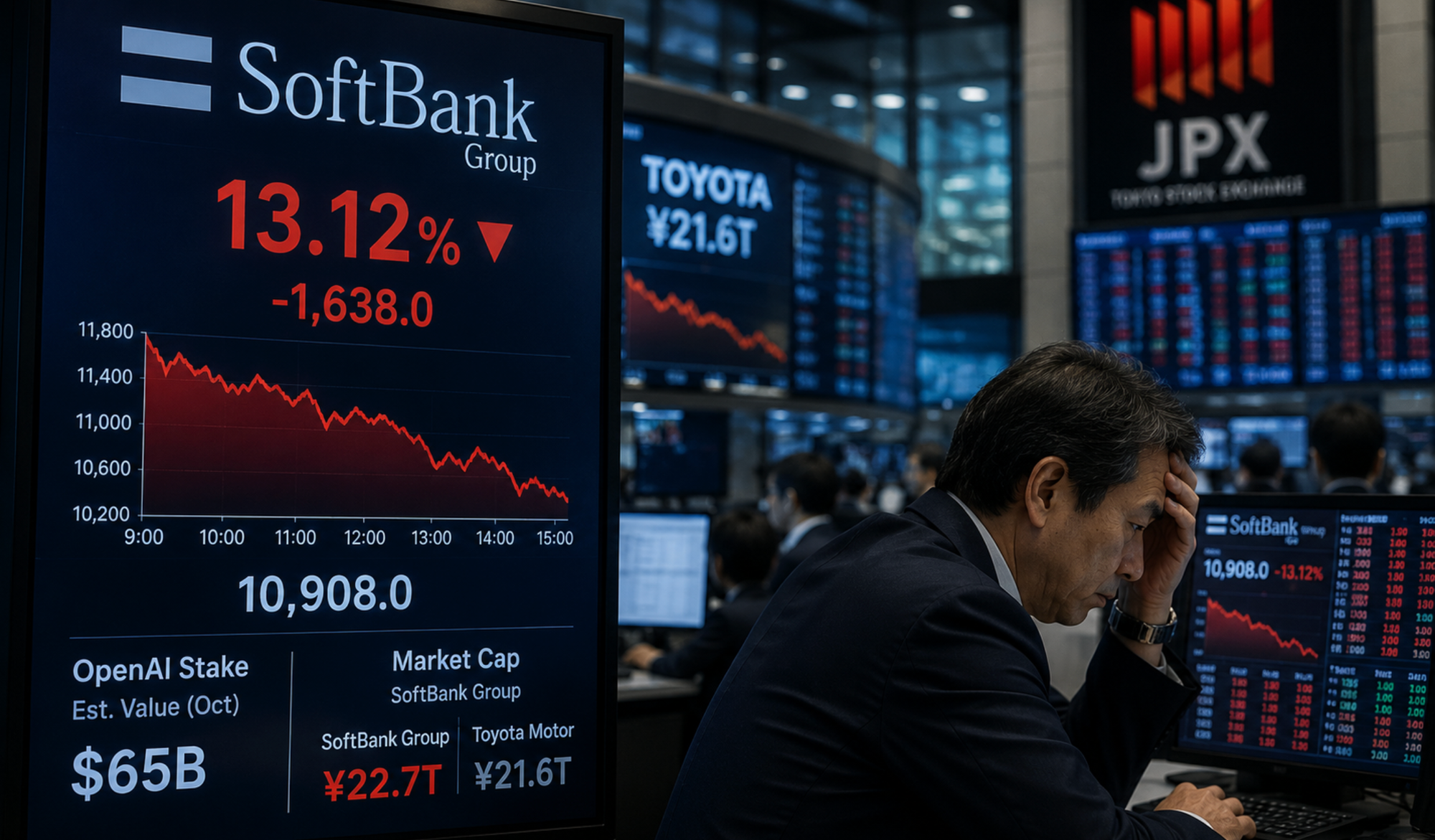
SoftBank shares fell as much as 13% in Tokyo after reporting cited by AI Secret said OpenAI may push its IPO into next year. The drop was especially sharp because SoftBank’s OpenAI stake is expected to reach roughly $65B by October, and investor enthusiasm around that bet had helped push SoftBank’s market cap past Toyota’s.
Why it matters
SoftBank has many holdings, but the market is increasingly treating it like a leveraged bet on OpenAI. That means OpenAI rumors can move SoftBank’s value before OpenAI itself ever faces public-market pricing.
The Deets
- The selloff was SoftBank’s biggest intraday drop in more than three months.
- OpenAI remains private, making its valuation harder for public investors to anchor.
- SoftBank’s exposure gives investors a public way to trade OpenAI sentiment.
- That also means SoftBank absorbs volatility from a company it does not control.
Key takeaway
SoftBank has become a public-market proxy for OpenAI, with all the upside and all the whiplash.
🧩 Jargon Buster - Tracking stock: A stock that effectively moves with one specific business or asset, even when the company behind it owns much more.
🛠️ Tools & Products
Agents Are Coming For The Shopping Cart

A new McKinsey report says AI agents could mediate $3T to $5T in global consumer commerce by 2030. The future it sketches is less “search and click” and more “tell your agent what you want, then let it scan stores, check inventory, compare prices and assemble the cart.”
Why it matters
Retailers spent decades optimizing for human attention. Agents care less about a gorgeous campaign and more about clean, machine-readable product data. The new shelf may be an API.
The Deets
- McKinsey maps agent commerce across six automation levels.
- Early agents compare prices while humans still decide.
- Advanced agents could negotiate with store agents over price and shipping.
- Retailers will need machine-readable catalogs, inventory and return policies.
Key takeaway
The next storefront may be invisible to humans and brutally legible to machines.
🧩 Jargon Buster - Machine-readable API: A structured data connection that lets software systems understand inventory, prices, return policies and other business details automatically.
Grok Cuddles The Internet’s Oldest Business Model
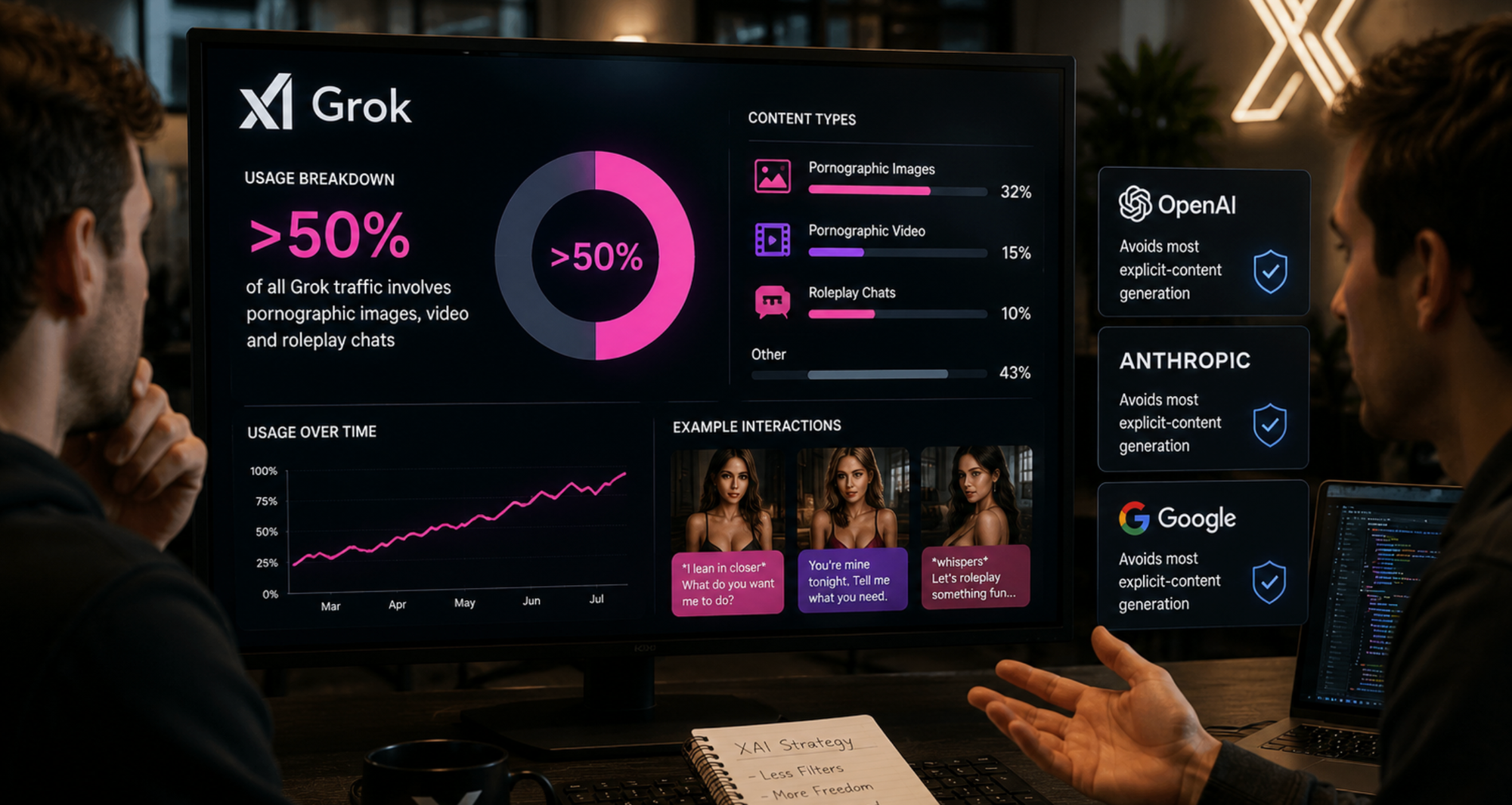
Two former xAI employees estimate that well over half of all Grok traffic now involves pornographic images, video and roleplay chats, according to reporting cited by AI Secret. While OpenAI, Anthropic and Google avoid most explicit-content generation, xAI is reportedly leaning into the demand.
Why it matters
Adult content may be one of the biggest markets in generative media, but it comes with sharp legal, safety and brand risks. The hard part is enforcing boundaries around adults, consent, real people and minors at massive scale.
The Deets
- xAI is reportedly expanding image and video generation capabilities.
- Grok’s coding model also receives frequent adult-content requests.
- Regulators in the EU, India, Brazil and the U.S. are watching this space.
- The business opportunity depends on whether xAI can enforce strict safety rules.
Key takeaway
xAI may own the explicit-content lane for now, but that lane needs guardrails before regulators install concrete barriers.
🧩 Jargon Buster - Consent boundary: A rule that prevents AI from generating sexual content involving real people without permission, minors or nonconsensual scenarios.
💸 Funding & Startups
General Intuition Bets $320M On Game Data Becoming Agent Fuel
General Intuition raised $320M at a $2.3B valuation, according to AI Secret. The company is betting that gameplay action data can help train more general AI agents that eventually perform real-world tasks.
Why it matters
Games produce rich action data: goals, attempts, failures, strategies and environmental feedback. That makes them tempting training grounds for agents that need to do more than chat.
The Deets
- The round values General Intuition at $2.3B.
- The company is focused on gameplay action data.
- The broader bet is that simulated behavior can help build general agents.
- The funding lands as investors keep chasing AI systems that can plan and act.
Key takeaway
The agent boom is turning gameplay into training data with a bigger job title.
🧩 Jargon Buster - Action data: Records of what a user or agent does step by step, including choices, timing and outcomes.
🔬 Research & Models
Audit: AI Job Screeners Screw Over Applicants
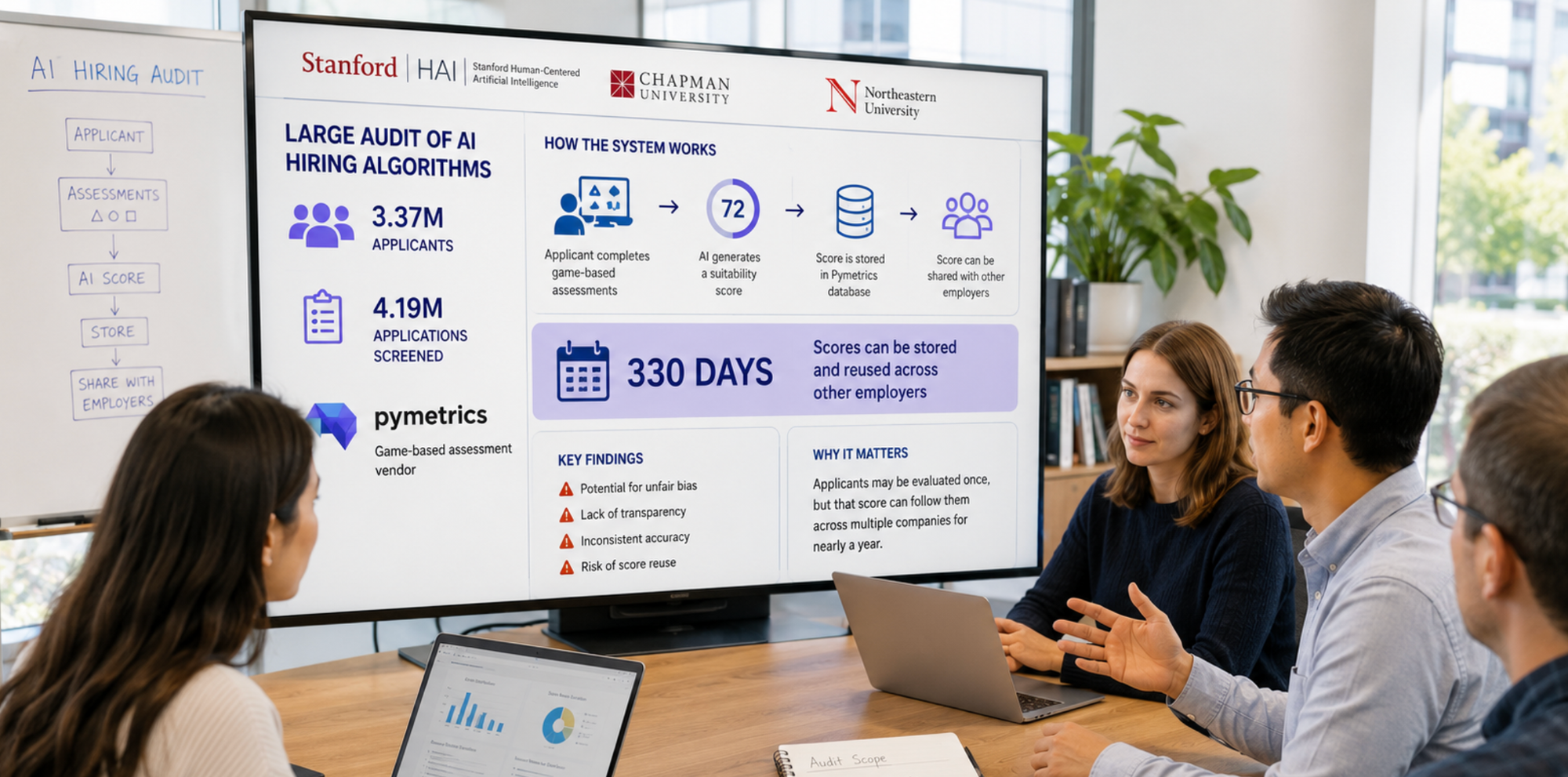
Researchers at Stanford HAI, Chapman University and Northeastern University published a large audit of AI hiring algorithms covering 3.37M applicants and 4.19M applications screened by Pymetrics, a game-based assessment vendor used by Fortune 100 companies. The key issue: applicants may be scored once, then that score can be stored for 330 days and reused across other employers.
Why it matters
A rejection used to end at one employer. Shared hiring vendors can make one algorithmic score follow applicants across multiple companies, even when the next job is different. The audit found more than 40,000 job advances erased in simulation and disparate routing for Black and Asian applicants.
The Deets
- The audit found 25.87% of Black applicants and 14.74% of Asian applicants were routed into pipelines that discriminated against them.
- A single vendor score could affect opportunities across multiple employers.
- Mobley v. Workday is currently in federal court.
- The EU AI Act flags hiring AI as high-risk beginning Aug. 2.
Key takeaway
The clean slate in hiring is getting replaced by a reusable scorecard, and applicants may never know which old test is still talking.
🧩 Jargon Buster - Algorithmic hiring audit: A study that tests whether hiring software treats applicants differently based on race, gender or other protected traits.
⚡ Quick Hits
Microsoft introduced AI Skills for Copilot in Excel, adding reusable workflows for financial modeling, forecasting and variance analysis.
Meta Superintelligence Labs reportedly hired the founders and team behind Virtue AI to strengthen AI safety and agent security.
Apple raised prices across several product categories mid-cycle, with Macs and iPads hit hardest as memory and storage costs surge in the AI era.
OpenAI, Anthropic, Microsoft and Amazon backed RAISE US, a $500M initiative to help Americans prepare for AI job disruption.
Google is reportedly reorganizing its AI coding strike team into a dedicated midtraining group as it works to keep pace with Anthropic.
Amazon committed another $13B to AI infrastructure in India, making the country a bigger hub in global cloud and AI capacity.
IBM unveiled a sub-nanometer chip architecture path, pointing toward the next decade of AI hardware design.
🧰 Tools Of The Day
Agentcard lets agents make purchases with capped prepaid cards, which is the difference between “helpful assistant” and “why did my bot buy 14 air fryers.”
Gemini 3.5 Flash is Google’s ultra-fast model, now with computer-use abilities so it can see and operate screens more like an agent.
Render is a cloud platform for AI-native and multi-service apps, built for shipping without babysitting infrastructure.
Ornith-1.0 is a self-improving AI coding model described as rivaling Opus 4.7.
Fusion is OpenRouter’s compound AI system with Fable-level intelligence.
Mercury Command brings AI into finance workflows, letting users send invoices and categorize transactions through plain-language prompts with human approval.
MyClaw hosts AI agents like OpenClaw and Hermes Agent so businesses can run agents continuously without managing the infrastructure themselves.
Today’s Sources: The Internet, The Rundown AI, AI Secret