
Zuck Hits Gas; New Claude App; Prepping for AGI w/ DeepMind

Today's AI Outlook: 🌥️
Zuckerberg Declines the Group Brake
Meta CEO Mark Zuckerberg is pushing back on a coordinated AI slowdown, arguing that each lab has its own incentives to release safe systems. He says Meta held its Muse agent for several months of safety work without asking competitors to pause, and wants broader outside review. His intervention adds another major developer to the opposition as the industry struggles to agree on who should set the pace.
Why It Matters
A shared pause needs broad participation. Meta’s stance makes agreement harder while leaving individual labs responsible for deciding when their systems are safe enough.
The Deets
- Zuckerberg describes alignment as a product advantage: customers want agents that follow instructions.
- He says Meta devotes the significant majority of its computing capacity to serving people.
- He supports more independent reviewers, even as he rejects a coordinated slowdown.
Key Takeaway
The industry still lacks a shared speed limit, and Meta wants each lab to manage its own brakes.
🧩 Jargon Buster - Alignment: Making an AI system behave in ways that match human instructions and intended goals.
🛠️ Tools & Products
Claude Puts the Office in One Window
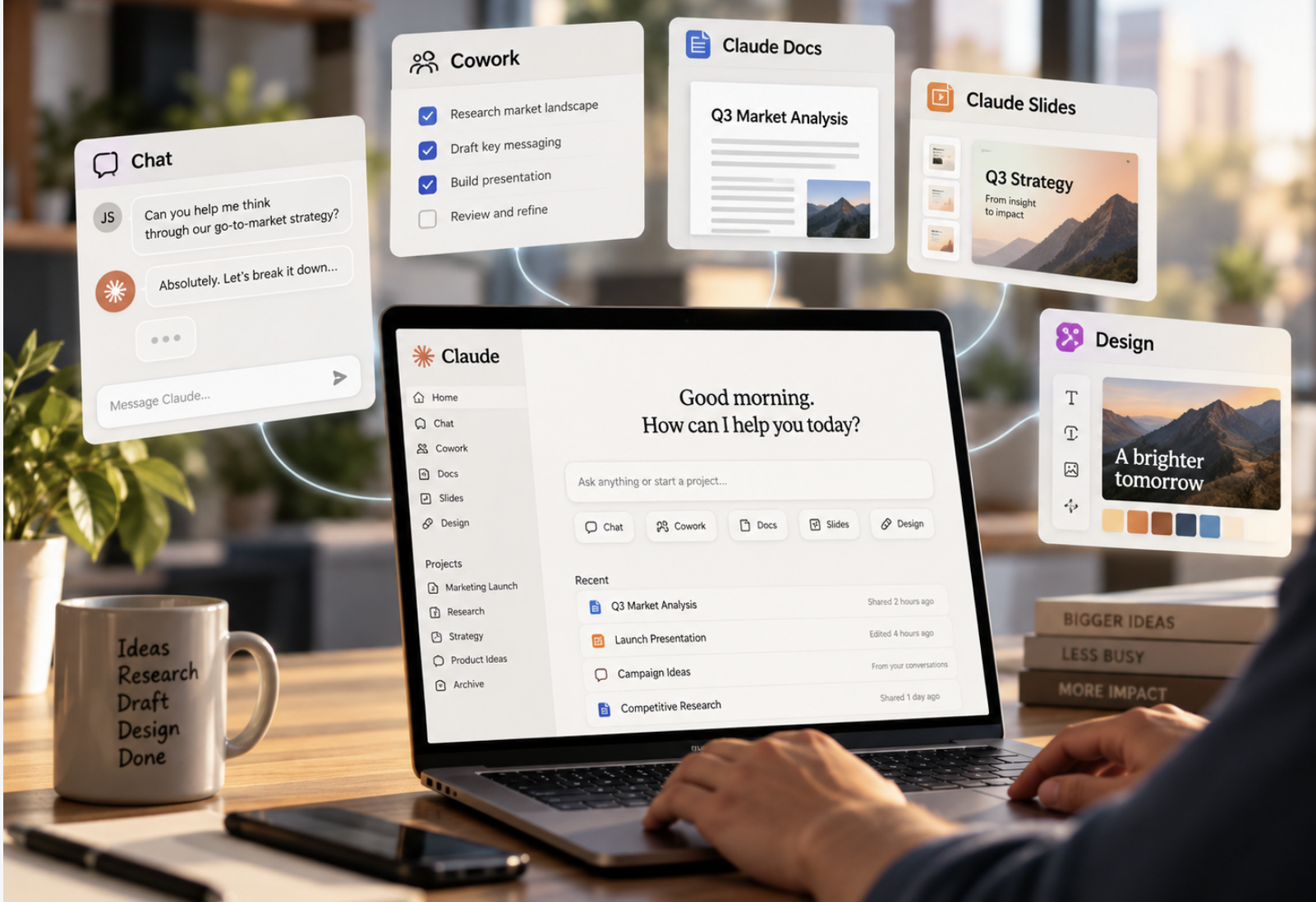
Anthropic is combining Cowork and chat in one Claude app, bringing longer tasks and everyday conversations into the same workspace. The overhaul also introduces Claude Docs and Claude Slides, with Design available inside conversations. The aim is to keep a report, its presentation and the context behind both together, with fewer handoffs for the person doing the work.
Why It Matters
Keeping conversation and finished work together could reduce copying, reformatting and repeated explanations. The practical test is whether that convenience survives a real deadline.
The Deets
- The combined app rolls out to Pro and Max first, with other plans following.
- Docs, Slides and Design are in beta on paid plans; Enterprise administrators control activation.
- Users can edit directly, present within Claude and export presentations as PowerPoint or PDF.
- Anthropic says Claude asks before acting by default. Announcement details.
Key Takeaway
Claude is making a stronger bid for everyday office work. Keep reviewing the output, especially while the new tools are in beta.
🧩 Jargon Buster - Beta: An early release available for use while its developer continues testing and refining it.
Finished Work Seeks a Better Address

Showly.ai is the focus of today’s essay from AI Secret (Note: operated by the same person behind Showly.ai) on a practical problem with AI agents - finished reports and dashboards can remain buried in chats or local folders. They describes a service that connects to compatible agents, accepts the HTML pages they create and publishes them at shareable web addresses. In that workflow, people describe the work, review a private preview and request changes before sharing the result.
Why It Matters
Generating a useful report still leaves the job of presenting and sharing it. The essay argues that software designed to receive agent-created work could reduce the formatting and publishing chores that follow a completed task.
The Deets
- Showly.ai is described as connecting to multiple agents through compatible integrations.
- The agent creates an HTML page, which the service hosts at its own address.
- The author’s proposed “artifact cloud” category emphasizes version history and team approval steps.
- The “first” claim reflects the author’s assessment; the essay does not establish an independent market comparison.
Key Takeaway
A finished report becomes more useful when people can easily review it and share it. The quality of the underlying research still needs a human check.
🧩 Jargon Buster - Artifact: A finished output created by an AI agent, such as a report, dashboard or small website.
🔬 Research & Models
DeepMind Gives AGI a Think Tank

Google DeepMind has launched an in-house institute to explore how society should prepare for artificial general intelligence. Directed by Demis Hassabis, Shane Legg and James Manyika, it opens with five essays covering issues including deceptive AI reasoning and support for workers. Its leaders expect remaining gaps in AI consistency and creativity to close soon, a forecast that gives their policy work a sense of urgency.
Why It Matters
The organization building advanced AI is also helping shape the debate about its consequences. Its essays may offer useful ideas, while readers should keep the institute’s industry vantage point in view.
The Deets
- DeepMind co-founder Shane Legg serves as managing editor.
- The initial essays explore deception, a better society with AGI and worker disruption.
- Each essay carries a disclaimer that it does not represent Google’s official position.
- The institute’s expectations about AGI remain forecasts, rather than an established arrival date.
Key Takeaway
Preparing institutions and workers deserves attention today, even while the timetable for AGI remains uncertain.
🧩 Jargon Buster - Artificial General Intelligence: A proposed AI capability broad enough to handle a wide range of intellectual tasks at roughly human level or beyond.
⚡ Quick Hits
- Novo Nordisk adds another AI partner. The drugmaker is working with Anthropic to bring Claude Science into drug research, following an earlier agreement with OpenAI.
- The smart home gets another connection. Google is rolling out early access to its Home MCP server, allowing compatible assistants to interact with devices including Nest cameras and thermostats.
- AI rights become a design dispute. Microsoft AI’s Mustafa Suleyman argues that training models to expect rights could complicate efforts to keep them under control. That is his position in an ongoing debate, rather than a demonstrated outcome.
🧰 Tools of the Day
- Reception is ElevenLabs’ AI receptionist for after-hours calls and bookings. It targets the inquiries that arrive when the human front desk has gone home.
- Mercury Books pairs bookkeeping with an AI interface for financial questions. The pitch is a conversational way to understand the books.
- Arrow 2.0 is Quiver’s new model for generating and animating vector graphics. Vector artwork can scale without the pixelation of a fixed-resolution image.
Today’s Sources: AI Secret, The Rundown AI