
AdsGPT Coming; Sam & Elon Feud Gets Personal; Robot Crushed By Train
Today's AI Outlook: 🌤️
ChatGPT Testing Ads, Once Called 'Last Resort'
OpenAI is officially testing targeted advertisements inside ChatGPT, marking a sharp turn from years of public hesitation. Ads will roll out to logged-in free users and the new $8/month Go tier in the U.S., appearing as clearly labeled Sponsored Recommendations beneath responses. Premium tiers remain ad-free, and OpenAI insists ads will not influence answers or involve selling user data.

The move lands as OpenAI prepares for a late-2026 IPO and launches ChatGPT Go globally. The timing is not subtle. Monetization pressure is rising, compute costs are ballooning and free usage is expensive. Sam Altman once called ads a “last resort.” Now they’re a controlled experiment.
Why it matters
AI assistants are built on perceived neutrality. Introducing commerce shifts the interface from tool to funnel, even if the answers stay untouched. This is less about today’s ad placement and more about tomorrow’s incentives: If ads work, the entire industry will likely feel the gravitational pull.
The Deets
- Ads excluded from health, politics and underage users
- Targeting based on conversation context
- Paid plans remain ad-free
- OpenAI says ads will never affect answers
- Go tier priced at $8/month with ads included
Key takeaway
Ads may scale fastest, but trust erodes slow and breaks fast. Execution here will set the tone for AI monetization across the industry.
🧩 Jargon Buster - Sponsored Recommendation: A paid suggestion shown separately from an AI’s generated answer, designed to avoid influencing core responses.
⚡ Power Plays
Musk and OpenAI Get Personal in Legal Battle
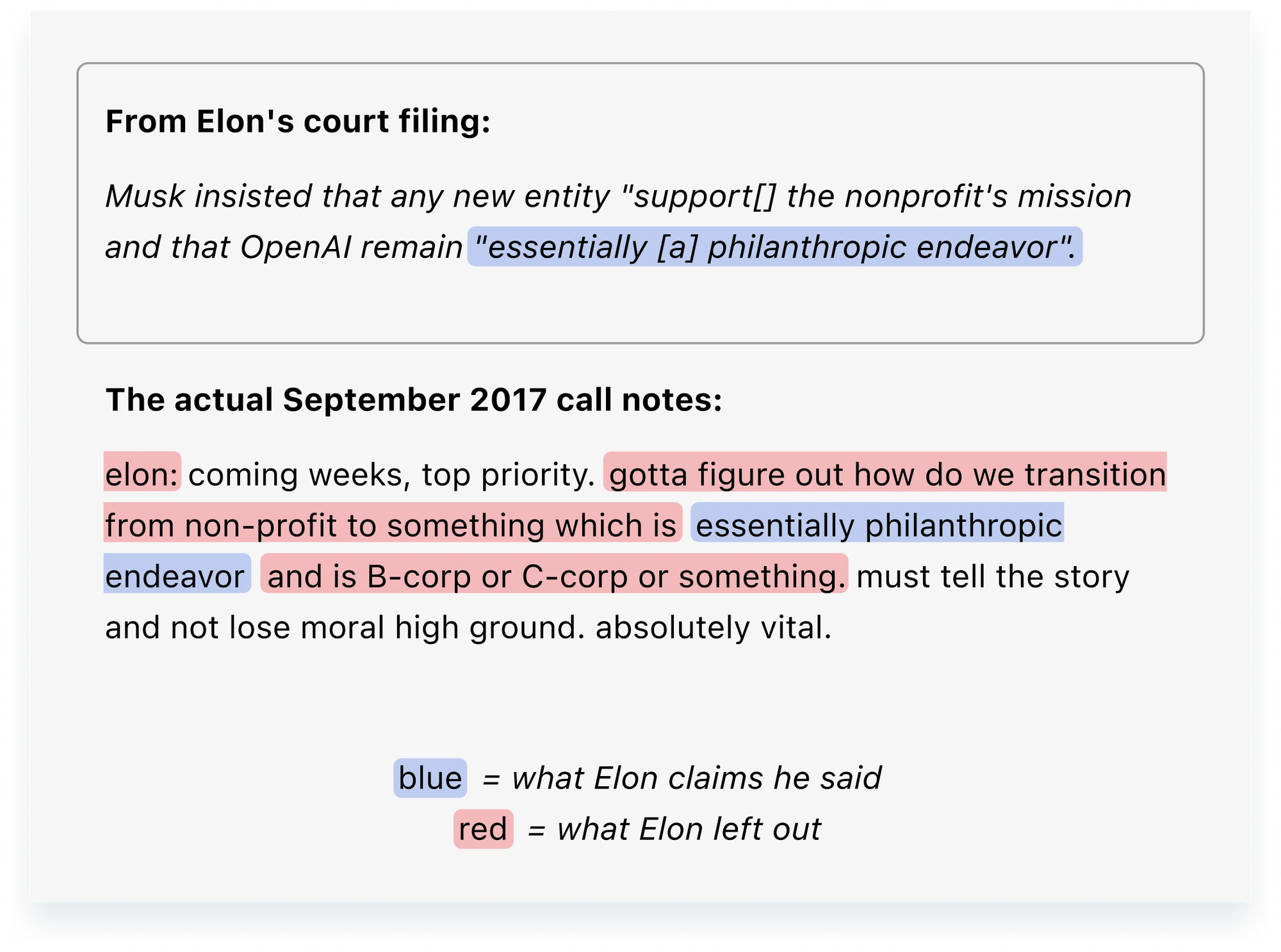
Ahead of an April trial, Elon Musk and OpenAI escalated their legal feud by publicly spilling the tea. Musk shared excerpts from Greg Brockman’s 2017 private journal, while OpenAI released its own correspondence accusing Musk of cherry-picking context. Both sides insist the full record helps them.
Musk is reportedly seeking $134B in damages, while OpenAI published a blog titled “The truth Elon left out.”
Why it matters
This is shaping up to be the messiest AI lawsuit ever, with implications for governance, nonprofit control, and the origin story of modern AI labs. The discovery phase alone is rewriting history in real time.
The Deets
- Brockman notes show early debates about OpenAI becoming a B-Corp
- Altman claims Musk wanted control paths tied to Mars colonization
- Musk promises testimony that will “blow your mind”
Key takeaway
This has gone beyond a lawsuit and into a battle over who gets to define AI’s founding myth.
🧩 Jargon Buster - Discovery: The pre-trial phase where both sides exchange documents and evidence, often the messiest part of major lawsuits.
🏗️ Funding & Startups
Anthropic Valued Like Infrastructure, Not a Startup

Anthropic is reportedly raising a massive $25B at a $350B valuation, with Sequoia Capital, GIC, and Coatue participating. Prior commitments from Microsoft and Nvidia already totaled up to $15B.
But this is not really venture scale... It's closer to utility scale.
Why it matters
Anthropic is being capitalized like power plants and fiber networks. At this size, competition shifts from clever features to who controls compute, energy and long-term contracts.
The Deets
- Valuation jump places Anthropic among the most valuable private companies ever
- Capital supports massive model training and inference demand
- Locks in dependence on chips, power, and geopolitics
Key takeaway
AI is becoming infrastructure. And infrastructure favors incumbents with deep pockets and political tolerance.
🧩 Jargon Buster - AI Utility Model: Treating AI systems as long-lived, capital-intensive infrastructure rather than fast-iterating software products.
🔬 Research & Models
Images in Under a Second May Change the Game

Black Forest Labs released FLUX.2 [klein], a 4B parameter image model optimized for speed. It runs locally, generates images in under one second, fits in roughly 13GB VRAM, and ships under an Apache 2.0 license. You can try it here.
Why it matters
Sub-second generation collapses iteration cycles. When speed improves by an order of magnitude, quality gaps matter less. This reframes image generation as interactive infrastructure, not a showcase demo.
The Deets
- Four-step generation
- Designed for local use
- Prioritizes workflow speed over visual ceilings
Key takeaway
Latency is becoming the primary competitive metric. Averages beat masterpieces when iteration is instant.
🧩 Jargon Buster - Latency-First Models: Systems optimized for response time rather than peak output quality.
🧰 Tools & Products
Coding From Your Phone With Codex
OpenAI’s Codex can now run in the cloud, letting developers code, review, and manage projects from anywhere, including a phone, when paired with Cursor and GitHub.
Why it matters
This pushes coding toward asynchronous, agent-driven workflows where humans supervise instead of grind.
The Deets
- Cloud reviews don’t count against local usage
- Supports slash commands like /review and /status
- Automatic PR reviews enabled via GitHub
Key takeaway
Coding is becoming ambient. Location no longer matters.
🧩 Jargon Buster - Agentic Development: Software workflows where AI agents autonomously execute tasks with human oversight.
🤖 Big Picture
When Robots Fail, Infrastructure Pays the Price
A Coco Robotics delivery bot stalled on active railroad tracks in Miami and sat motionless for about 15 minutes before being struck by a passenger train. The company cited a rare hardware failure.
Why it matters
Robots failing is commonplace in these early days. Failing inside high-energy infrastructure zones is not. Lithium batteries and motors turn minor errors into serious hazards.
The Deets
- Incident caught on video
- Robot was not on active delivery
- Raises questions about exclusion zones and override speed
Key takeaway
The problem is less autonomy and more containment.
🧩 Jargon Buster - Hard Exclusion Zones: Areas where autonomous systems are technically prevented from entering due to risk.
⚡ Quick Hits
- ClickHouse hit a $15B valuation as AI drives real-time analytics demand.
- Google expanded Flow AI video tools to Workspace users.
- Reuters warns AI-generated slop is disrupting sports media trust.
- Google says Gemini will stay ad-free to avoid trust erosion.
- Wikimedia partnered with Amazon, Meta, Microsoft, and others for AI training.
🛠️ Tools of the Day
- Scroll.ai turns knowledge bases into enterprise-grade chatbots.
- Claude Cowork brings agentic coding to Pro users.
- MuseMail.ai creates on-brand emails from one prompt.
- OMEGA Browser is a 3.6MB RAM-only, privacy-first macOS browser.
Today’s Sources: The Rundown AI, AI Secret, Robotics Herald