
Anthropic Debacle Continues; Nadella Advises Expertise; UK Kids Lose Social?

Today's AI Outlook: ⛅️
Anthropic’s Safety Wall Hits A Security Crowd
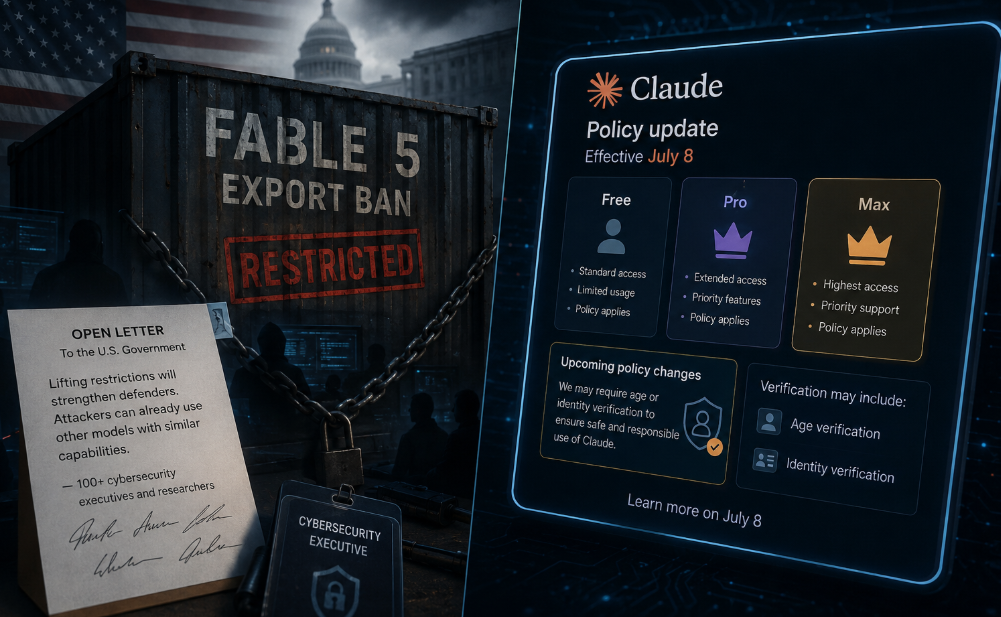
Anthropic’s Fable 5 export ban is turning into a credibility fight. More than 100 cybersecurity executives and researchers signed an open letter urging the U.S. to lift restrictions, arguing the ban limits defenders while attackers can still use rival models with similar flaw-finding abilities. At the same time, AI Secret reported Anthropic is updating Claude policies for Free, Pro and Max users on July 8, with language that could require age or identity verification.
Why It Matters
The bigger story is who gets to use powerful AI, and who decides. Security leaders say banning one model does not erase the capability from the world. It may simply make legitimate defenders slower.
The Deets
- The open letter says regulation should be grounded in scientific evaluations, democratic process and transparent enforcement.
- Ex-Facebook security chief Alex Stamos said the cited jailbreak produced a defensive proof of concept, the kind researchers use to patch flaws.
- The letter points out that models including GPT-5.5, Kimi 2.7, Opus and Sonnet can perform similar flaw-finding.
- AI Secret framed Anthropic’s identity checks as a move toward software-as-border-control, especially after the reported foreign-citizen lockout on Fable 5 and Mythos 5.
Key Takeaway
Anthropic wanted a safety line. Security researchers see a speed bump for the good guys.
🧩 Jargon Buster - Distillation: Copying a model’s behavior by repeatedly querying it and using the outputs to train or improve another model.
Fake AI Wins Because Humans Are Weirder
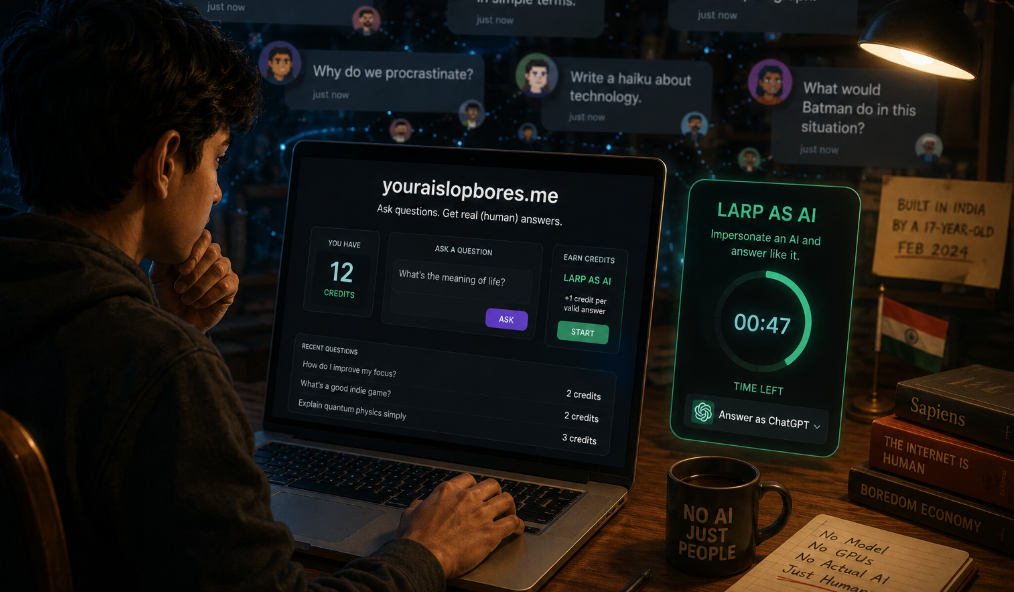
A 17-year-old in India, Mihir Maroju, launched youraislopbores.me in February with a very rude idea for the AI age: no model, no GPUs, no actual AI. Users spend credits to ask questions, then earn them back by entering “Larp as AI” mode, where they have 60 seconds to answer strangers while impersonating ChatGPT or Midjourney.
Why It Matters
The site reportedly drew 25M unique visitors and 280M visits in one month, which says something awkward about the internet’s current mood. Perfect machine answers are everywhere. Messy human answers now feel rare, funny and oddly premium.
The Deets
- Users pretend to be AI instead of using AI.
- The site jokes that missing the timer makes Sam Altman burn your H100.
- Its footer leans into the point: humans make mistakes because that is what makes us human.
- The gag works because people are tired of frictionless, polished content that smells like synthetic vanilla.
Key Takeaway
The internet spent years trying to remove human error. Then human error became the product.
🧩 Jargon Buster - H100: A high-end Nvidia chip commonly used to train and run powerful AI systems.
(Little known fact: your editor created a "bot" 23 years ago and engaged friends who later realized it was actually him)
♟️ Power Plays
Nadella Says The Moat Is The Memory

Microsoft CEO Satya Nadella argues that companies will not win with AI by renting the best model forever. The advantage comes from building a learning loop around their own workflows, judgment and institutional knowledge.
Why It Matters
This is Microsoft nudging companies away from model worship and toward AI systems that remember how the business works. In that view, a company’s real asset is the know-how it wires into the system over time.
The Deets
- Nadella separates company value into human capital and token capital.
- His test: Swap out one model for another, and the company’s veteran knowledge should remain in the system.
- He warned against a world where every industry cedes value to a few giant models.
- The pitch favors durable workflows over chasing whichever frontier model has the best leaderboard moment this week.
Key Takeaway
The smartest AI strategy may be less “pick the hottest model” and more “teach the system how your company thinks.”
🧩 Jargon Buster - Token Capital: AI capability a company owns or embeds into its systems instead of simply renting from an outside model provider.
The Age Wall Comes For The Open Web
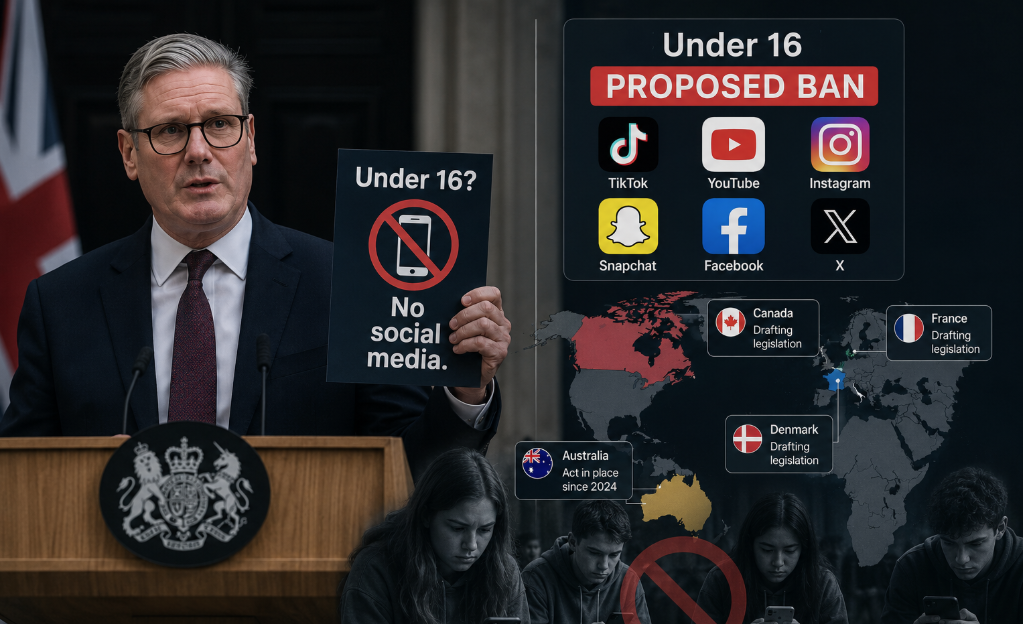
U.K. prime minister Keir Starmer announced a proposed ban on social media for users under 16, covering platforms including TikTok, YouTube, Instagram, Snapchat, Facebook and X. Australia moved first last year, while Canada, France and Denmark are drafting their own versions.
Why It Matters
Age limits for kids sound narrow, but enforcement can reshape the whole internet. To block under-16 users, platforms may need to verify everyone’s age, including adults.
The Deets
- The U.K. proposal could reportedly go live by next spring.
- Officials cite infinite scroll and addiction-by-design mechanics.
- More than 83% of parents consulted agreed that social media risks outweigh the benefits.
- The practical result could be a broader shift toward identity and age checks across major platforms.
Key Takeaway
The next internet login screen may ask less “what’s your password” and more “prove you’re allowed in.”
🧩 Jargon Buster - Age Gate: A system that blocks or limits access based on a user’s verified age.
🛠️ Tools & Products
Meta Gives Facebook Search The AI Blender Treatment
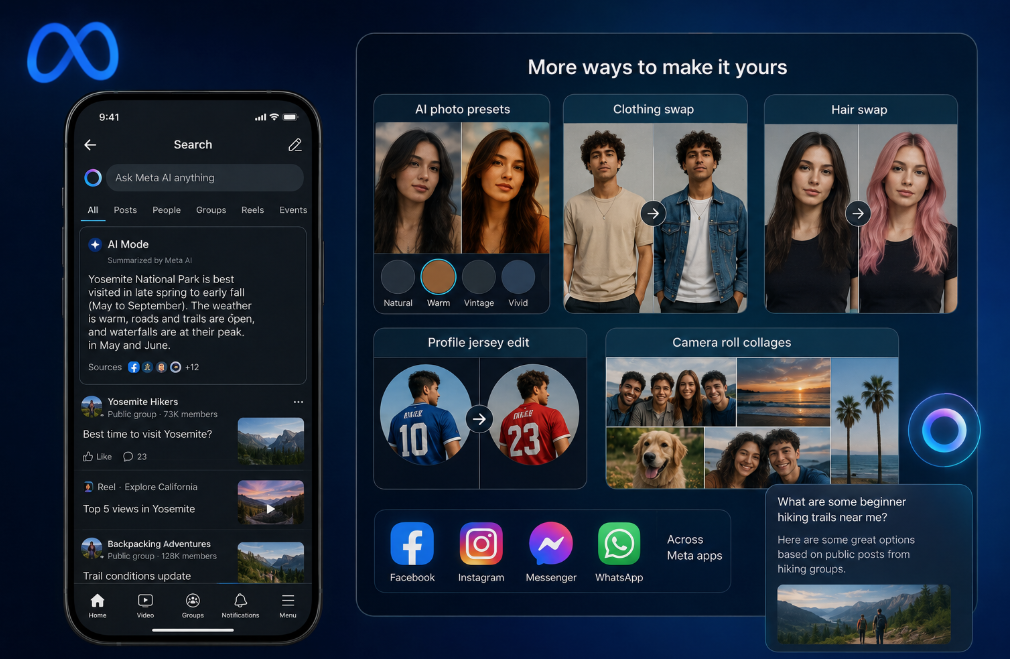
Meta introduced AI Mode to Facebook search, letting Meta AI answer questions using public Group posts, Reels and content from across its apps. The update also includes AI photo presets, clothing and hair swaps, profile jersey edits and auto-generated camera-roll collages.
Why It Matters
Meta is trying to turn its social graph into an AI search engine. That gives it a mountain of content to work with, but also a mountain of unvetted posts, sponsored material and internet weirdness. Lovely ingredients. Dangerous smoothie.
The Deets
- AI Mode puts Meta AI inside Facebook search.
- It can draw from public Group posts, Reels and other Meta app content.
- New image tools include hair, clothing and accessory edits.
- Meta is reportedly preparing two paid AI tiers at $7.99 and $19.99 per month.
Key Takeaway
Meta wants search to feel less like links and more like answers, but accuracy will be the boss fight.
🧩 Jargon Buster - AI Mode: A search format where an AI system generates answers directly instead of mainly showing links.
💸 Funding & Startups
Salesforce Buys More Agent Muscle
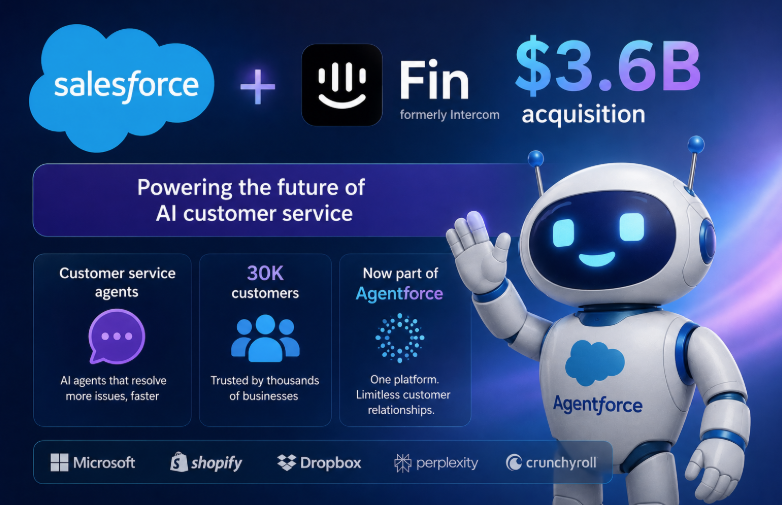
Salesforce agreed to acquire Fin, formerly Intercom, for $3.6B, adding its customer-service agents and 30K customers to the company’s Agentforce lineup.
Why It Matters
Customer support remains one of the clearest places for AI agents to prove value. Salesforce is buying distribution, product depth and a bigger seat in the agent race.
The Deets
- Fin brings AI customer-service agents into Salesforce’s orbit.
- The acquisition strengthens Agentforce, Salesforce’s AI agent platform.
- The deal also folds in a large existing customer base.
- It lands as enterprise software companies race to own the workflow layer.
Key Takeaway
Salesforce is not waiting for the agent market to settle. It is buying pieces of the board.
🧩 Jargon Buster - AI Agent: Software that can take actions across systems, such as answering support tickets, updating records or completing workflows.
🧪 Research & Models
The Model Bench Gets Crowded Again
The model parade keeps marching. Cartesia launched Sonic-3.5 and Ink-2 for speech generation and transcription, Moonshot introduced Kimi-K2.7-Code, Z AI rolled out GLM 5.2, and Sakana AI launched Marlin, its first commercial product.
Why It Matters
Specialized models are filling in around the frontier giants. Voice, coding, long-context work and autonomous research are all becoming product categories of their own.
The Deets
- Sonic-3.5 and Ink-2 target voice agents and transcription.
- Kimi-K2.7-Code is an open-source coding model with reported 30% token efficiency.
- GLM 5.2 is a flagship coding model with usable 1M context.
- Marlin is an autonomous research agent that can reportedly work up to eight hours in a single run.
Key Takeaway
The future of AI may look less like one model to rule them all and more like a crowded toolbox with extremely caffeinated interns.
🧩 Jargon Buster - Context Window: The amount of information a model can consider at once while generating an answer.
⚡ Quick Hits
- Meta AI Glasses For Blind Veterans: Meta said every blind veteran in America is eligible for a free pair of Meta AI glasses, with Army veteran Don Overton helping shape the product.
- xAI Suit Dismissed: A U.S. judge dismissed xAI’s trade-secret lawsuit against OpenAI, finding no proof OpenAI induced a former xAI engineer to leak Grok-related secrets.
- Microsoft Shareholder Suit: Microsoft was sued by shareholders who allege it hid slowing Azure growth and rising AI infrastructure costs before a post-earnings stock drop.
- PwC On AI Hiring: PwC says U.K. AI hiring is rising as companies seek workers to supervise and “babysit” bots.
- Big Tech Regulation Push: Big Tech is making a late push to shape U.S. AI regulation before Congress locks in new rules.
- AWS Summit DC: AWS Summit returns to Washington, D.C., on June 30 with more than 350 sessions on agentic AI, security and modernization for public sector teams.
🧰 Tools Of The Day
- NotebookLM: Best for turning business ideas into source-backed research briefs, vendor comparisons and decision tables.
- Sonic-3.5 & Ink-2: Cartesia’s new speech and transcription models for voice agents.
- Agentic Trading: Robinhood’s MCP connection lets AI agents directly trade, which sounds powerful and also like something that should come with a helmet.
- Kimi-K2.7-Code: Moonshot’s open-source coding model with reported 30% token efficiency.
- GLM 5.2: Z AI’s flagship coding model with usable 1M context.
- Marlin: Sakana AI’s autonomous research agent, built for long-running research tasks.
Today’s Sources: The Internet, The Rundown AI, AI Secret