
Leaked: OpenAI Costs Balloon; GPT Voice Listens; DeepSeek Raises Big

Today's AI Outlook: ⛅️
Leaked Memo Shows OpenAI’s Revenue Rocket Has Expensive Fuel Problem
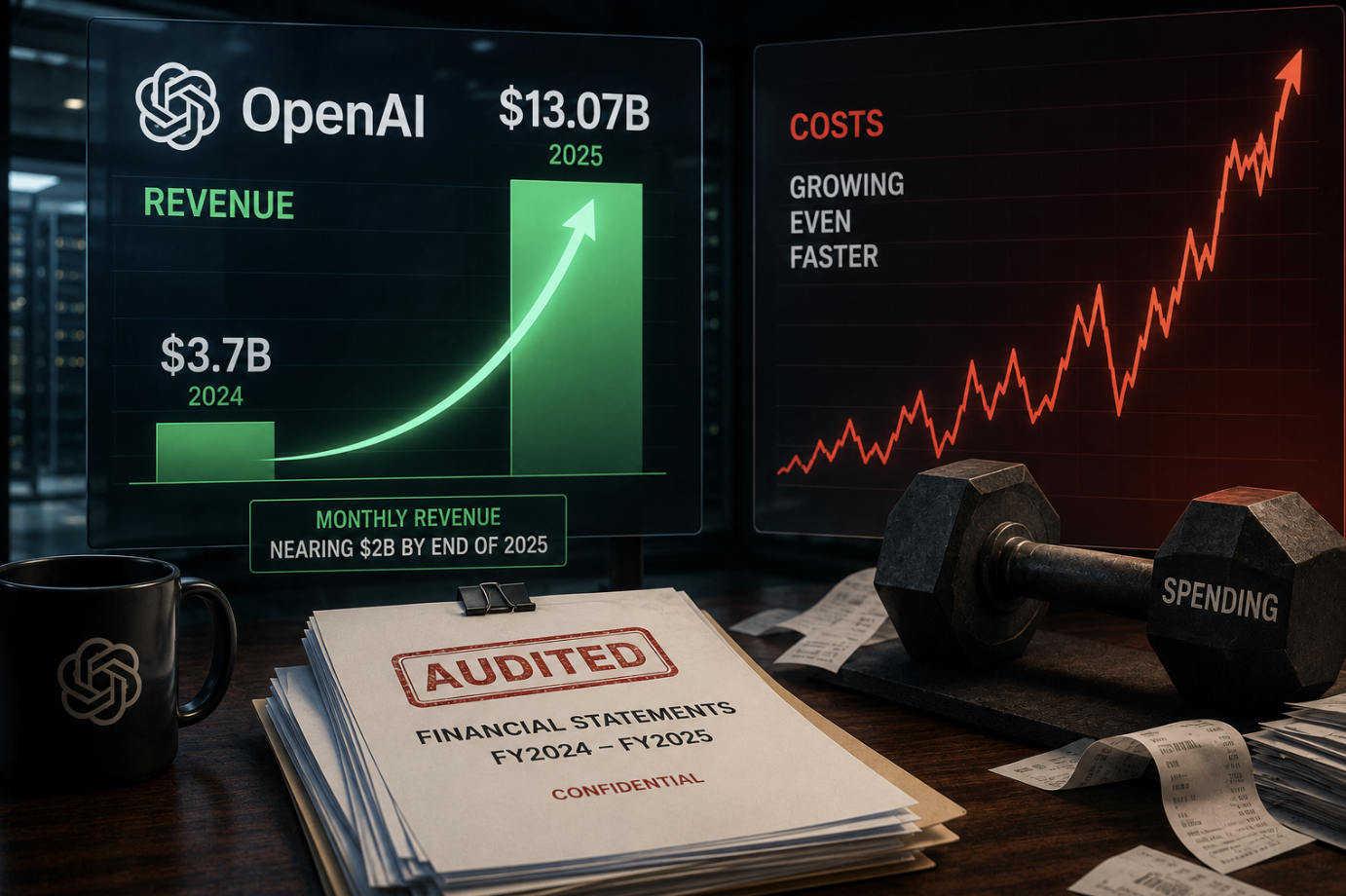
OpenAI’s business is growing fast, but newly leaked audited financial documents show that its costs are growing even faster. According to reporting from Ars Technica, OpenAI revenue jumped from $3.7B in 2024 to $13.07B in 2025, with monthly revenue reportedly nearing $2B by the end of 2025. That is a monster growth curve, but the company’s spending curve is still doing CrossFit.
Why it matters
OpenAI is trying to convince investors it can become profitable by 2030. The challenge is that its biggest expenses, especially R&D, Microsoft compute costs, inference costs and sales spending, are still swamping revenue.
The Deets
- Revenue: OpenAI grew from $3.7B in 2024 to $13.07B in 2025.
- R&D costs: Research and development hit $19.18B in 2025, up from $7.81B the year before.
- Microsoft bill: OpenAI paid $10.59B in R&D costs to Microsoft alone in 2025.
- Cost of revenue: The cost of delivering products rose to $7.5B, likely tied to inference and compute.
- Sales and marketing: Spending climbed from $1.11B in 2024 to $5.73B in 2025.
- Operating loss: OpenAI’s loss from operations grew to $20.92B in 2025.
- Net loss: The headline net loss hit nearly $39B, though roughly $30B appears tied to a one-time accounting charge related to investor valuation changes.
- Users: ChatGPT reportedly has more than 900M weekly active users, but only about 50M are paid subscribers.
Key takeaway
OpenAI has solved the demand problem. Now it has to solve the “every answer costs money” problem.
🧩 Jargon Buster - Inference: The moment an AI model generates an answer, image, video or other output after a user prompt. Training builds the model. Inference is when the model actually gets used.
ChatGPT’s Voice To Get Faster, More Human

OpenAI is preparing a major upgrade to ChatGPT Voice built around a bidirectional audio model called GPT-Bidi-1, according to AI Breakfast. The idea is simple and very human: let the assistant listen and speak at the same time, so it can better handle interruptions, adjust mid-sentence and stop doing the awkward frozen-podcast-host routine.
Why It Matters
OpenAI is trying to defend ChatGPT’s lead at a moment when that lead is visibly shrinking. ChatGPT’s AI assistant market share reportedly fell below 50% for the first time, landing at 46.4%, while Gemini and Claude continue gaining ground. The fight is shifting toward assistants that can hear, act, browse, click and automate.
The Deets
- GPT-Bidi-1 reportedly includes High, Medium and Instant intelligence tiers, giving users a choice between deeper reasoning and lower latency.
- OpenAI is also building deeper OS and browser automation into Codex.
- Its stack includes Computer Use for mimicking clicks and keystrokes, a Chrome extension for authenticated web sessions, and an isolated in-app browser for sandboxed debugging.
- OpenAI also introduced Deployment Simulation, testing future systems against 1.3M historical, de-identified conversations.
- The company reportedly has a $13B revenue run rate, but large operating losses and heavy R&D spending remain a pressure point.
Key Takeaway
OpenAI’s next moat is less about answering better and more about acting faster, listening better and living closer to your workflow.
🧩 Jargon Buster - Bidirectional Audio Model: A voice AI system that can listen and talk at the same time, making conversations feel more natural when people interrupt or change direction.
⚡ Power Plays
SpaceX Buys Cursor, And The Coding Crown Changes Hands Fast

SpaceX has officially moved to acquire Cursor maker Anysphere in a $60B all-stock deal. The deal follows SpaceX’s public-market surge and gives Elon Musk’s ecosystem a major AI coding platform at a time when coding agents are becoming one of the most valuable front doors into AI.
Why It Matters
Cursor’s arc shows how compressed AI market cycles have become. It reportedly reached $1B in revenue in 18 months, but its market share slipped from 41% in June 2025 to 26% by May 2026 as Anthropic gained ground. In AI software, the victory lap now comes with a stopwatch.
The Deets
- SpaceX and Cursor first announced an April deal with an acquisition option.
- Cursor CEO Michael Truell teased a new model that is “generally intelligent,” trained from scratch and comparable in size to Opus.
- SpaceX said Cursor is already part of model-training work for Grok Build and its own editor.
- The deal gives Musk a stronger developer platform across SpaceX, xAI and the broader Grok stack.
- Cursor also introduced Origin, a GitHub competitor, and an iOS beta app.
Key Takeaway
Cursor cashed out while still strategically valuable, giving SpaceX a coding-agent beachhead and Musk another piece of the AI stack.
🧩 Jargon Buster - AI IDE: An integrated development environment, or coding workspace, with AI built in to help write, debug and manage software.
Anthropic Blinks On Pricing As API War Heats Up
Anthropic delayed a billing overhaul for the Claude Agent SDK on the day it was expected to launch, according to AI Breakfast. The proposed change would have pushed heavy automation users away from flat-rate subscription pools and toward usage-based API pricing after a small monthly credit.
Why It Matters
Developers are becoming the new swing voters in AI. OpenAI is reportedly preparing aggressive API price cuts, and Anthropic appears unwilling to hand those users a reason to leave.
The Deets
- The delayed billing plan would have affected tools like the Agent SDK and
claude -p. - Heavy automation users would likely have seen much higher costs.
- Anthropic is reportedly heading toward an IPO, making developer retention especially important.
- AI Breakfast also reports geopolitical friction around U.S. export limits on top Claude systems.
- The Rundown AI says the Trump administration reportedly rejected a U.K. request to exempt G7 allies from the Anthropic export ban.
Key Takeaway
The model race is turning into a pricing, access and sovereignty fight, with developers stuck in the middle and holding the credit card.
🧩 Jargon Buster - Agent SDK: A software development kit that lets developers build AI agents that can perform tasks programmatically instead of only chatting.
xAI’s Memphis Turbines Get A National Security Shield

The Department of Justice backed xAI in a lawsuit from the NAACP seeking to stop 57 unpermitted natural gas turbines powering xAI’s Colossus data centers near Memphis, according to AI Secret. The DOJ argued that shutting the turbines down would harm national, economic and energy security.
Why It Matters
AI infrastructure is becoming political infrastructure. When compute becomes tied to military readiness and national security, environmental permitting fights start looking like geopolitical fights with exhaust fumes.
The Deets
- The turbines power xAI’s Colossus data centers.
- xAI reportedly classifies the trailer-mounted turbines as “mobile.”
- The DOJ memo cited Grok as one of four AI models supporting military operations.
- SpaceX’s IPO filing reportedly earmarked another $2.8B for turbines.
- The lawsuit was brought by the NAACP.
Key Takeaway
The new AI advantage increasingly runs through power, permits and political cover, not only model quality.
🧩 Jargon Buster - Compute: The processing power needed to train and run AI models, usually provided by huge clusters of chips inside data centers.
🛠 Tools & Products
Perplexity Finance Wants To Be Your Stock Research Tab
The Rundown AI highlights Perplexity Finance as a free AI stock research hub inside the Comet desktop browser. Users can screen stocks in plain English, inspect ticker pages, review bull and bear cases, check earnings and ask follow-up questions with the Comet assistant.
Why It Matters
Financial research is a tab explosion factory. Perplexity is trying to collapse screeners, filings, news, analyst targets and portfolio context into one AI-guided workspace.
The Deets
- Users can search prompts like “Find energy stocks with low PE ratios.”
- Ticker pages include Overview, Financials, Earnings and Analysis tabs.
- The Comet assistant can explain stock moves in plain English.
- Users can set price alerts and watchlists.
- Perplexity also supports brokerage account connections through Plaid.
Key Takeaway
Perplexity Finance is pushing AI search from answer engine toward workflow hub, especially for retail investors who hate spreadsheet spelunking.
🧩 Jargon Buster - Stock Screener: A tool that filters stocks based on criteria like valuation, sector, revenue growth or analyst ratings.
💸 Funding & Startups
DeepSeek Raises Big As Open Models Gain Momentum
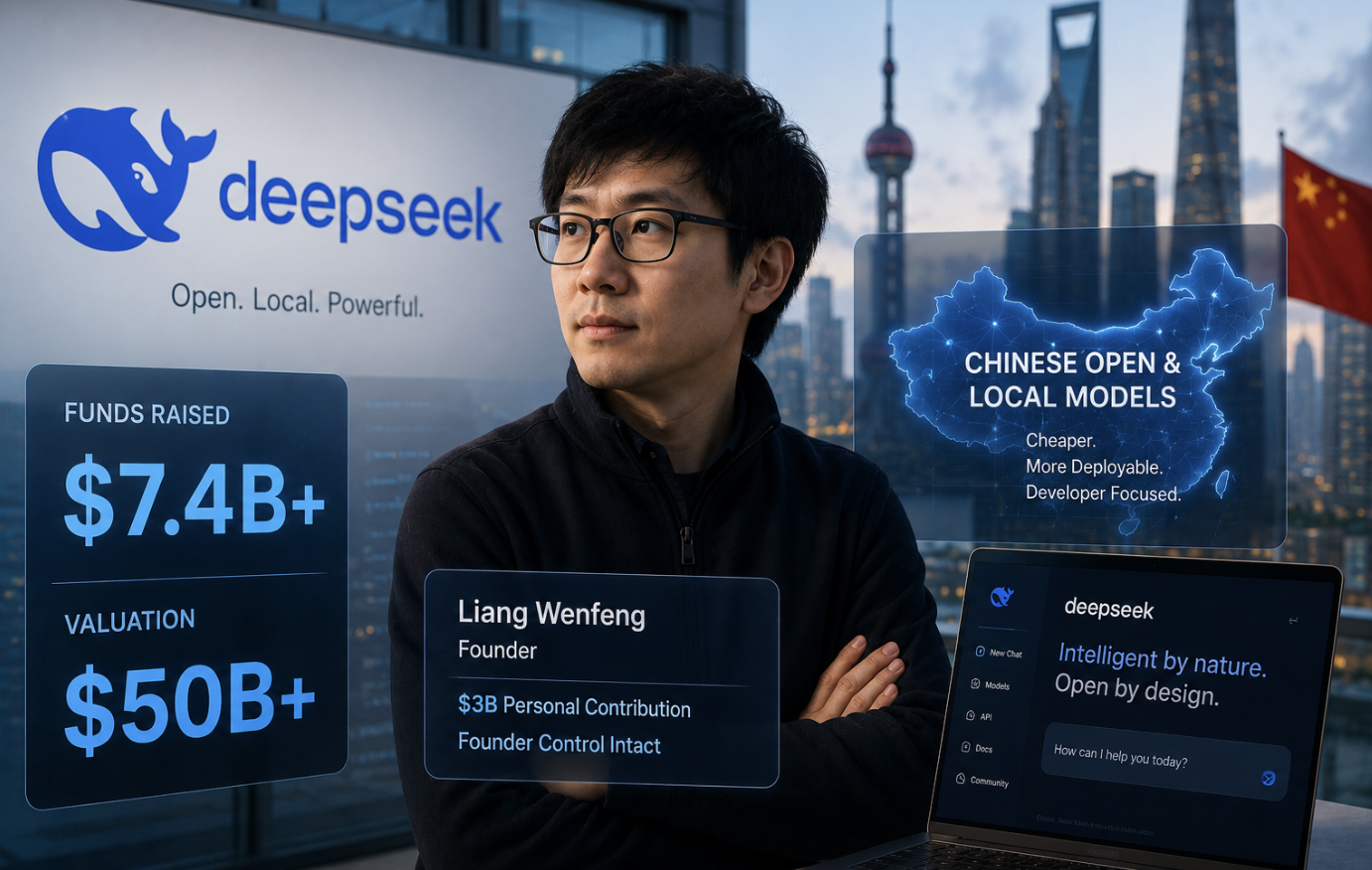
DeepSeek reportedly raised more than $7.4B at a valuation above $50B, according to The Rundown AI and AI Secret. Founder Liang Wenfeng personally contributed $3B, keeping founder control intact as Chinese open and local models gain attention from developers looking for cheaper, more deployable alternatives.
Why It Matters
As U.S. model access gets tangled in pricing shifts and export controls, open and locally deployable models are becoming more attractive to governments, companies and developers who want options.
The Deets
- DeepSeek’s raise makes it one of China’s most expensive AI startups.
- Its valuation reportedly topped $50B.
- The deal comes as Chinese labs including DeepSeek, Moonshot AI and Z.ai gain usage momentum.
- OpenRouter rankings reportedly show strong demand for cheaper alternatives.
- The trend benefits teams seeking more control over deployment and cost.
Key Takeaway
The open-model wave is getting capital, users and geopolitical tailwinds all at once.
🧩 Jargon Buster - Open-Weight Model: An AI model whose trained parameters are released so developers can run or adapt it more freely than a closed commercial model.
🔬 Research & Models
Z.ai’s GLM-5.2 Brings Open Weights Closer To The Frontier
Chinese AI lab Z.ai released GLM-5.2, an open-weights model that The Rundown AI says is competitive with GPT-5.5 and Claude Opus 4.8 across coding benchmarks. The model includes a 1M-token context window, strong long-horizon task performance and two effort modes, High and Max.
Why It Matters
Open models are narrowing the gap with closed frontier systems while remaining cheaper and easier to deploy locally. That combination hits the market exactly where customers are most sensitive: performance, access and cost.
The Deets
- GLM-5.2 was released under an MIT license.
- It keeps pricing in line with GLM-5.1, at a fraction of frontier-model costs.
- It reportedly surpasses GPT-5.5 on some coding, reasoning and math benchmarks.
- Its overall scores are just below Opus 4.8.
- The model’s 1M-token context window helps with long documents, large codebases and extended agent tasks.
Key Takeaway
GLM-5.2 makes the open-model lane look less like a discount aisle and more like a serious frontier-adjacent strategy.
🧩 Jargon Buster - Context Window: The amount of text, code or data an AI model can consider at one time before generating a response.
Meta Tries To Patch Its AI Morale Bug

Meta CTO Andrew Bosworth pledged a culture reset after reports of forced Applied AI transfers, model-training grunt work and sinking morale, according to The Rundown AI. The memo promised manager caps, more internal job movement and better office perks.
Why It Matters
AI reorganizations look clean in strategy decks and messy in Slack. Meta’s AI push may be producing stronger models, but internal resentment can become a real execution problem when top AI talent has options.
The Deets
- Bosworth said Meta “did an atrocious job explaining the vision” of its AI reorg.
- Thousands of employees were moved into work supporting AI models in March.
- The changes reportedly damaged internal trust.
- One worker called the unit “the gulag.”
- Meta also faced backlash over mandatory employee computer mouse tracking for AI training data.
Key Takeaway
Meta can ship better AI only if its humans stop feeling like training data with badges.
🧩 Jargon Buster - Model Training Data: The information used to teach an AI system how to recognize patterns and generate useful outputs.
Seattle’s 911 AI Problem

Seattle Fire Department has reportedly used Corti, an AI tool from a Copenhagen startup, on every 911 medical call since December 2023. The system helped dispatchers route some callers to a nurse line instead of sending ambulances, but AI Secret reports the department did not disclose the system, file it under Seattle’s surveillance ordinance or seek City Council approval.
Why It Matters
AI triage can help reduce pressure on overloaded emergency systems. The problem is accountability. When AI influences whether someone gets an ambulance, the public deserves audits, oversight and a very low tolerance for “trust us.”
The Deets
- The tool was used on every 911 medical call.
- Its purpose was to help identify lower-acuity cases that could go to a nurse line.
- Reported diversions jumped 32%.
- Seattle officials allegedly skipped required surveillance review processes.
- The risk is not abstract. A wrong call in emergency triage can be fatal.
Key Takeaway
AI in public services needs more than good intentions. It needs visibility, audit trails and democratic oversight before it touches life-or-death decisions.
🧩 Jargon Buster - AI Triage: The use of AI to help sort cases by urgency, such as deciding whether a caller needs an ambulance or another form of care.
⚡ Quick Hits
- Microsoft launched Copilot Cowork worldwide with usage-based pricing, giving Microsoft 365 users an AI agent for multi-step tasks.
- Databricks acquired Panther to strengthen cyberattack detection inside its data intelligence platform.
- HSBC formed a multi-year AI partnership with Google Cloud focused on wealth management, financial risk and staff productivity.
- McKinsey said AI could unlock €15B in productivity gains for Hungary by 2030, while executives remain divided on adoption costs and competition.
🧰 Tools Of The Day
- Perplexity Finance: A finance research hub inside Comet for screeners, ticker summaries, earnings context, alerts and portfolio analysis.
- GLM-5.2: Z.ai’s open-weights model with a 1M-token context window, strong coding benchmarks and MIT licensing.
- Mercury Command: A natural-language banking agent with approval workflows built in.
- Framer 3.0: Canvas-native agents that can help build and run websites.
- Cursor Origin: Cursor’s new GitHub competitor, launched alongside an iOS beta for the AI coding platform.
- nexos.ai: A multi-model AI subscription hub that routes tasks across 100-plus models.
- MintDreamer: A set of tuned image apps for tasks like restoring photos, changing hairstyles, staging rooms and creating headshots.
Today’s Sources: The Internet, Ars Technica, AI Breakfast, The Rundown AI, AI Secret