
OpenAI Rushes Release; AI Startup Beats Google; Robot Kicks @ss
Today's AI forecast: 🌤️
OpenAI Fast-Tracks GPT-5.2 After Google’s Gemini 3 Push
OpenAI just slammed its foot on the accelerator and is reportedly pushing GPT-5.2 out the door on December 9, weeks ahead of schedule. The reason: Sam Altman called a “code red” after Google’s Gemini 3 performance numbers landed, prompting OpenAI to cut short its usual validation cycle. GPT-5.2 had been planned as a quiet, late-December upgrade, not a fire drill.
The rushed release is more than a date change. Sources say the build was still midway through validation when the ship date became non-negotiable. OpenAI is trying to claw back leaderboard dominance as Gemini 3 spreads across the Android ecosystem, Google Search and Workspace, giving Google a distribution advantage that model quality alone can’t counter.
Why it matters
We now live in an era where AI rollouts behave like earnings calls, with benchmark results acting as revenue beats or misses. Even if GPT-5.2 wins back the top spot on ARC-AGI-2 or other leaderboards, OpenAI faces a platform problem: Google is embedding its models everywhere users already are. Winning the scoreboard doesn’t automatically win the ecosystem.
The Deets
• Release moved up to Dec 9
• Triggered by Google’s Gemini 3 launch
• Model was reportedly only partially validated
• Goal: regain benchmark dominance but likely can’t match Google’s distribution scale
Key takeaway
In today’s AI race, victory isn’t user growth; it’s leaderboard bragging rights.
🧩 Jargon Buster: Validation - A process that tests whether a new model version works safely and reliably before release. Think of it as AI’s version of pre-flight checks.
Source: AI Secret, The Rundown
⚡ Power Plays
Meta Buys Limitless to Build Glasses That Remember

Meta just acquired Limitless, the startup behind the $99 AI pendant that records, summarizes and stores real-world conversations. The hardware is being discontinued, but the team and its memory software are heading straight into Meta Reality Labs, where they’ll work on next-gen Ray-Ban Meta and even “in-lens” display glasses.
If current smart glasses can see and hear, Limitless offers the missing piece: memory. Their continuous recall system turned life into a searchable timeline, the kind of thing Meta has been salivating over for years.
Why it matters
The next battleground for wearables isn’t just display quality or battery life. It’s persistent context. Glasses that can remember what you saw, heard or said unlock a new category of personal AI: wearables that act as second brains, not just hands-free smartphones.
The Deets
• Limitless hardware discontinued
• Team + memory tech absorbed into Meta Reality Labs
• Product focus: next-gen Ray-Bans + memory-enabled display glasses
• Goal: persistent, searchable real-world context
Key takeaway
Meta doesn’t just want glasses that see the world. It wants glasses that remember it.
🧩 Jargon Buster: Continuous Recall - Software that constantly captures and summarizes ambient conversation, creating a searchable memory stream.
Source: AI Secret, The Rundown
⚖️ Power Plays
NYT, Chicago Tribune and Global Media Turn Up the Heat on Perplexity

The New York Times has filed yet another copyright lawsuit against Perplexity, accusing the startup of repackaging paywalled journalism into chatbot answers. It joins a growing global pile-on from outlets like the Chicago Tribune and Nikkei. Critics say Perplexity’s “RAG” system behaves more like a data raid than retrieval.
Why it matters
Perplexity is becoming the poster child for the “scrape first, settle later” era of AI. Even as it signs deals with Getty and launches a Publisher Program, lawsuits keep stacking up. At some point, the startup will need more than licensing patches; it needs a survival strategy.
The Deets
• Multiple new lawsuits from major global publishers
• Allegations: scraping, repackaging, evading paywalls
• Perplexity continues negotiating while expanding product footprint
• Tension between publisher compensation vs. AI search innovation
Key takeaway
If half the internet calls you a thief and you call it innovation, someone is lying.
🧩 Jargon Buster: RAG (Retrieval Augmented Generation) - A technique where AI pulls external documents to strengthen its generated answers. When done wrong, it becomes copyright roulette.
Source: AI Secret, The Rundown
🧪 Research & Models
Poetiq Cracks the ARC-AGI-2 Benchmark and Beats Google ... Using Google 😄
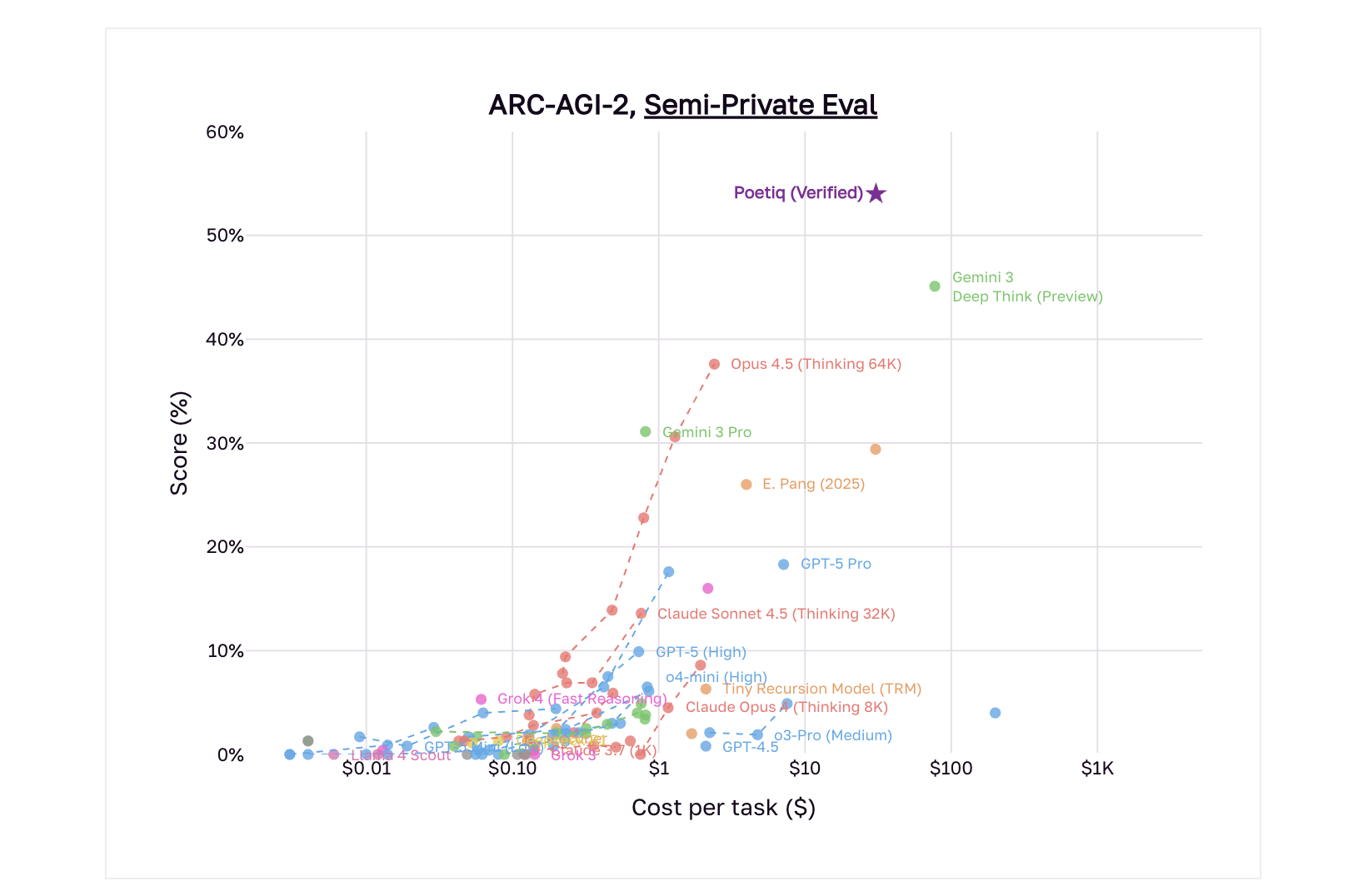
In a plot twist worthy of Silicon Valley satire, six-person startup Poetiq claimed it just beat Google’s own reasoning benchmark score using Google’s own model. Their meta-system optimized Gemini 3 Pro to hit 54 percent on ARC-AGI-2, surpassing Google’s best “Deep Think” variant at 45 percent.
Even wilder: six months ago, top models couldn’t break 5 percent.
Why it matters
Poetiq shows that the next frontier might not be bigger models but smarter orchestration. Their system can adapt to new models in hours, not months, and costs half as much per task as Google’s best internal system.
The Deets
• Poetiq score: 54 percent, $30 per task
• Google Deep Think: 45 percent, $77 per task
• First time any system has crossed 50 percent
• Built via continuous refinement + self-auditing
• Adaptable to new base models within hours
Key takeaway
Breakthroughs may come less from scale and more from clever engineering stacked on top of existing models.
🧩 Jargon Buster: ARC-AGI-2 - A reasoning benchmark designed to test abstract problem solving, often considered a proxy for early AGI-like capabilities.
Source: The Rundown
Poetry Jailbreaks Models Throttles
Researchers at Italy’s Icaro Labs found that rewriting harmful prompts as poetry can bypass safety systems across frontier models. Some models fell for this technique 100 percent of the time.
Why it matters
It’s another reminder that AI safety is an endless cat-and-mouse game. Patch one jailbreak vector and a creative user invents a new one, this time with rhyming couplets.
The Deets
• Tested 25 frontier models
• Average success rate: 62 percent
• Gemini 2.5 Pro: 100 percent vulnerable
• GPT-5 nano: fully resistant
• Researchers withheld the actual poems because they are “too dangerous”
Key takeaway
AI safety is whack-a-mole, and the moles are now writing sonnets.
🧩 Jargon Buster: Jailbreak - A technique that gets an AI model to ignore or circumvent safety rules.
Source: The Rundown
🤖 Robotics
EngineAI’s T800 Robot Demonstration Goes… Too Well
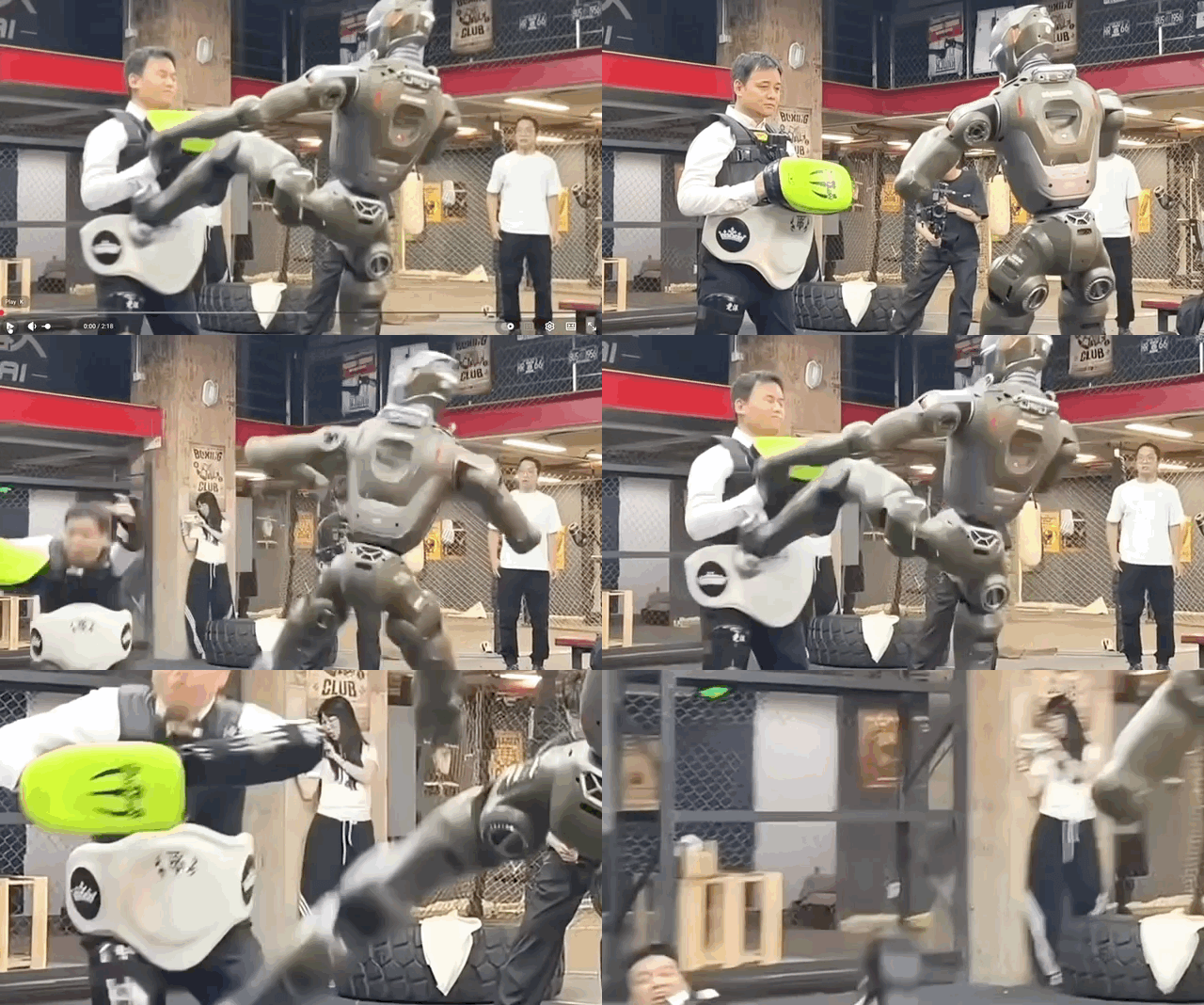
EngineAI attempted to silence critics who were claiming its T800 demo videos were CGI. The CEO stepped into the frame to take a hit directly from the 75-kg humanoid. The robot delivered a clean side kick, sending him stumbling back on camera. The message: Yes, it’s real. The subtext: Maybe too real.
Why it matters
Robots performing powerful strikes in controlled demos is one thing. Doing it with a human in the strike zone raises safety red flags. Industrial robotics depends on trust; marketing stunts like this can spook the very buyers they want to impress.
The Deets
• Kick produced ~450 N·m torque
• CEO wore body armor
• Demonstration intended to disprove CGI claims
• Instead highlighted risks of high-force actuation
Key takeaway
EngineAI proved the robot is real, powerful, and concerning in all the wrong ways.
🧩 Jargon Buster: Torque - Rotational force. More torque means more “launch your CEO across the room” energy.
Source: Robotics Herald
⚙️ Tools & Products of the Day
• TRAE - An ultra cost-efficient coding agent for developers who want performance on a budget.
• KaraVideo - A central hub for all major AI video models, letting you jump between generators without a dozen tabs.
• Heardly - A speed-reading assistant for books using AI condensation.
• CopyOwl - A one-click deep-research agent that pulls structured insights from any topic.
⚡ Quick Hits
• OpenAI turns off ad-like suggestions after user backlash.
• Meta signs new licensing deals with CNN, Fox News, and USA Today to feed real-time news into Meta AI.
• Walgreens partners with Rokt on AI-driven retail media upgrades.
• Google drops Gemini 3 Deep Think for Ultra subscribers only.
• Gartner advises blocking AI browsers due to agent-driven risk exposure.
Today’s Sources: AI Secret, The Rundown AI, Robotics Herald